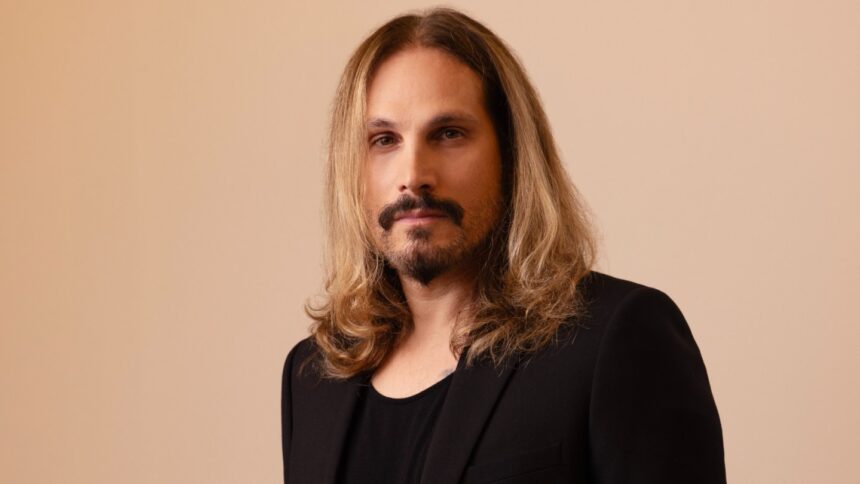
Marco Perego, a conceptual artist whose work has been shown all over the world, grew up on world cinema and tends to watch a film every day. However, the Italian native has mostly worked outside filmmaking circles – until now. Making his directorial debut in 2023, The absence of Aden — which starred his Oscar-winning wife Zoe Saldaña — Perego launched the production company Leaf Entertainment alongside Michael Cerenzi. The goal was simple: to work with the best and most famous international authors and help them realize their next projects. Easier said than done, isn’t it?
Maybe, but Perego has reached an incredible level in a very short period of time. At this year’s Cannes Film Festival, he will make history as the first producer to enter the main competition with three films – among the most prestigious and anticipated: MinotaurIt is the first film in nine years by Russian director Andrei Zvyagintsev (Juggernaut, without love); FjordThe drama is directed by Sebastian Stan and directed by Romanian teacher Cristian Mungiu (4 months, 3 weeks and 2 days); and paper tigerthe latest star from Croisette regular James Gray starring Scarlett Johansson, Adam Driver and Miles Teller. This doesn’t even cover Perego’s full Cannes slate: he’s also behind Kantemir Balagov Butterfly jamis being screened in Directors’ Fortnight.
As Perego says Hollywood ReporterHe knows he’s new to the production game and he does things differently. He sees each highly anticipated film on his slate as part of a larger collective project: “My ultimate goal is to build the idea of a company of artists,” he says. “I feel very fortunate to give these directors a voice.”
You have a background as a visual artist. You are now the producer of three competing films at Cannes. How did that happen?
Growing up in a small place in Italy, my mother and father would show me movies all the time. I was very curious – it could be a great voice for all these different places around the world, where you can talk about social commentary, or just tell a story about the human condition. The first question I asked myself was: Where is the space to support this? We started a company called Leaf Entertainment. I asked my partner Michael [Cerenzie]“What do you think about starting to really produce authors?” I’ve been very fortunate to be part of this very strong community of all these great directors. …There is a cultural imperative to help and protect the voice of these great authors, now more than ever.
It’s been nearly a decade since Andrei Zvyagintsev’s last film, and he’s been open about health issues in the intervening years. How did you get involved with him? Minotaur?
I’ve known a friend of his for a long time, and I kept telling him that anything he wanted to do, I wanted to support him. Juggernaut It really changed something in my life: it was a great movie, I watched it several times. And I am an artist: my work is not like an ordinary producer. I don’t want to come in and invade this space. I just want to say, “Hey, I’m here. I can be helpful. Tell me how I can help you.” In this film, MK Productions and Charles Gilbert, who is a great producer, were really involved. I asked: “Can I Zoom with Andre?” Then I told him: “I’m not here to give you a message. I’m here to support you.” You will see that it is a very important film. I just supported him to make the best movie he could do.
I mentioned the need to support these authors now. Is this a unique problem in the United States, in your view? What was it like to get paper tiger Extraterrestrial by James Gray?
Once again, I came at last [among the producers]. You can’t understand now how putting a film together was a real challenge for someone like James.

There were some reworks as it remained under development. Did you come in then?
I read the script before. Then, yes, I came. I was having lunch with James and we had a call with the producers, like Rodrigo [Teixeira]And they said, “The movie’s not going to happen.” He had a movie before and was supposed to go with my wife Zoe, who is a really good friend. “Okay, let me think about this,” I said. Within a week we collected the rest and he went off to make his film.
How did it turn around if it didn’t seem like it did?
He was missing the financial aspect and I helped figure out the financial aspect. I supported that aspect and the film came out.
What are some of the biggest challenges right now in getting films made like? paper tiger to make?
There are many. It’s very difficult to create a real business right now. All over the world, people go to the cinema to watch this type of movie. There’s more [understanding] About what it means to be an author, so I hope America really does that [embrace that]also. The big challenge here is pure economic business. There’s a struggle now to get these kinds of films together, and that’s where I see an opportunity: to step in and try to support them.

I know you’re focused on the distribution end, strategizing on ways to get these films out widely. paper tiger It was recently sold to Neon in the US, and I imagine a lot of the filmmakers you work with are resistant to streaming. Do you find it?
Everything finds balance. The question we need to ask is not whether we are for or against streaming, but how we can support filmmakers on this [topic] correctly. Thinking about it, streaming is going to be part of the future, but the question is can we protect and continue to produce the kind of films that go to the theater, that create an experience — and then, if they need to go to streaming, they go to streaming. It is very important that you have this experience. I believe in the spirit of cinema because when I was very lonely, I used to spend a lot of time in the movie theater.
I don’t think one thing takes away from the other. I think it’s important to check: Can we support each other? What does the director want? This is what we need to consider very carefully. It’s about asking the director how you see your film, and where you see your film. I ask the question all the time: What does James want, what Andre wants, what all these people want.
After this first round of production, what are some of the big lessons learned for you about how to move forward?
The first big lesson is that I think, more than ever, directors need to talk together. Just to understand where it all started for me here, there’s this picture of all these great artists together at Mr. Chow. I asked myself: Why is there no such photo of authors today? I grew up with Coppola, Scorsese, Spielberg, Lucas – and they were all together. So I created a statement for the creative community, why we need to do this again. My first step was: “Let me see if you want some help from a complete outsider.” The second part, now, is trying to bring the community together and figure out where film is going to change in the next five years, and how we can support filmmakers in that. That’s really what I want to do now: build this community. I want to get the same picture of all these great directors together, who can learn [from] Each other, exchange ideas with each other, and protect each other.