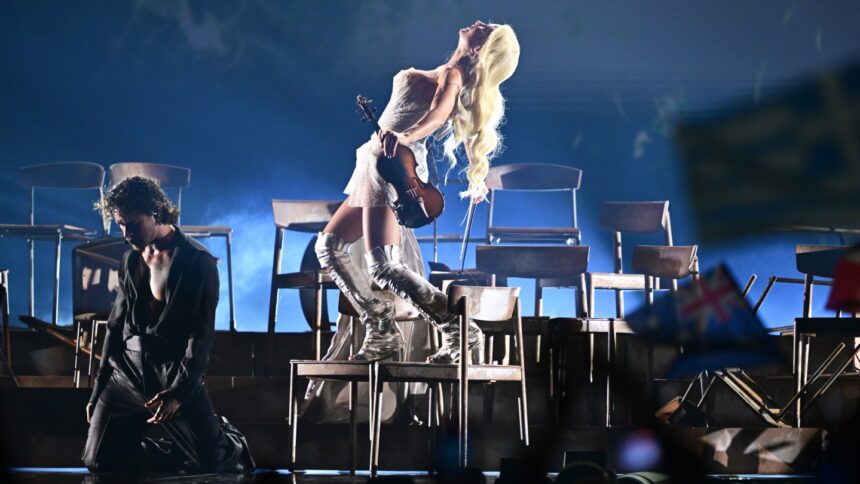
The scene on stage at the Eurovision semifinals in Vienna this week was that expected gathering of cheesy love: Greece’s panther-clad Akilas, Moldova’s Satoshi anthem (“aloha, adio, vida loca”), and, yes, a Franco-Hebrew Israeli tribute from Noam Bitan to his legend Michel. All three advanced to the final this weekend.
But behind the scenes, there has been an increasing scramble to hold together a politically fragile coalition and a financially weak competition. If the efforts fail, this could be the last year the 70-year-old Eurovision giant can continue. The bold experiment in pop culture unity – and the birthplace of ABBA and Celine Dion – is no more.
Sources familiar with Eurovision and the European Broadcasting Union that runs it say that as a result of Israel’s annexation, corporate sponsors pulled out this year, leading to a significant double-digit drop in revenue from 2025, while lost license fees from the five boycotting countries (Eurovision broadcasters renegotiate their deals every year) took a further hit. Spain, Slovenia, Ireland, Iceland and the Netherlands are boycotting this year’s competition and will not broadcast the broadcast. The countries withdrew after organizers decided not to hold a vote on Israel’s ban in late 2025 following the Gaza ceasefire.
According to sources, the competition is in fact almost heading towards the abyss with six additional countries preparing to withdraw due to Israel’s annexation. Those countries – Belgium and several Scandinavian countries said to be among them – were eventually brought back from the brink. Had that not happened, there would have been a realistic possibility that Eurovision would have been canceled in 2026 given the losses the organization would have suffered, said a senior source who requested anonymity because he was not authorized to speak about the situation publicly. Hollywood Reporter. Member fees are the group’s largest source of revenue, closely followed by sponsorship.
This year’s participation of 35 countries is the lowest since the format was expanded to include a semi-final round in 2004; At the height of Eurotopia that followed the Amsterdam Treaty in the late 2000s, as many as 42 countries participated.
Moreover, the financial picture could not be brighter next year. Spain and Slovenia are unlikely to return, and Netanyahu’s continued militaristic policies could mean other countries join the boycott, leading to the potential cancellation of the competition in 2027 with so much revenue out of the way.
On the other hand, if the EBU chooses to try to ban Israel without clearly violating the rules in the hope of wooing those countries again, it could lead to a rough look at a competition “established with the aim of bringing together public broadcasters across Europe.” [and] Strengthening relations between countries.” It is also possible that countries allied with Israel will withdraw in protest.
The EBU would not have many reasons to ban Israel; Almost no country, no matter how fast and fast it plays in its voting campaigns, plays the game. Russia was banned after invading Ukraine, but its media is state-run, and it has a history of international sanctions that Israel does not.
After the top ten countries, including Israel, were selected in the first semi-final on Tuesday, another ten countries will be selected on Thursday, with the 20 winning nations and five countries with automatic berths competing in the final this weekend. All of this will happen against the backdrop of the Gaza protests inside and outside the Stadtthal in Vienna.
The EBU’s ultimate nightmare scenario: if Israel wins this year, after almost winning Eurovision last year. Bitan, the 28-year-old son of French immigrants who sings in French, English and Hebrew, is one of the favorites this weekend with “Michelle,” especially for the telecast, which makes up half of the final score (the jury makes up the other half). If the country wins, it would mean it would host the competition in 2027, a move that is sure to spark more boycotts. Israel has won three times before, most recently in 2018, without major backlash.
Of course, it was this TV that became the lightning rod. The Kan public broadcaster has encouraged Israelis in the European diaspora to vote multiple times — current rules allow 10 per phone — in an organized campaign that critics say flouts the rules and advocates say is in fact practiced by a group of countries with a strong diaspora. Some critics also pointed out that there was evidence that at least some of the campaign funds came from the Israeli government (it was independent) – New York Times He conducted an investigation this week into this case. Advocates say social campaigns from other countries are also mixing up money and a double standard is being applied to Israel. What is the purpose of the national folk song competition, they wonder, if not to strengthen the status of nations or restore a modicum of patriotism to their beleaguered citizens?
While boycotters say the contest was never intended to legitimize countries with problematic governments, Israel’s advocates say too many countries participated under right-wing governments — Poland under PiS and Hungary for a time under Viktor Orban — and Israel is being targeted as a Jewish nation.
In any case, the EBU – whether it saw Israel’s deviation from the rules as going too far or perhaps was concerned that the country would win and cause it more headaches – last weekend sent a cease-and-desist letter to Kan last weekend to halt the campaign, which it did. The country still advanced to the finals.
The European Broadcasting Union is in a dilemma over TV rules: it could reduce the maximum votes from ten per phone to five or fewer (it’s already down from 20), but people will just use different phones, and in any case the contest benefits financially and in terms of participation from more votes. The best leverage for the EBU might be to privilege the judging panel over fan voting – but that would undermine the populist nature of the contest and potentially alienate many viewers.
The best hope for the future of the competition, and one that EBU bosses are openly talking about: Netanyahu’s electoral defeat in the fall. If Israel goes to the center and withdraws from Gaza and Lebanon, this could mean the return of many countries. Or at least that’s what organizers hope.
An EBU spokesman did not respond to a request for comment. A Kan spokesman did not immediately respond to this request.
Eurovision was established as an institution above politics, as a way to simultaneously ignite national pride while accommodating the ugliest parts of these identities. Although absurd on one level (one of last year’s finalists was a Finnish ode to orgasm called “I’m Coming”), Eurovision remains a strangely powerful ode to the binding power of music and even the democratic vote, the Magna Carta in spandex.
Of course, all of this was conceived in a fog of post-war radio optimism – before the echo chambers of social media, before the Balkanization of politics, and, yes, before the recent resurgence of far-right parties. It remains to be seen whether Eurovision can be an antidote to those ills or just another victim of them. Even if Israel elects a more centrist government, EBU organizers are privately concerned, according to sources, that the continental nations could shift toward the hard right — the National Rally is leading in the polls in next year’s French election, and Nigel Farage is leading in the UK — threatening to turn the entire contest into a kind of democratic chaos.
If the competition ends, anxiety will begin: Has the European Broadcasting Union written its end by insisting on annexing Israel? Or have the boycotting countries killed a good thing for no good reason, especially since a large number of countries with right-wing governments or in military conflicts have been included before?
For now, on the Less, there are soldiers. Organizers hope that other countries will be able to return even if those boycotting Israel do not; Hungary, for example, has not returned to normal since Covid-19, but it may return with Orban out of power now. Eurovision’s defenders point out that it has suffered too much turmoil in Europe itself over the past 70 years, from the Balkan Wars onwards. As Satoshi tells us in his Romanian Esperanto translation: “Farewell, crazy life… it calls us forever to work, to soup.”