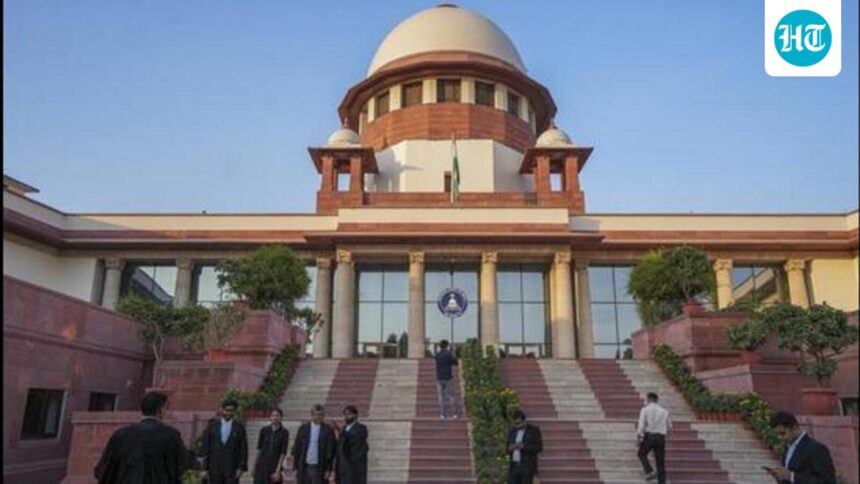
The Supreme Court on Wednesday expressed serious reservations over the Delhi High Court’s 2025 ruling which ruled that law students cannot be prevented from appearing in examinations merely because of lack of attendance, stating that such a view could reduce law college hostels to “mere boarding and lodging facilities” where students no longer feel the need to attend classes.

A bench of Justices Vikram Nath, Sandeep Mehta and Vijay Bishnoi agreed to examine the validity of the Delhi HC judgment while issuing notice on the petition filed by Narsi Monje Institute of Management Studies (NMIMS) challenging the judgement.
Meanwhile, the bench refused to suspend the Supreme Court ruling for the time being. “We are not putting this matter on hold. We will hear the matter and decide and put the right position of the law,” the bench observed.
During the hearing, senior advocate Mukul Rohatgi, representing NMIMS, said the Delhi HC ruling had made attendance norms almost meaningless and was creating serious difficulties for legal institutions across the country.
“The Supreme Court says there is no requirement to attend anywhere. People don’t want to go to colleges. I wonder why we went to college at that time,” Rohatgi said.
The bench appeared to largely agree with this concern and observed that if such a position were accepted, the National Law University premises would become “mere boarding and lodging facilities”.
The matter has been flagged with a batch of pending petitions challenging Bar Council of India circulars requiring disclosure of criminal background, declarations regarding concurrent academic pursuits and compliance with attendance norms for law students.
This controversy goes back to a November 2025 ruling by the Delhi High Court, which stated that no student enrolled in a recognized law college or university shall be prevented from appearing in examinations or continuing academic progress solely on the ground of insufficient attendance.
The ruling arose from proceedings linked to the suicide of a law student in 2016, in which allegations of harassment were raised due to lack of attendance. The Supreme Court noted that attendance regulations should not be enforced with such stringency that they cause mental distress to students or contribute to serious consequences.
It also directed the Bar Council of India to reconsider the criteria for compulsory attendance for three-year and five-year LLB programs in the light of the National Education Policy 2020 and evolving educational frameworks.
Relying on the division bench ruling, a single judge of the Delhi High Court later granted relief earlier this year to several Delhi University law students who were either denied permission to appear for examinations or had their results withheld due to lack of attendance.
Before the Supreme Court, NMIMS claimed that the Delhi High Court ruling opened the “gates of litigation” by students seeking permission to write examinations despite failing to meet the minimum attendance requirements, thereby undermining academic discipline and institutional independence.
The appeal stressed that classroom teaching remains central to legal education, especially in five-year integrated law programs where students enter directly after school. She said that lectures, tutorials, moot court exercises and practical training cannot be completely replaced by internships, competitions or co-curricular activities alone.
The petition also referred to Rule 12 of the BCI Rules on Legal Education 2008, which stipulates a minimum attendance requirement of 70%, while actually allowing limited tolerance of up to 65% in exceptional circumstances.
The College has also drawn on legal education practices in jurisdictions such as the US, UK, Australia and Singapore to argue that compulsory attendance standards are globally recognized as an integral part of professional legal training.
Notably, the Supreme Court had already expressed concern over the Delhi High Court ruling during an earlier hearing on May 7 in the pending challenge to the BCI circulars. The bench, led by Justice Nath, observed that the decision had created “chaos” and had become a matter of concern for national law universities.
“Students do not attend classes… NLUs are known for their good faculty… If students do not attend, what is the point?” He noticed the bench.