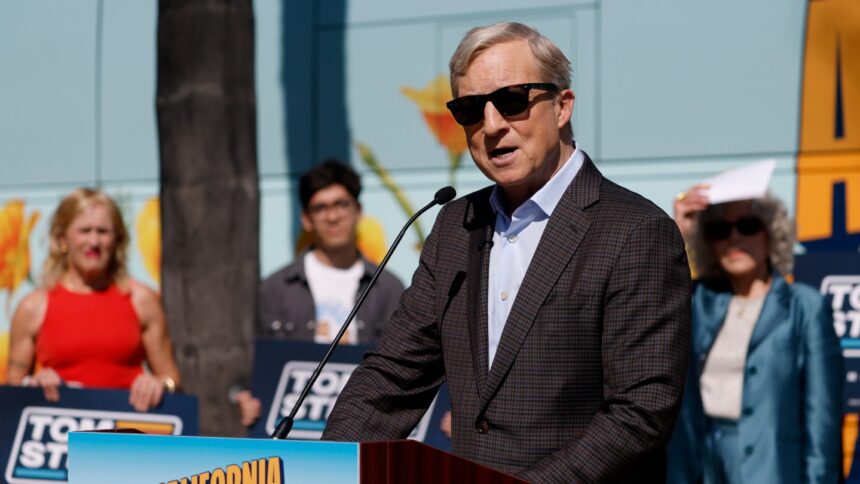
As Paramount and California’s most powerful attorney general talks about a Warner Bros. Discovery merger, the man vying to be the state’s top official has a clear message: This can’t stand.
Tom Steyer, the progressive billionaire who is currently third in the state’s seven-person gubernatorial race, says he will support an anti-merger lawsuit brought by California Attorney General Rob Bonta (or any potential successor). He also said he would support stronger state legislation to restrict mergers of Par-WBD size in the future.
One big reason? Freedom of expression.
“This is a right-wing takeover of the media,” Steyer said. Hollywood Reporter On Tuesday, David Ellison and Paramount successfully won the bid to buy WBD and its CNN gem. “Just the right’s continued attempt to control information. You know, when you try to do a coup, the two things you control are the military and the TV stations,” Steyer added, also apparently referring to military decisions made by President Trump in Iran and Venezuela without congressional approval. “And that’s what we see.”
Steyer believes that if Ellison — who has made a number of public appearances with Trump including hosting a dinner for the president last month — is allowed to buy CNN, the center-left network would become a mouthpiece for the president.
“I’m one of the people in this world who thought Ted Turner was an incredibly creative, incredibly forward-thinking person,” Steyer said, citing the recently deceased CNN founder. “And to take the news network that brought you the Iraq war and was basically the most trusted place for news, and hand it to one of Donald Trump’s friends — are you kidding?”
He added: “It’s a credibility buy when you don’t have any. That’s all it is.”
For his part, Bonta expressed concerns about the merger, saying in a letter dating back to February (when Par and Netflix were acting as buyers) that “the proposed Warner Brothers transactions should undergo full and robust review, and that California is looking closely. We are committed to fighting market consolidation that we find unlawful.” Bonta held a press conference on Monday in which he criticized the prospect of “higher prices, lower wages, fewer jobs, lower quality, and fewer choices,” echoing a grassroots movement that has also made the issue in Hollywood. Ponta could have some leverage to extract concessions, but his track record of a government prosecutor stopping national media mergers is already poor.
Paramount’s Chief Legal Officer, Makan Delrahim, recently responded in a letter to the Attorney General that “Paramount’s proposed merger with WBD will help bring about meaningful improvements to movie theaters and their audiences.” CNN was not the focus of the latest evasion, but it will certainly be part of any action Bonta takes.
The governor’s support will certainly pave his way. Republican Steve Hilton, the front-runner who has been endorsed by Trump and is a longtime Fox News host, will almost certainly not object to the merger. Xavier Becerra, former California state representative and Democratic front-runner, hasn’t made a big statement about the relationship either.
Steyer had sharp words for his Republican rival, especially after he said he was the Republican Party’s front-runner THR Two weeks ago, “we really want to change behavior, and we may have to do something extravagant” and announced a potential 60 percent tax break to that end.
“The idea that Steve Hilton is going to protect Hollywood is crazy,” Steyer said Tuesday. “Hollywood is about freedom of expression. Expression, creativity, and challenging the status quo. And what those things are [Republicans] Obviously what we’re trying to get at is a government vehicle that’s always boring, always stupid, and always the exact opposite of creativity.
The candidate has been more circumspect on the issue of film tax credits, declining for now to put a number on what percentage he would like to see under his term. He has said he wants the existing credit — which typically ranges between 35 percent and 45 percent — to go to above-the-line expenses as well as to below-the-line expenses, a move the producers have pushed for. He reiterated his support for the necessity of not setting a ceiling for that amount compared to the current annual limit of $750 million.
But he added a caveat. “I view the tax credit as a partial answer. That’s the easy answer. But the other reality is that we need to get rid of over-regulation to make sure that small productions in particular are able to afford to film in California,” Steyer said.
He explained that, in general, he wanted to protect California workers and industry — IATSE endorsed Steyer — but said he believed the blanket focus on tax breaks missed the mark.
“We have to get regulations under control, we have to get costs under control, we have to support the industry more broadly, through funding the arts and vocational training and all these things that ensure we have a great ecosystem,” he said, noting that lowering housing and other costs, he pledged, would also help the industry. “In the short term, the answer is tax breaks, but in the long term it cuts costs and builds capacity. And I want to win in the long term.”