Nine days into the 1968 Cannes Film Festival, Jean-Luc Godard and a group of New Wave rebels shut down the Croisette, shutting down the world’s most spectacular cinematic spectacle in solidarity with the student protests sweeping France. After nearly six decades, the question hanging over this year’s edition is whether geopolitics – from Gaza to Iran – can hijack the narrative again, or whether Cannes will once again prove that it can absorb shock without losing control.
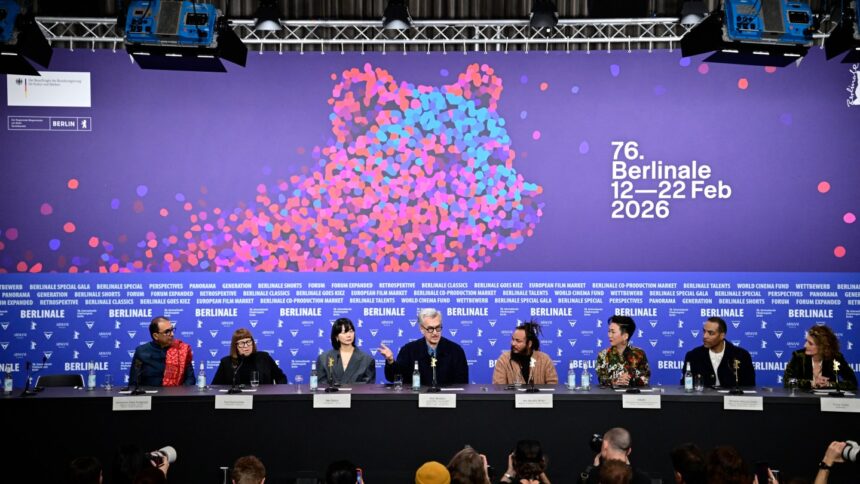
This year’s Berlin Film Festival offers a cautionary tale. The violent debate over the war in Gaza sparked a political firestorm that nearly cost festival director Tricia Tuttle her job. Jury president Wim Wenders’ insistence that “we have to stay out of politics” was quickly overtaken by the filmmakers, who refused to do any such thing. Statements on stage about Gaza – Syrian-Palestinian director Abdullah Al-Khatib, winner of the “Berlinale Horizons” section for his drama film Siege recordswhich described the German government as “accomplices in the genocide in Gaza by Israel” – sparked an institutional backlash. It’s all been on public display, making far more headlines than any of the films involved.
Producer Mike Downey, former president of the European Film Academy, sees similar political fault lines running through Cannes this year. “I think something like that [what happened in Berlin] “It could happen in Cannes, if Cannes didn’t dominate the narrative,” he says. “Neutrality is kind of impossible, as Berlin and Wim discovered.”
There is no shortage of combustible materials. The war in Gaza remains a gathering point for artists and activists (Palestinian director Rakan Mayasi will be in Cannes to screen his latest film, Yesterday the eye did not sleep (In some view), while rising tensions around Iran — and a festival lineup packed with Iranian voices, including Asghar Farhadi, Bigha Ahangarani, Karim Lakzadeh, and Mahsa Karampour — will certainly add another geopolitical layer. With two prominent Russian directors in the official selection, Andrey Zvyagintsev Minotaur In competition, Kantemir Balagov Butterfly jam In the opening of Directors’ Fortnight, Russia’s war on Ukraine may also be a flashpoint.
At Cannes last year, politics were present from the beginning. The opening ceremony witnessed a tribute to Fatima Hassouna, the photojournalist killed in Gaza, the subject of Sepideh Farsi’s documentary. Put your soul on your hands and walkfrom jury president Juliette Binoche, while Robert De Niro used the honorary Palme d’Or moment to attack Donald Trump. Outside the theater, more than 300 filmmakers, including Binoche, Javier Bardem, Joaquin Phoenix and Pedro Pascal, signed an open letter condemning the film industry’s “silence” on Gaza. The temperature was high, but, unlike Berlin, the festival never lost its prestige. Political debate has never trumped debate over movies.
The Cannes 2026 jury’s opening press conference on Tuesday included jurors’ comments on how politics and films relate to each other, including comments from Demi Moore and president Park Chan-wook, while Paul Lafferty also shared candid thoughts.
Salma Abu Ayyash of the Palestine Film Foundation makes a clear distinction between Berlin, where she says she felt Palestinian directors and their supporters “felt threatened” — some in the German media called for Al-Khatib to be arrested and charged with “hate speech” — and Cannes, where “we feel very safe and very valued. It’s not an institutional thing, but there is a network of people in Cannes that makes us feel heard. It makes a big difference for us when we go to a festival where we feel heard.” The police are after us, versus a festival where the doors are open and expression is protected.”
Downie says Cannes remains “one of the last bastions of cultural integration” in an increasingly imperiled festival scene. “It’s always a great place to hear voices, whether it’s environmental voices, whether it’s LGBTQ voices, whether it’s about what’s happening in Iran or Gaza, or about the electricity workers’ strike. Cannes has always been a place for rioters. Maybe that’s why I love it.”
But unlike Berlin, Cannes, after 1968, was adept at preventing troublemakers from seizing power. The festival has spent years refining the rules of the game that allow for but contain dissent. A strict “no protest” rule rules the red carpet — security shuts down political demonstrations almost as quickly as selfies — and the festival’s tightly choreographed premieres and ceremonies leave little room for disruption. The focus is always on presentation – the spectacle of cinema as a global industry and cultural event. Political discussions are largely found within the films themselves, or in demonstrations and discussions held at a safe distance from the palace.
“I was struck by the fact that in the last two years I spent in Cannes, there were no scandals of the kind that Berlin finds impossible to avoid at the moment,” says Philip Altermann, European culture editor for The Guardian. “Cannes still showcases works [and] I get the impression that people who go there end up kind of following the rules. They may make very difficult films, but there is no situation where artists clash with organizers at an award ceremony.
Politics, from Gaza to Iran, from Russia to the White House, will be everyone on the Croisette this year. The question is whether this idea remains embedded in films – and the conversations around them – or breaks through and takes center stage, sparking the kind of institutional crisis that has gripped Berlin. If history is any guide, Cannes will let the hype in, but will keep the focus where it wants: on the films and on the performances.