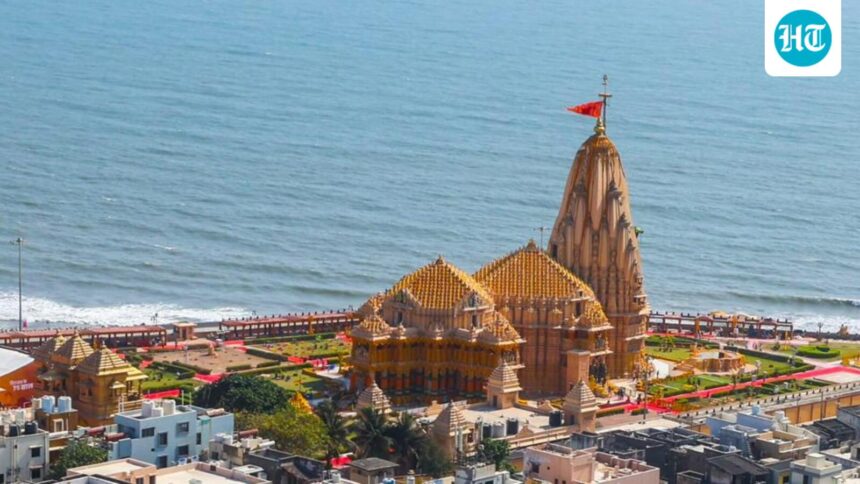
Situated on the shores of the Arabian Sea, Somnath Temple is a living symbol of the country’s enduring civilization, spiritual continuity and collective self-respect. Witness to centuries of conquest, reconstruction, resistance, statecraft, and national resurgence.

The celebration of Somnath Swabhiman Parv in 2026 is a special occasion that presents this long historical journey to a new generation with confidence, poise and cultural pride.
In 1026 AD, Mahmud of Ghaznavid’s attack on Somnath was not merely a religious invasion; He also strategically aimed to control the thriving sea trade routes and the enormous wealth associated with the temple. At that time, Prabhas Patan, near present-day Veraval in the Gir Somnath district of Gujarat, was one of the most important ports on the western coast of India. The Somnath Temple represented not only spiritual authority but also the economic vitality and political influence of the region. Thus the destruction of the temple was also an attempt to weaken the entire social, economic and political system.
Even after Emperor Aurangzeb’s orders in 1706, Somnath continued to face frequent attacks and desecration. Idols were destroyed, temples were damaged, but neither the tradition of Hajj nor the faith of the worshipers disappeared; Eventually the national leadership came forward after independence to rebuild and protect Somnath. Thus, Somnath’s history is not merely a history of suffering; It is also a history of resistance and revival.
Somnath and Maharashtra
The relationship between Somnath and Maharashtra is rooted not only in geography, but in history and political developments. As invaders like Alauddin Khilji advanced towards Gujarat, attacks on Saurashtra and Somnath became easier.
During this period an important historical lesson became clear: as political stability weakened in Maharashtra, the security of India’s western coast was also threatened.
The Hindavi Swarajya established by Chhatrapati Shivaji Maharaj was later defended and strengthened through the struggles of Chhatrapati Sambhaji Maharaj, Rajaram Maharaj and Maharani Tarabai. During the Peshwa era, Maratha influence expanded beyond the Deccan region into northwestern India. Maratha forces crossed into Gujarat, and within a few decades, Mughal dominance in Katiawar declined dramatically. In this shifting balance of power, Somnath once again came under direct Indian political control.
Maratha contact with Somnath operated simultaneously on cultural, economic and strategic levels. On a cultural level, Punyaslok Ahilyadevi Holkar’s contribution remains one of the most important chapters in Somnath’s modern history – in 1783 the Queen of Indore decided to rebuild the temple using her personal treasury, which had lay in ruins for nearly a century.
Economically, the Marathas viewed the Somnath-Veraval region not only as a pilgrimage centre, but also as a valuable revenue area. Income from pilgrimage taxes, port-related duties and revenues from surrounding lands helped finance military campaigns in northern India, maintenance of forts and administrative operations. Strategically, Somnath and the Kathiawar district served as a western buffer zone for Maratha power. Somnath, Veraval and nearby forts were used as front line outposts.
In this broader history, the role of the Gaikwad family deserves special mention. The Gaekwads originated in Maharashtra, and ruled large parts of Gujarat and Kathiawar for a long time. Therefore, the day-to-day functioning and broader governance of the Somnath district remained closely linked to Maratha political power.
When Somnath came under British rule
In the nineteenth century, as the East India Company systematically dismantled Maratha power, temple lands and the revenue rights associated with Somnath became an important topic in treaties and political settlements. The agreements concluded between the Gaikwad and the Company government included several provisions relating to religious institutions and their economic rights. Eventually, control of revenue passed to the colonial administration, while cult rituals and temple traditions remained in the hands of local priests and institutions.
Reconstruction of Somnath
After independence, Sardar Vallabhbhai Patel decided to rebuild Somnath after merging Junagadh with India. It was a symbol of national self-respect and cultural renewal.
At the same time, Jawaharlal Nehru and Mahatma Gandhi expressed reservations about the state’s direct association with religious institutions, stressing the importance of maintaining a secular framework. However, KM Munshi and Sardar Patel said that while the Indian state would remain secular, it would still be able to honor and preserve the nation’s cultural memory. Ultimately, the rebuilt Somnath Temple, opened in 1951, emerged from this vision.
Somnath Swabhiman Parve 2026
In 2026, Somnath Swabhiman Parv gives renewed meaning to this long historical journey. Commemorating the thousandth anniversary of Mahmud Ghaznawi’s first conquest, the occasion was observed across the country as a celebration of enduring faith and national consciousness.
With the participation of the Gujarat government, the Union government, cultural organisations, saints, scholars and thousands of devotees, the commemorative events acquired a broad national dimension. From 8 to 11 January 2026, religious ceremonies, continuous chants, lectures, fairs and yatras conveyed a common message that no matter how often India faces attempts at destruction, its civilizing spirit lives on.
Pilgrimages from various parts of the country and the Swabhiman Yatra from Delhi reinforced the idea that Somnath is not just a Gujarat issue, but part of India’s collective cultural consciousness.
Role of Prime Minister Narendra Modi
Narendra Modi played a prominent role in the commemorative events. Prime Minister Somnath visited on January 10 and 11, 2026, and through his speeches and contributions an important message emerged, which is that respecting cultural memory does not mean fueling hatred against anyone; Rather, it reflects the nation’s secure confidence in its identity.
(Devendra Fadnavis is the Chief Minister of Maharashtra.)