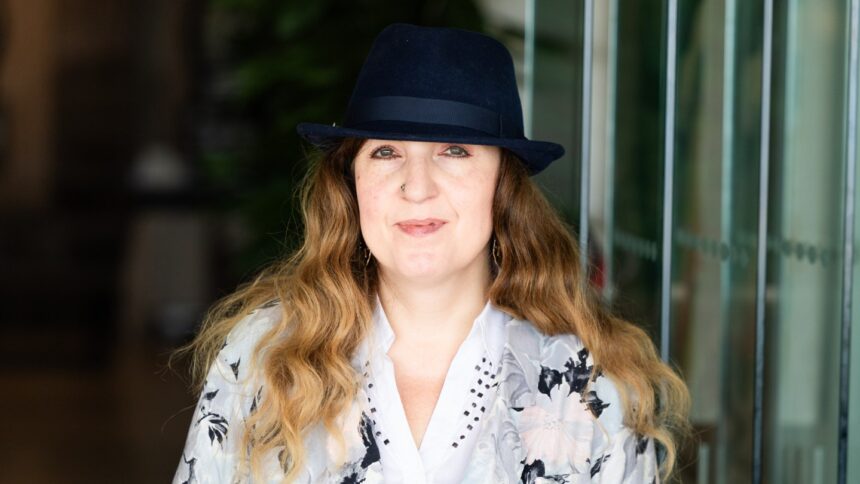
Mia Baez ends her term as administrator of one of the biggest supporters of British independent films, the British Film Institute Film Fund.
She has done and watched it for the past five years, having become the first person ever to hold the position for a fixed term – a change implemented in recognition of how impactful the job will be – and joining at a time when the industry, post-pandemic, has been transformed forever.
Baez, who will leave her position in October this year, has experience in production, display, distribution and international sales strategy. She considers herself a cultural and gender equality activist, and in collaboration with the BFI Film Fund, she has brought all this experience together overseeing a budget of around £20 million ($27 million) a year. She has showcased relatively unknown filmmakers to Oscars, directed Bafta winners among others, and done it all with what she says is a knack for pushing the industry’s risk aversion to the max.
“I guess [risk] “It’s certainly a key part of what public money is there for,” Baez says. Hollywood Reporter Before her last Cannes Film Festival as Chair of the BFI Film Fund. She cites some of her recent thrilling successes – Rich Peppiatt’s buzzy autobiography “Print the Legend.” PatellaHarry Layton’s BDSM biker drama one billion and Akinola Davies Jr., Lagos Group My father’s shadowhas been selected as the UK’s entry for the 2026 Academy Awards – as evidence that that boldness is rewarded.
Bays has also revitalized the country’s largest open-access fund by reshaping the team, improving how the fund performs against the BFI’s inclusion targets, and even creating entirely new funds of money for more experienced managers (the Impact Fund), as well as higher-budget live short projects (Future Takes). It funds only 12 feature films a year, and focuses on talent seeking to make cultural and social resonances.
As the process of hiring her replacement officially began, Baez sat down with her THR To talk about the obstacles plaguing the British film industry – and what we should be optimistic about. It discusses some of the buzzy BFI films arriving on the Croisette this year, such as Cleo Barnard. I see buildings falling like lightning; Why co-productions could be the savior of British film? The main advice she gives to her successor.
Thinking about the past five years, what feelings do you have?
Well, I subscribe to creative renewal, so I think it’s healthy. I think five years is a good amount of time to make enough change — to do it very quickly — and then get off a fixed ship, I hope. Reflecting on the films and features we’ve supported, we’ve won a BAFTA for Best [British] For the first time two years in a row, Patella In 2025 and My father’s shadow This year, both incredibly unusual, I would say, new voices and narratives. We also won best [British] Independent Film Award [BIFA] Two years in a row [with] Patella and one billion. Obviously, awards are only one arbiter of influence. But our films have been selected as the UK’s entry for Best International Film at the Academy Awards – Santosh In 2025 and My father’s shadow In 2026. And then… Two black boys in heavenwhich is supported by our Animation Short Fund, won the BAFTA Award for Best Animated Short this year. and Majid / Zafarwhich via Future Takes – our top budget short chart – won a BIFA Award for Best Short Film and was also nominated for a BAFTA.

What goes into the decision-making process for you – what should the project include to get funding?
Our fund priorities are really important guidance. That’s why it’s very important to us that everyone who applies understands our priorities, what we’re looking for, and what guides our decisions while applying. This has been a very big part of the work – to make sure the fund is transparent. There are six priorities for the Fund: [and] This is a very important tool. There are other frameworks around having a balanced slate, prioritizing UK-wide, so that not everything that’s made is from London and the South East – that we represent the whole of the UK – and that we support creative risks, and that films can have some impact, both at home and abroad. [We] Consider the audiences and perhaps the underserved.
What do you think is the biggest obstacle facing the British film industry at the moment?
These are distribution challenges. The more we have the downturn that we’re seeing now among distributors who have become risk averse and less risky with money on releases and P&Ls. [prints and advertising] And the struggle to sell internationally, which creates an environment that makes it very difficult to make risky films, which tend to be the kind of films we support. It makes our money more important than ever. But like I said, we only make 12 features a year, so that doesn’t really allow for much in the grand scheme of things. It does a lot of work, but it’s not enough. I mean, thank God our sister fund, the Global Screen Fund in the UK, is there too. They’re there to support minority co-productions, and the great news is that they’ve got more money now. Over the next few months, they will announce new interventions and new funds. This is very important, because we need to co-produce more. It is very difficult to fully finance a film outside the UK at the moment. Yes, those are the challenges
Once industry contracts and other investors become risk averse, what this does is exclude underrepresented voices. This is the fear – undoing the progress made over the past few years in diversification [film]which created some wonderful and exciting works. But thank God we can continue to exist.
Is co-production the way to go for British film at the moment?
Yes, 100 percent. Even with countries and regions within our smaller urban agglomerations between the United Kingdom and Ireland, [it] It can be quite significant – access to the two tax breaks and then access to public funds. We finance with Ffilm Cymru [Wales] and screen scotland and northern ireland. These are incredibly meaningful partnerships. Kneecap is a really good example, which is a co-production between the UK and Ireland, two broadcasters and three large lottery funds. I don’t think this movie would have been made without that. But I hope this has opened the door to favoring more Irish-language work and showing that this kind of work is actually exciting. It’s an incredibly important part of [Irish] Heritage as well, the Celtic language.
Do you consider your job risky? Do you think films should be risky in the current climate?
Yes, this is certainly a key part of what public money is there for. Risks can appear in different ways. It is not always about the content and about exciting novels that push the boundaries. clearly, Patella He is a great example of this. one billion It’s another version of that. Palestine 36 It’s another version, because that was an untold story – the colonial influence of the United Kingdom in Palestine and [how] We see the effects of that to this day. These films wouldn’t be made without us. This enriches not only film culture, but wider culture in the UK – how we see ourselves, and how we represent ourselves. It is essential that we do this. If we guide everything solely through our personal taste… I think that in past eras, a lot of these roles were often [navigated] With the principle of taste maker. We’ve moved away from that to have a broader scope about the role we play, and what we don’t see being achieved is definitely what we should be there for.
What do you feel optimistic about?
I am always supported by work. And I feel like British filmmaking at the moment is truly world-class and always a testament to that. When we just look at our list and how impactful those are Flam internationally, we know it by how well it sells and how important it is at the box office at home and abroad – within a relatively limited world. We are still seeing some deals around the world. I’ve loved the long-awaited return of comedy we’re seeing in the UK. Seven out of 10 qualifying Indian films at the UK box office last year were comedies or comedy-dramas. I’m really excited about it. We’ve had a bit of a renaissance [with] Movies like Wallis Island poem and Marching powder, one billionVery, very strong scope of work. But again, we have a really important comedy tradition, which I felt like had disappeared a little bit. Our area newcomer It made a really big mark at Sundance this year, very proudly, very culturally Scottish, and really human translated. I had the pleasure of being in a room full of 400 people at Sundance giggling.
Talk to me about what’s going to happen in Cannes – I see buildings falling like lightning amazing.
I’m so glad to hear that. I loved working on this film, as it is a novelist collaborating with a screenwriter, collaborating with Cleo Barnard, the director, and Tracy. [O’Riordan]Product. They were a really strong team. They’ve put together such an amazing crew. The actors are all just absolute knockouts, not just in that piece, but they are all true rising stars. The kind of chemistry they create together…they’ve been so collaborative. So I’m really excited about this movie, because I feel like it really speaks to the challenges of a generation, especially the 30-something generation. He really opens up a very important conversation that’s probably not just British, and he does it with such great heart and such tenderness and such care.
What advice would you give to your successor?
I really like the principle of beginner’s mind – going in and not thinking you know everything. You may have an idea, but the context changes as you get more information. Just being able to listen is an incredible part of what good leadership looks like, and then being able to act on it and balance offering your own ideas, but also listening. You’re really dealing with what the industry is telling you it needs now. Some of that you have to filter out. Some of that won’t be possible. But there will be good ideas, and there may be important changes needed over the next five years. The fund may turn around, because that’s what the industry needs next.
Is there a particular project or creativity that you are particularly proud to support?
It is a choice between children. It’s very difficult. I just want to focus the team’s work.