


NEW DELHI: Gig and platform workers need to work for at least 90 days annually with an aggregator to avail social security benefits, said the final set of rules drafted under the new Social Security (CoSS) Act.
In case a worker deals with multiple aggregators, the minimum is raised to 120 days, a decision that will affect those working with Swiggy and Zomato or Uber, Ola and Rapido.The rules pave the way for states to notify their own rules by taking a cue from the central rules.Under these latest CoSS rules, an eligible service and platform worker includes all those workers with whom the aggregator engages directly, through an associate, holding or subsidiary company, or through a third party.
Any income generated from the aggregator on any given day will be treated as a single day with the platform.For those who use multiple platforms, work days are cumulative. For example, profit from three collection companies in one calendar day will be counted as three days of participation.
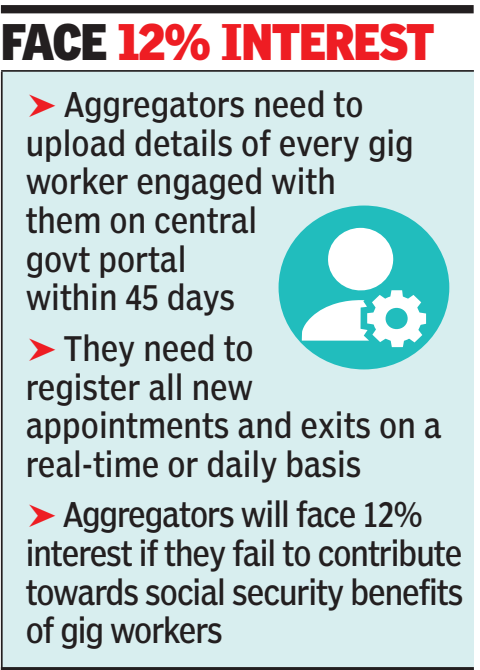
In addition, the rules make it mandatory for aggregators to upload details of every worker working for them on the central government portal within 45 days, including recording all new appointments and discharges on a real-time or daily basis.
This is done to allow ID cards to be issued to every registered worker and qualified platform worker.The rules also stipulate that poolers face 12% annual interest if they fail to contribute to Social Security benefits for gig workers enrolled with them.“If any aggregator fails to pay any amount of contribution due under sub-section (4) of section 114, within the period of time prescribed by the Central Government for the purpose, such aggregator shall be liable to pay interest on the amount of contribution, which shall be payable, at the rate of 1%, for every month or part of a month comprising the period from the date such payment is due until such amount is actually paid,” the rules said.The rules also stipulate that a freelancer will stop qualifying for Social Security benefits, such as health, life and accident insurance once they reach age 60, or if they have not worked at least 90 days with one pool — or 120 days across multiple pools — during the previous fiscal year.