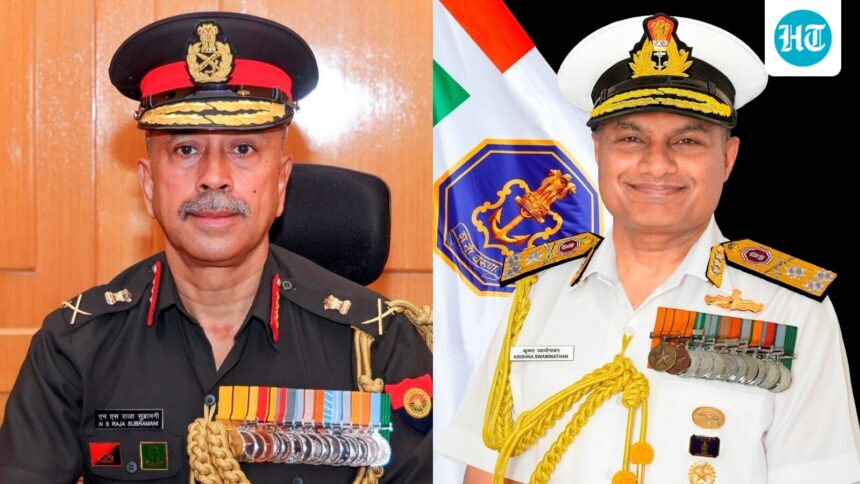
India on Saturday appointed Lieutenant General NS Raja Subramani (retd) as the new Chief of Defense Staff (CDS) and Vice Admiral Krishna Swaminathan as the new Chief of the Navy, to hold the top military posts ahead of the major command restructuring.

Subramani will take office on May 30, succeeding General Anil Chouhan. Swaminathan takes charge on May 31, replacing Admiral Dinesh K Tripathi.
The appointments come at a pivotal moment as the armed forces advance theater, a long-awaited reform designed to integrate the military’s resources into future conflicts.
Subramani is currently the Military Advisor to the National Security Council Secretariat, headed by National Security Advisor Ajit Doval. He assumed this position on September 1, 2025, a month after his retirement as Deputy Commander of the Army.
Read also | Self-reliance is crucial in an uncertain world: CDS
Swaminathan is the Flag Officer Commanding-in-Chief, Western Naval Command, headquartered in Mumbai.
Subramani “will also serve as Secretary to the Government of India, Department of Military Affairs, from the date of his assumption of charge until further orders,” his appointment order said. As CDS, he will serve as permanent Chairman of the Chiefs of Staff Committee and Military Advisor to Defense Minister Rajnath Singh.
The new defense and security centers are expected to accelerate the process of establishing joint services commands, which is the main goal of the theater campaign. These commands will integrate military elements, assets and personnel from three services under a single commander-in-chief.
Chouhan, the outgoing Democratic Defense Minister, recently submitted a detailed proposal to strengthen the theater to the Defense Minister. The model includes establishing a China-centric Northern Theater Command in Lucknow, a Pakistan-centric Western Theater Command in Jaipur, and a Naval Theater Command in Thiruvananthapuram.
The Government has identified the establishment of theater commands for integrated application of force, operational efficiency, and optimal use of resources as a key area of focused intervention in 2025.
Under the appointment rules, the government can select a CDS from any serving chief, serving three-star officer, or any retired chief or three-star officer below 62 years of age. The government extended Chouhan’s term for eight months last September.
Subramani will be the army’s third chief of staff, after Jins Bipin Rawat and Chouhan. An alumnus of the National Defense Academy in Khadakwasla and the Indian Military Academy in Dehradun, he was commissioned into the 8th Battalion of the Garhwal Rifles in 1985.
He previously served as Commander of the Central Army in Lucknow. Subramani also attended the Joint Services Command and Staff College in Bracknell, UK, and the National Defense College in New Delhi.
Swaminathan, the most senior officer after Tripathi, served as Deputy Chief of the Navy before heading the Western Naval Command. He is a graduate of the National Defense Academy. Joint Forces Command and Staff College, Shrivenham, United Kingdom; Naval War College Karanja; and the US Naval War College in Rhode Island. He was commissioned into the Navy on July 1, 1987, and is a communications and electronic warfare specialist.