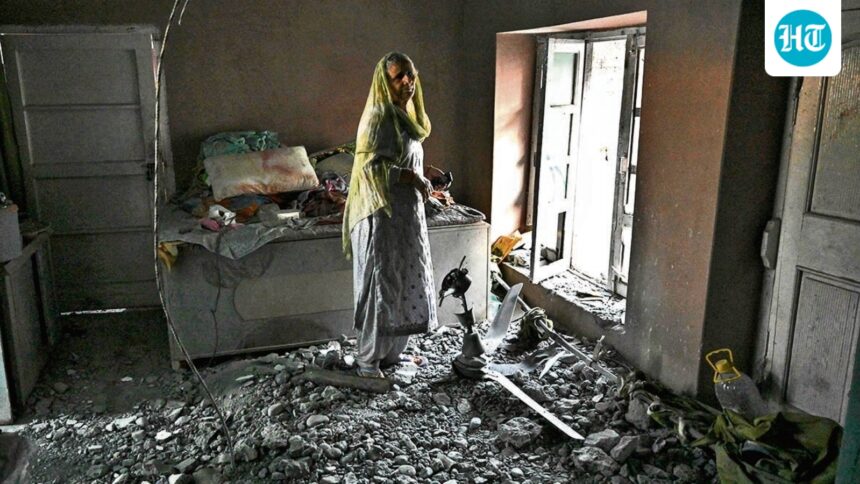
The roar of the shells outside was deafening, and its terrifying sound echoed throughout the neighborhood. Sanjeev Kumar (48 years old) watched television broadcasting news of mortar shells falling on his city of Poonch. Hours earlier, in the middle of the night, India struck nine terrorist targets across the border in Pakistan, in retaliation for the killing of 26 people in the Pahalgam terror attack.

Quickly, Kumar made a decision. The family had to leave the city. He packed his son Vihaan and wife Rashmi Sudan into the car and set off for Jammu, hoping to seek safety in the winter capital of the Union Territory.
This was not the case. At around 10.30 am, as the family was driving through Khanitar area on the outskirts of Poonch, a shell exploded near the car, fragments of which penetrated the glass and injured Vihaan. The 14-year-old boy died hours later.
One year later, Kumar has still not come to terms with that moment.
“Life is not the same anymore,” said Kumar, a government school teacher. “I don’t go anywhere anymore. I keep looking at his drawings. We kept them in his room the same way he left them. It has been a year, but it feels like he was with us just yesterday.”
He added: “My wife was also injured in the bombing and is still receiving treatment. We ask the administration and the government to build a memorial for all those who lost their lives in Poonch.”
Vihan was one of 28 people killed in cross-border shelling during the four days of Operation Sindoor last year. HT spoke to the families of five victims one year later.
Ramiz Khan was one of them. The 46-year-old lost his 12-year-old twins, Zain and Zoya, as the family prepared to leave the city.
“I feel like I’ve lost my purpose in life,” Khan said, his eyes moist.
“When the bombing started, my son was terrified and we decided to leave Poonch,” he recalls. “But the shells fell outside our house.” Khan, who works in the Ministry of Education, said: “I was injured in the attack and found out about my children 15 days later. I was devastated. They were everything to me, and I had a lot of plans for them. They were good in studies, and my son aspired to become a doctor. No parent should have to go through such pain.”
In those four fateful days, 16 people – including four children – died in the Poonch district alone.
Shahida Kauser, whose husband Muhammad Abrar Malik was killed in the bombing on May 8, has been struggling to make ends meet since his death. “He was a driver and the sole breadwinner for our family,” said the 36-year-old resident of Mandi tehsil in Poonch. “I have three children, all of them are in school. I couldn’t even fix my house.”
She added: “I still remember that night. He had gone to the bathroom when the bombing started and was killed. Our house was also damaged.” “I have to ensure that my children get an education, and there is no one to support us.”
Many older residents said they had seen bombing before, but never this intense and frequent.
Within two days, authorities estimated that 200 mortar shells had been fired across the border.
Surjan Singh, 60, whose nephew was killed, said: “We still remember the moment when shells fell on our house. My nephew, Amarjeet Singh (a former soldier), was hit by shrapnel in his lung. Shells rained down on Poonch from the night of May 6 to 10, leaving devastation in every corner of the city.”
He added: “We have not forgotten this horror. It has been a year, but our wounds are still fresh. We believe that those who were killed made sacrifices for the country. We only ask the government to help us build shelters so that we can save our lives in such situations.”