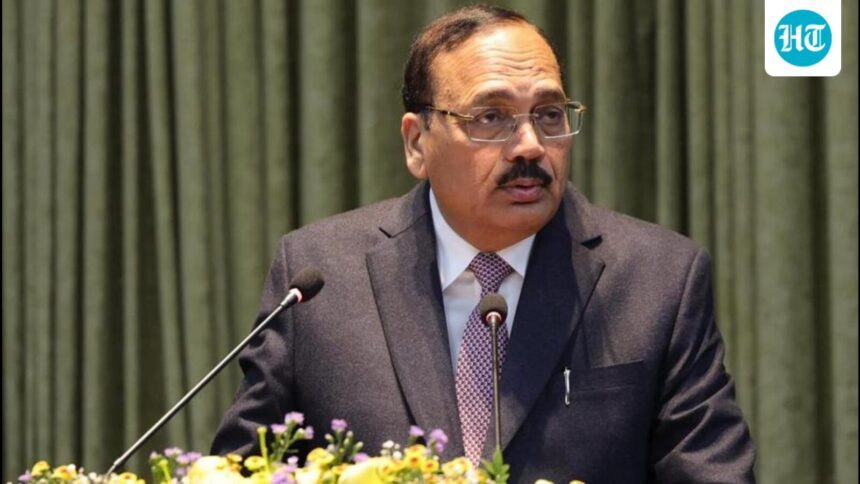
Surya Kant, Chief Justice of India (CJI), on Wednesday fondly recalled his literary upbringing and credited his father for instilling in him a deep love for Hindi, Sanskrit and Haryanvi literature, as he delivered the keynote address in Hindi at the Rashtrakavi Ramdhari Singh Dinkar Memorial Lecture.

Speaking at the eighth memorial lecture titled ‘Rashmirathi: An Odyssey of Social Justice’, the CJI said the occasion was special on a personal level as he “always loved to think and speak in Hindi”.
“I grew up in a literary family. My father, Shri Madan Gopal Shastri, was a famous writer in Sanskrit, Hindi and Haryanvi, and Ramdhari Singh Dinkar was among his favorite poets,” Justice Kant said.
The CJI recalls hearing countless Dinkar compositions from his father during his childhood and grew up amidst frequent literary discussions at home involving writers, poets and intellectuals from Haryana and Punjab.
“There was always one common view among them – that Ramdhari Singh Dinkar distinguished himself because of his national thought, cultural awareness and commitment to human values,” Justice Kant said, adding that Dinkar was not just a poet, but a “Yog Nirmata” (age maker) whose writings gave voice to the marginalized, challenged injustice and inspired social reflection.
Referring to Dinkar’s famous epic ‘Rashmirathi’, the CJI said the work was much more than a mere literary text and embodied constitutional values, social justice and human dignity.
Using the character of Karna as a symbol of merit that was denied recognition due to discrimination based on birth, Justice Kant said Dinkar attacked a social order where identity is determined by caste and lineage rather than ability and character.
Quoting Dinkar’s verses from ‘Rashmirathi’, the CJI noted that the poem remains relevant even today as issues of equality, dignity and social justice remain unresolved in many forms.
Senior advocate Vikas Singh, who is also the president of the Supreme Court Bar Association, chaired the event organized by the non-profit Respect India. Lok Sabha member Manoj Tiwari received the Dinkar Sanskriti Samman Award for his contribution in promoting the poet’s legacy.
In his speech, Judge Kant also linked Dinkar’s vision to the constitutional guarantees under Articles 14, 15, 16 and 17 (which guarantee equality before the law, prohibit discrimination, and guarantee equal opportunities), stressing that the Constitution sought to create an equal society free of discrimination. He added that literature has historically contributed to shaping civilization and moral awareness, adding that “poetic justice” often preceded social and constitutional justice.
Referring to the idea of “poetic justice,” Justice Kant said that writers around the world have contributed to shaping humanity’s understanding of justice, equality and dignity. He cited poets including William Wordsworth, Percy Bysshe Shelley, John Keats, Sumitranandan Pant, Mahadevi Varma, Harivansh Rai Bachchan and Rabindranath Tagore.
Quoting Tagore’s famous phrase – “Where the mind is fearless and the head is held high”, the institute observed: “Your head can remain held high only when society is equal, when there is social harmony coupled with social justice.”
Moving from literature to contemporary realities, the ICJ said that the era of digital innovation, artificial intelligence and globalization had rapidly transformed life, but the central question remained whether the benefits of progress were reaching everyone equally.
“Development does not mean merely expanding resources; it also means merely distributing opportunities,” Justice Kant said, adding that Karna’s struggle showed how talent cannot fully flourish unless society itself becomes willing to recognize it.
Justice Kant also spoke about the role of the judiciary, saying that the courts played an important role in ensuring justice, but justice could not remain confined to judicial decisions alone. “True justice is achieved when society itself becomes ready to reflect and transform,” he said.
He added that the law can provide structure and direction, but the responsibility to walk this path lies with society. Without equality, sensitivity and respect in social behaviour, even the scope of the law will remain limited.
Concluding his speech, the CJI said that true justice cannot be achieved only through courts and laws, but requires society itself to embrace equality, sensitivity and dignity in daily life.