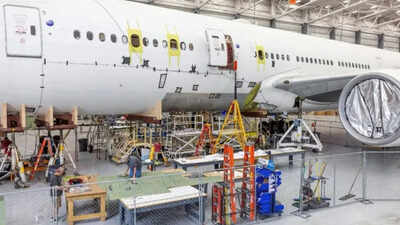
NASA’s Boeing 777 has returned to Langley Research Center in Virginia after undergoing major modifications that transformed it from a commercial airliner into a powerful airborne scientific laboratory.
The plane reportedly spent months in Waco, Texas, where engineers performed extensive structural upgrades to prepare it for its new role. Its return represents an important step for NASA’s airborne science program, which appears to be expanding its ability to study the Earth from high altitudes. Scientists are already looking forward to upcoming missions that could provide deeper insights into weather patterns, climate systems, and atmospheric behavior.
The aircraft is expected to play a central role in future research flights scheduled over the next few years.
NASA’s Boeing 777 flight laboratory has been upgraded for advanced scientific research missions
The Boeing 777 was originally a passenger plane, but has now been significantly redesigned for scientific research. According to reports, major structural changes were made during the modification phase, including reinforced parts of the fuselage and redesigned internal systems. Engineers installed specialized research stations inside the cabin, allowing scientists to operate the devices directly during flight.
The aircraft also features enlarged observation windows and hatches in the lower fuselage. These modifications allow advanced sensors such as lidar and infrared imaging systems to collect data more effectively. It appears that the goal was to transform the plane into a full-fledged scientific platform rather than just a transport vehicle carrying equipment.
Why did NASA choose the Boeing 777?
NASA previously relied on its DC-8 aircraft for airborne research missions, but that aircraft is now retired after decades of service.
The Boeing 777 appears to be its modern replacement, offering much greater space, range and capacity.The plane can reportedly carry between 50 to 100 personnel and about 75,000 pounds of scientific equipment. It is also capable of flying for up to 18 hours, giving researchers much longer for uninterrupted observation. Experts point out that this extended endurance is crucial for studying large-scale atmospheric systems that evolve over long distances and time periods.
Inside the plane: A reconfigured cabin for advanced climate research
Everything inside the plane has changed as much as outside the plane. The cabin has been completely modified in order to conduct scientific experiments inside the aircraft. The wiring inside the plane has been updated to accommodate the advanced equipment used by scientists and many other research stations inside the plane.In addition, the modified aircraft is said to enable rapid response from on-board devices while communicating with people on the ground.
Thus, scientists will be able to make the necessary adjustments as they work without having to land the plane first.According to reports, NASA has decided to conduct its first scientific experiment using a Boeing 777. This mission will begin in January 2027. It will be called NURTURE and is dedicated to studying severe winter weather systems such as heavy snowfall, ice, stormy winds, and rough seas.The Boeing 777 will reportedly travel through various locations in North America, Europe and Greenland, as well as in the Arctic and North Atlantic regions.
How precise modifications enabled a new era of airborne research
The editing process was very complicated indeed. First, engineers had to ensure that the aircraft would be structurally safe, but also include the necessary scientific functions. For example, thousands of holes were drilled in the fuselage in order to install the necessary equipment. Furthermore, larger windows were added to make it easier to see sensors and other equipment.
Reports indicate that structural modifications to the aircraft were carried out by companies such as L3Harris Technologies, while NASA focused on other components of the operation.This system could allow researchers to track weather systems in real time across large areas, something previous aircraft have been able to do in short periods of time. This new platform may encourage collaboration between researchers from different countries during a single trip.At present, the plane is parked in Langley, awaiting its maiden flight. While the full scope of its development remains to be seen, there seems to be a lot of anticipation among researchers who have been waiting for this platform for years.