

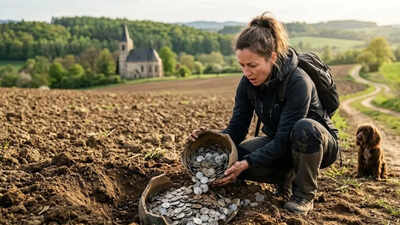
In the Kutná Hora region of the Czech Republic, what began as an ordinary walk across a freshly plowed field turned into one of the largest discoveries in the history of Central European coinage. A local woman, who chose to remain anonymous, found 2,150 coins from the late 11th and early 12th centuries.
The coins were inside a broken ceramic bowl. This collection shows a great deal of wealth from a time when politics were very unstable. Specialists at the Institute of Archeology of the Czech Academy of Sciences described this discovery as a jackpot for historians. It provides rare evidence about money systems, metal use, and economic changes during the difficult rule of the Přemyslid dynasty in medieval Bohemia.
More than 2,000 ancient coins were found during a casual walk
As noted at the Institute of Archeology of the Chinese Academy of Sciences, in a field near Kutna Hora, a woman found some silver coins that were partially exposed due to the weather.
She reported her findings, which prompted archaeologists from the Czech Academy of Sciences to investigate. They discovered 2,150 silver coins. These coins were originally kept in a ceramic vessel that had broken down over time. This discovery is considered one of the most important discoveries in the region during the past ten years.
Experts now needed to quickly stabilize and preserve the coins to prevent oxidation of the silver alloy.
Why were more than 2,000 coins hidden for centuries?
According to a study published by the Czech Academy of Sciences, experts estimate that the coins date back to the period between 1085 and 1120 AD, the time known for minting silver dinars.
This collection contains coins of King Vratislaw II and Princes Bretislav II and Borivoj II. At that time, the dinar was the main currency of the Premysland state. The sheer size of the coins suggests that they were not just someone’s personal savings. Alternatively, it may have been a large cache such as military pay or war treasures hidden during civil unrest between contenders for the Bohemian throne.
How XRF technology traces ancient silver
Scientists are now examining the chemical composition of silver using X-ray radiation (XRF) along with other non-destructive techniques. These analyzes aim to trace silver ore back to its origins, perhaps linking coins to specific local mines or historical trade routes. Since the treasure was discovered largely undisturbed in its original location, it offers a unique glimpse into history. This allows researchers to explore economic conditions such as purchasing power and inflation during the early 12th century.