Logo text
Lord of the FliesWilliam Golding’s 1954 novel, is one of those properties that seems to have been constantly adapted for the screen – although unlike the films of Peter Brook (1963) and Harry Hook (1990), both of which are interesting but imperfect, it is in fact rarely adapted.
Sure, there was a 1975 Filipino film and simpsons “Das Bus” episode, but at that point you’re looking at texts inspired by, but not quite adapted from, Lord of the Flies. That’s when the floodgates open, because a few texts of the past hundred years are inextricably woven into our culture.
Lord of the Flies
Bottom line Very close to the final adaptation.
Broadcast date: Monday, May 4 (Netflix)
ejaculate: Winston Swyers, Lux Pratt, David McKenna, Ike Talbot
author: Jack Thorne
exit: Mark Munden
without Lord of the Fliesnothing Battle Royaleno Yellow vestsno 100no Survivor no Kid Nation. We won’t have classics like lostInteresting antiques such as the societyTotally forgotten shows like Prairie Or absolute garbage like The Island. Sure, that’s easy to say Lord of the Flies Basically the same Robinson Crusoe meet Tom Brown’s School Days meet The most dangerous gameBut from 1954 onwards, the strongest line of DNA in the genre goes back to Golding.
Writer Jack Thorne and director Mark Munden Lord of the Flieswhich was produced for BBC iPlayer and BBC One (with Australia’s Stan) long before Netflix gained US distribution, is sure to spark a new variety of comparisons in your mind.
Thanks to Thorne’s involvement, this is easy to see Lord of the Flies Kind of tropical Adolescence — a reminder that young people had seriously flawed primitive instincts long before the Internet misdirected them. Thanks to Cristobal Tapia de Fer’s propulsive score, which once again blends animalism and choral (with cameos by Benjamin Britten, among others), it’s easy to realize that White lotus It always has been Lord of the FliesWith bed turn-down service.
But the four-hour series’s greatest achievement is that, despite all the inevitable comparisons one might be tempted to make, Lord of the Flies is entirely its own thing, as bold but as devoted to its source material as any TV adaptation in recent memory.
Nevertheless Lord of the Flies He certainly suffers from some of the bloat endemic to live streaming, and even his excesses come in the name of emotional strength. The series is determined to make sure its most devastating moments hit hard, and if that requires extending those pivotal scenes beyond what’s strictly necessary, no one seems concerned.
Although familiar to almost anyone who has taken middle school English over the past eight decades, the story still retains the power to shock.
The series is set sometime in the 1950s, and begins on a lush tropical island somewhere. A plane has crashed, and for whatever reason, none of the adults survive.
We are first introduced to David McKenna’s short character, Nicky, who has been crushed by the cruelty of youth with the nickname “Pig”.
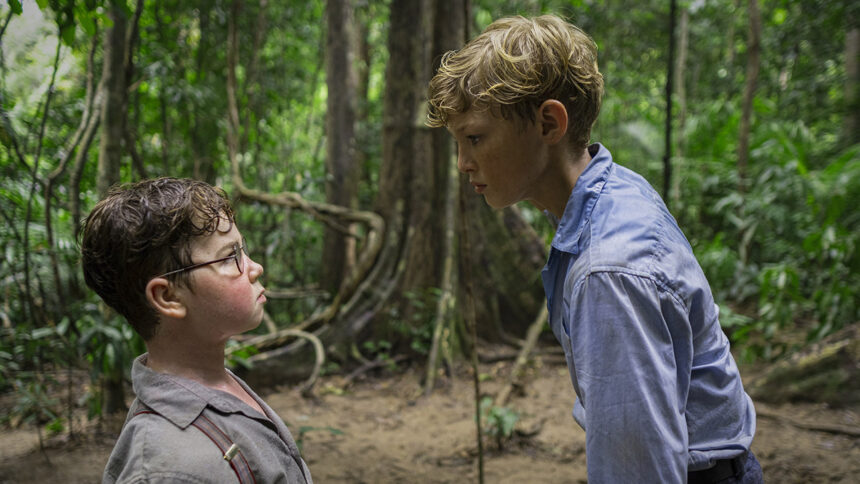
Piggy, possessing endless random trivia and a devotion to the outdated pop culture given to him by his aunt, soon meets the confident and friendly Ralph (Winston Sawyers), and with the help of a handy conch, they round up dozens of surviving children.
There are the “toddlers,” children around five or six years old who crave guidance and supervision.
Then there’s the chorus from Tony’s Academy, an instantly raucous group led by Jack (Lux Pratt), the youthful embodiment of British public school privilege.
Following in Piggy’s footsteps, Ralph advocates structure and responsibility, including building a shelter and building a fire.
After his own due, Jack invites him to have a good time and break the boundaries of the adult world.
In the election, Ralph is voted in as tribal chief, while Jack and his choir boys reluctantly accept the responsibilities of hunting and keeping the fire – kindled with the help of Piggy’s thick glasses – burning.
It doesn’t take long for Jack to decide that he doesn’t respect Ralph’s attempts at maturity. This creates a rift between the survivors, an escalating conflict in which the youth’s behaviors, for better and worse (mostly the worst), boil down to their terrifying essence.
There will be plenty of opportunities to praise Thorne’s writing, which relies heavily on the most memorable dialogue from the book – “Sucks to your assmar!” It has been a regular rejoinder in my family – and maintains the basic structure of the book. I didn’t read Lord of the Flies In at least 35 years, Thorne’s versions of the characters are more accurate than I remember, though that may be more a function of memory than anything else. I know why Piggy’s heroism and resilience resonated with me as a child, and Thorne maintains these aspects, without losing sight of the ways in which long-term exposure to Piggy can cause discomfort. When young, Jack seemed quite feral, while Thorne maintained his worst traits, while displaying insecurities and upbringing flaws that would make him dangerously unstable.
I never thought about the doctrinal aspect Adolescence It was the best thing the popular series did and everything Adolescence We had to say about how the Internet’s petri dish grows the most ferocious tendrils of masculinity, which is better said in… Lord of the Flies. Think of this mysterious island as an unmoderated Reddit forum, filled with bullying and a growing distrust of difference, feelings, and vulnerability.
There will be ample opportunities to sing the praises of Munden’s direction, coupled with Mark Wolf’s heavily digitally enhanced cinematography. The four episodes are filled with eye-catching visuals, enhancing the green color of the foliage and every green and precarious stretch of the island, but the show isn’t just visual candy. Horrific scenes begin and become downright nightmarish, including a breathless encounter with a CG pig, a night-time celebration that leads to a disorienting tragedy and the very bad thing that happens at the climax of the story – a sequence that stretches far beyond what is necessary without ever drugging viewers with a gut-punch that I remember so clearly from my first read.
Yes, four hours seems like a long time, but to me it didn’t feel like that long. There are aspects of the story of wish fulfillment followed by an extended descent into horror. Spending time with the latter reinforces the former. I never tired of the charming cinematography, at once naturalistic and operatic, nor of some of Munden’s visual tricks, such as the documentary-style close-ups of the young actors, which don’t necessarily do anything, are just there. The use of a fisheye lens can lose its novelty, and sometimes the awkward camera angles seem more like showing off than taking us into the story. But only sometimes.
Thorne and Munden will get their huge plaudits and deserve them, but I want recognition more than anything. Lord of the Flies As a triumph of casting. Nina Gold and Martin Weir have assembled a group of young, unknown actors in whom any misjudged performance could have undermined the whole, but each casting is impeccable. McKenna embraces every inch of Piggy’s awkwardness, every desperate plea for acceptance and friendship, without polish or artificiality. Sawyers has the assertive charisma of a natural leader, with the fragility of a child who might value popularity too much. Pratt makes Jack an annoying antagonist — I immediately compared him to Draco Malfoy in my notes before I discovered that Pratt had already been cast in the role in the upcoming HBO series Unnecessary — but he’s as sad and pathetic as he is evil, which is probably as he should be.
The best performance comes from Ike Talbot as Simon, a kid who finds himself caught between the two factions. His work in Episode Three is heartbreaking and layered, right in a “bookmark that name” kind of way. But in fact, every performer, both adults Or the little ones, he works in the service of the whole, and Munden coordinates their interactions in a way that suggests organized chaos. Assuming that everything on set is fully supervised at every turn, the results are often both exciting and ultimately terrifying.
the previous Lord of the Flies The amendments, whatever their otherwise failings, were showcases for discoveries. I’m sure the commercial and artistic risks of an ensemble that doesn’t include veterans – Rory Kinnear is memorable in a brief, flashback-driven role – partly explains why we haven’t gotten a new look. Lord of the Flies Every few years.
Now we definitely don’t need another for a while. What Thorne, Munden, and company have accomplished with this still relevant text may not be definitive, but it is very close.