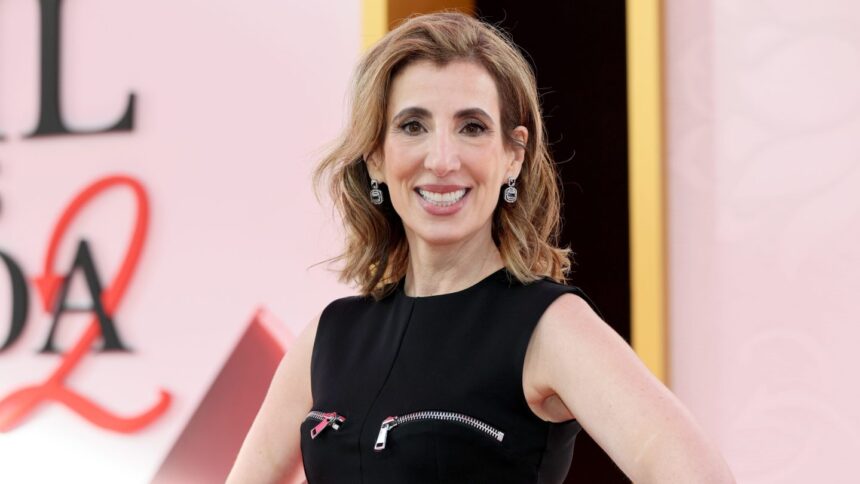
Aline Brosh McKenna always seemed aware of writing a sequel to The devil wears Prada The runway would be dangerously narrow for walking. Maybe that’s why, just three years ago, she wasn’t particularly interested in the idea. But when Meryl Streep says she’s considering revisiting one of her most famous roles, what’s a screenwriter to do?
It took 20 years after they released one of the most influential comedies of the 21st century to get the whole band back together again. But, McKenna says, once she met Streep…things moved very quickly. “Merrill’s opinion is very important,” says McKenna, whose other credits include: 27 Dresses, Morning Glory, We Bought a Zoo and His crazy ex-girlfriend. “And when she said she would be open to hearing some ideas, by then, we had gathered a lot of them.
During the last episode of Hollywood Reporter Podcast I have a ring (Spotify, Amazon Music, Apple), McKenna talked about building a very different but equally enchanting world with music The devil wears Pradadiscuss how the original elements have aged and why “that’s it” was enough.
When we spoke in early 2023, Emily Blunt and Anne Hathaway were really pushing the idea of a sequel. She asked if I was interested and I said, “Not really.”
I know! This was right around the time I started thinking about it. I’m pursuing all three of these industries: journalism, fashion, and publishing, all fields that I love and, perhaps, in another world, would work in. As these fields have been turned upside down, I have always wondered. “What do these four characters do in a world where how to make money is different?” The social values of workplaces have changed. The world has changed a lot in 20 years. Then I started calling David Frankel and saying, “You know what? I have some ideas.” But the key to it, always, was finding a place that Meryl was passionate about.
So how do you get Meryl Streep excited? I wanted to get her thoughts ahead of time. So, I was excited to go see her and talk to her about it. We happened to go to see her one night when Lin-Manuel was on [Miranda] He was performing it at the Washington Heights Theater for which he was raising money. I haven’t seen him in theater in years. And we just spent today talking about where these characters are going to be. She felt like she was divided.
We live in this culture where there’s an expectation that if people like something — a series, a movie, a book — that they feel entitled to more of it. This has led to some great works. This also resulted in a lot of work that may not have been needed. From your group, what metric did you use to decide that a film should be made — and that this wasn’t just feeding into the reboot and sequel culture?
I’m a big fan of movies from the 30s and 40s. If something works, keep doing it. Even if it’s just the same actors, even if it’s just Hepburn and Tracy, if it’s something the audience responds to, they’ll make multiples. The idea that you can take existing material and repackage it and update it doesn’t bother me. In this case, we were not asked. The impetus did not come from Disney. Wendy was motivated [Finerman]who produced the original, brought it to our attention that Meryl would like to talk about it. So it felt like building any film. It came from a story we were excited to tell. There was nothing sarcastic or calculated about it, except that I as a fan wanted to go and revisit this.

Which I’ve thought about a lot over the years, I think.
I’ve thought about Miranda Priestly many times over the past twenty years. Anytime you’re in a slightly annoying situation…you get the wrong coffee order or someone sits in your plane seat. It’s always fun to imagine what Miranda would say.
There were always a lot of expectations about this project, but were you prepared for the scrutiny during production? The paparazzi photos from the set last summer felt like such an event.
I didn’t expect that. I generally didn’t work on things that were expected while we were doing them. No one was standing around excited 27 dresses. It’s a completely different circumstance. But I was really surprised by the crowds. We were shooting during the summer. The weather was great. We were all over town. Even if people didn’t search for it online, sometimes they would pass by and see it. I felt that way in New York. We all crave a community experience. This film is a shared experience, a shared memory from a time when things were different. There was more monoculture. There’s a longing for a feeling of solidarity and community and everyone talking about the same movie. This is something to hold on to.
How does the novelty of this anticipation affect the writing process? How much do you think about fan service being necessary, but not overdoing it?
For me, I like it when something is fan service, but you don’t have to know it [that’s what it is]. You don’t have to have seen the first movie to enjoy this one. And if you get the reference and remember where it came from, that’s great. In a way, this makes the references more fun. This is a friend. If you think of it as your friend of 20 years, you have your own jokes – for example “that’s it”, which has become a catch phrase. As a little Easter egg, I think we only say “that’s it” once. We’ve thought a lot about where to put “that’s it.”
If memory serves, the original film was at least at one point misclassified as a rom-com. It is very clear that it is not. How do you think about that, in terms of genre?
I definitely wrote traditional rom-coms. I think it’s because of the tone – the kind of optimism and comedy that you associate with romantic comedies. So there was always a little bit of that. But women in the workplace are just real magic to me. It always has been. I’ve just read designer Claire McCardell’s autobiography. I’m reading Judy Blume’s autobiography right now. Quite simply, I think they were role models for me. It’s those stories, those movies: working girl, broadcast news, Even those that aren’t related to female protagonists. Tutsi It is a very important film for me. It is a workplace comedy in many ways. It’s about someone who needs a job. I’ve always longed for those stories as much as I longed for Jane Austen, Edith Wharton, and Charlotte Brontë. I just love the idea of the workplace being a theater of emotion and ethics.
How brand conscious are you when you’re writing the fashion part of this? The brands that appear in the film are a big part of it. Are you thinking about LVMH as you write?
No, although in this movie we are definitely using real designers. We had to invent a designer in the first movie, kind of by necessity. The idea is always to look at it from an outside perspective. That’s how I look at it. I’m a girl from New Jersey. One of my favorite New Yorker cartoons is a woman wearing a T-shirt that says DKNJ. The caption reads “Donna Karen’s Nightmare.” I’ve always felt this way because I grew up trying to put together something cool for myself. This film is not an advertisement. This does not support any particular designer or design sensibility. Although it’s very important to be original, it’s not a click-and-shop movie.
There was a real recasting of Adrian Grenier’s character in the first film as a sort of villain. What is your reading on that?
I get asked about that a lot. My experience coming to New York was that there was a lot of sensitivity about selling out if you were in a creative community. This is less common now. It’s probably more prevalent in Generation X than in Millennials overall. But when I started, I really wanted to write commercial comedies. That’s what I loved. And I remember feeling in the early ’90s, “Oh my God, am I a traitor?” There were definitely people who told me that. I really don’t think you can appeal [Nate’s] Motives. You have become a different person with different values than the person you are dating . He’s there to remind her that it’s a Faustian story and she’s sliding down the drain. That’s what it’s there to do. I wanted to create someone who had that incredible ferocity and purity that you have in your twenties. The character of Nate is a kind of avatar of someone who understands that Andy is crossing her moral boundaries. This is his role in the story. It’s interesting to me that this has been highlighted, but the idea of selling has actually changed. We are in a world where the economic climate is very difficult to survive. We’ve gone from “don’t sell” to “bring your bag, girl.”

The original film had one of the most memorable makeover scenes in cinema. This has been a mainstay of my filmography for years. We don’t see montages of the transformation anymore. What do you think about that?
It’s an interesting transformation at Prada because it’s not “homely sexy.” It is “unfashionable to fashionable”. One of the things I love about fashion is that some of the things that patriarchal society tells women — a big bosom, for example — fashion rejects. There are things that are so stereotypically desirable that fashion is turned upside down. Like five years ago, everyone was wearing false eyelashes, right? Now all shows this season, no mascara. There is a kind of change where you take a woman and turn her from an object of the female gaze into an object of the male gaze. That’s not really what the first movie was doing. It didn’t make her sexier. He was giving her the keys to this locked room.
A lot has changed in fashion aesthetically between the two films.
I find it interesting and ultimately funny how these things change. Thick eyebrows, thin eyebrows, and yes, eyelashes! No eyelashes! Dropped waist, high waist. It’s always moving, these little measures of style everywhere. But with fashion, obviously it’s somewhat about sex appeal, but it’s not that either. It’s about understanding what the silhouette means. What does a low waist mean in your twenties? What did big shoulder pads mean in the 80s? The return of massive amounts of volume in the last couple of years that we have seen. What does that mean? And now things are starting to dwindle again.
Don’t tell me that. I really over-indexed the puffy pants.
Well, we do it for men too! The men move very slowly in relation to the silhouettes.
Before I let you go… Will The devil wears prada 2 Will it be released on May 1 and get an invite to the Met Gala three days later?
I highly doubt it. (He laughs.) I mean it’s a good example of what we did in the first movie. We had a version of the Met Ball, and I don’t think everyone knew what that was at the time. Now that’s the Super Bowl or the Oscars for many people. People sit with popcorn to watch the arrivals. I will watch.