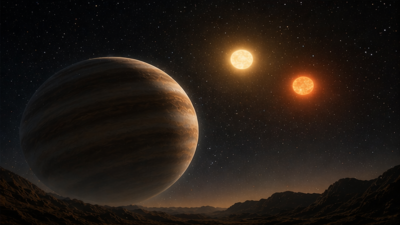
Wolf Cukier, a seventeen-year-old NASA intern, has discovered a unique circular planet, TOI-1338 b, orbiting two stars. His diligent analysis of TESS data revealed anomalies in the light curves, which led to this important discovery. Representative image (generated by artificial intelligence)
Imagine starting a summer job, and within seventy-two hours, you find something that has been hiding in the vastness of space for billions of years. For most teens, summer training involves filing papers or grabbing coffee, but seventeen-year-old Wolf Cukier spent his 2019 summer break very differently.
While working at NASA’s Goddard Space Flight Center, he sat in front of a computer to look at data from the Transiting Exoplanet Survey Satellite, also known as TESS. By the time his first week was over, he had discovered a real-life version of the fictional planet Tatooine.This was not a sudden discovery in a movie-style “aha” moment, but rather the result of tireless effort, which is the essence of all scientific processes.
Cukier’s task was to analyze light curves, which are graphs depicting fluctuations in the brightness of the star in question. Low brightness usually means that there is something between the observer and the study object that is blocking a large amount of its light.
While others might only notice data points and lines on graphs, Cukier saw that the anomaly in question appeared at an unusual point in time, marking the beginning of the discovery of TOI-1338 b.
Disable the dance of the starsThe difficulty of this observation is exacerbated by the peculiarity of the system itself. Normally, planets move around a single star, creating predictable shadow cycles. In the case of TOI-1338 b, we have a circumbinary planet – a planet moving around two suns. Since the movement of these two suns themselves is periodic, it causes a constant change in the times at which the transits can be observed.As detailed in the paper titled TOI-1338: TESS First Transiting Circumbinary Planet, the system is located about 1,300 light-years away in the constellation Pictor. The two stars in the center are different in size; One is about ten percent more massive than our Sun, while the other is cooler and lighter. The planet itself is gigantic, roughly seven times the size of Earth. Because it orbits both stars, its transits are irregular in terms of timing and duration.
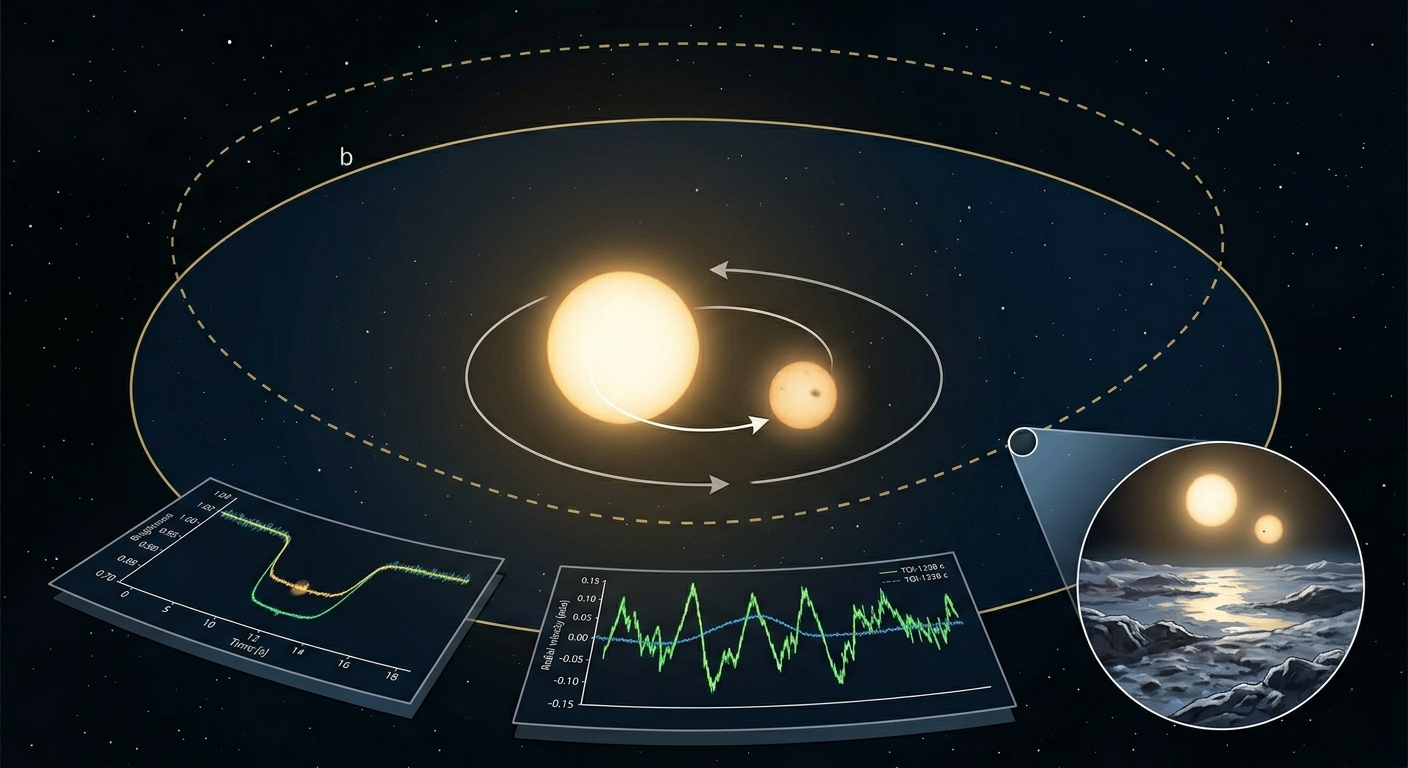
This discovery paved the way for the identification of a second planet in the same system, highlighting the crucial role of human observation in scientific achievements. Representative image. Image credit: Google Gemini
At first, when Cukier saw the data, he felt it might be an eclipse, as expected in binary stars. However, careful observation showed an anomaly in the time period. Instead of describing this phenomenon as a defect, Cukier committed to the scientific process and highlighted the “incorrect” decline. In doing so, he was able to bring together a large group of researchers from multiple organizations to support his findings, which proved to be a clear win for a brilliant student in a field that requires rigorous evidence.Scientific discovery does not stop thereTOI-1338 b was not a one-off discovery that would make the news and then be forgotten. An accidental discovery by a teenager gave rise to many important discoveries in the future. The easy identification of a protoplanet has led to increased vigilance on the part of scientists working in this field. After years of searching, researchers discovered another planet in the same system and published their results in the journal Nature Astronomy.The second planet, referred to as TOI-1338 c or BEBOP-1c, was discovered using the radial velocity technique.
It entails measuring the minute changes that occur in the star’s speed due to the gravitational force exerted by the planets orbiting it. The discovery of a second planet in this binary configuration was extremely rare, and thus the system emerged as an excellent testbed for studying planetary formation in such complex systems.For NASA, this was a historic moment. It demonstrated that the TESS mission was able to find the most difficult types of planets, even in data that appeared chaotic or irregular.
It was also a powerful reminder that human interest is still important in the age of artificial intelligence. Computers are great at following rules, but humans are great at noticing when a rule is broken.Today, it remains one of the best scientific discoveries due to its connection to history and the contemporary world. The Earth moved in a path orbiting two stars for billions of years, unnoticed, until a teenager decided to look into an anomaly of light fluctuations that exceeded expectations. It’s a lesson for everyone: the greatest changes begin when we pay attention to events occurring at the wrong time.