Sophie Rumvari tends to keep her forecasts “volatile.” Since the beginning of her first feature film, Blue heronthe Canadian native remained focused on what she could control: the experience of making a deeply autobiographical film on her own terms. She didn’t have high hopes of landing a blockbuster acquisition from the festival arc, let alone a months-long press tour from there.
“I certainly wasn’t expecting theatrical distribution for an indie Canadian character drama in 2026. I assumed it would go straight to streaming,” she says. “The feedback you get from the industry as a new director is: ‘It’s a bad time. “No one takes any risks.”
Yet here Rumvari sits on the patio of a Hollywood restaurant, struggling to find time to eat bits of her chopped salad in between thoughtful answers to questions about her unexpected sensation. Blue heron It turns out he didn’t go directly to the live broadcast; On the contrary, it is being carefully brought to big screens across North America by eclectic Janus Films. Romvari’s drama is the best-reviewed film of the year, according to both Rotten Tomatoes and Metacritic, and has already won awards at festivals ranging from Locarno (where it had its world premiere) to Toronto (where Janus snatched the rights).
So far, though, about to Blue heronLos Angeles Edition Rumvari prefers to keep things straight. “My life up until now has been a combination of part-time jobs, editing, grants – that’s how I’ve earned an income,” she says. “The whole goal is: Can I build a career where continuing to work is sustainable?”
Romvari, 35, has made her name on the short film circuit, with raw self-portraits that often delve into her family archives and traumas. She grew up on Vancouver Island with her parents and three siblings, who immigrated from Hungary just before she was born; Coming to terms with the deaths of two of her older brothers is a tribute Still processingwhile Norman, Norman It focuses on her beloved older dog as she grapples with his death. The memoir project reaches a kind of climax Blue heronwhich is not a documentary – but it is still firmly rooted in Rumvari’s past, specifically the echoes of the sudden death of her troubled older brother.

“I feel like a different person after I made this film because now I feel like I can move through the world knowing that I did everything I could to unpack and understand that period of my life and my family’s life,” Rumvari says. “I’ve explored it artistically in a way that allows me to move forward in a way that I don’t think I would have if I hadn’t.”
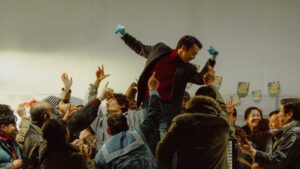
Vancouver group Blue heron It is brilliantly presented in two timelines, the first as an intimate family drama seen through the eyes of young Sasha (Ellul Jouvin), Rumvari’s stand-in, as she observes the growing tension between her mother (Eringu Riti) and her brother Jérémie (Edek Beddos), who seems increasingly aloof and isolated. About halfway through, we shift to the aftermath of Jeremy’s death, where an adult Sasha (now played by Amy Zimmer) works as a director and tries to piece together what happened and why. These two sections meet, to some extent, in Blue heronThe film’s climax is poignant and surprising, which recreates a key scene from Rumvari’s childhood – or at least it appears that way on the surface.
“Watching this film, one would expect that this is the most dramatic thing that has ever happened in my life — but this one event, this conversation, I don’t remember that happening,” she says. “People might look at this film as my life, and I have to accept that as someone who has made myself vulnerable as a director.”
In reality, Blue heron It is a more complex project – emotionally nuanced and rigorous, certainly, but also unusually controlled for a debut. This was on purpose, as Rumvari had the patience to seize the moment, improving her visual style and tightening her narrative style. She was also working with a wealth of, if not overt, cinematic references flowing through her unique expression.
When asked to name the touchstone, she sipped her Diet Coke, laughed and pulled out her phone, her salad still intact. “I’m so grateful for Letterboxd. Letterboxd is my brain,” she says. You caption detailed master shots by Robert Altman Short cuts And the painful intimacy of Jonathan Caouette distortion As some crucial inspiration. Later, an email she had sent to her co-star Zimmer, titled “The Delicate Cinema of Women,” appears. It’s full of other influences, like Mike Leigh’s Secrets and He lies And Joanna Hogg Eternal daughter.
However, time may have had the greatest influence on this Blue heron. “Debut films are often full of ideas, and that can be in many ways, but I feel that because I waited a little longer – a lot of people make their first films earlier – I benefited from the confidence and creative ability to have more distance between myself and the narrative than if I had done it in my 20s,” she says. “When you’re a filmmaker working with limited means, you never know if you’re going to get another chance. I really wanted to make sure I was doing my absolute best. I made exactly the movie I wanted to make.”
Through the Canadian Arts Funding System, Rumvari received a research grant to write his project Blue heron The script she lived off of during that time, and then a production grant to actually make the film. “When I started working in Canada, I wasn’t aware of the advantage of living in a country that had access to funding for the arts,” she says. “The version of this film that I would make within the American system would be very, very different — and I don’t know if that film would get distribution.”
Even with government support, Rumvari needed a certain amount of resilience. She started acting before she had the money to produce. “It was like: ‘We have to go, I’m making this movie,'” she says. “That’s actually half the battle: just saying: I’m a director and I’m making a movie.”

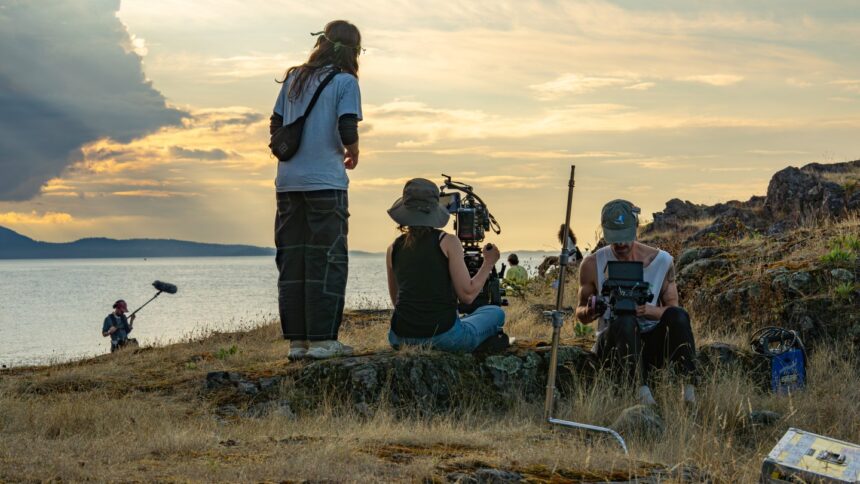
After a summer photo shoot, Romvari camped out Blue heron Editor Curt Walker’s living room all winter in Toronto, and she took a job as a supervisor at a local movie theater to make ends meet while wrapping post-production: “Obviously I was running out of money, so I was like, ‘Can I work here?'” She still works there part-time and has had the opportunity to show Blue heron There as a special preview offer. Romvari walked across the street to introduce the film, then returned home to eat leftovers and walk her dog during the film, then returned for a Q&A.
Romvari is in that crowd. “A lot of filmmakers seem to hate making films — or they seem to hate being on set, or maybe they hate publishing or whatever — and it’s not something I could imagine doing unless I loved it as much as I do,” she says. “Every day I would say, ‘Wow, you are expending so much emotional, intellectual, and social energy every day.’” You have to be prepared every day to solve problems, answer questions, and be at your most present game. I was surprised with myself that I was able to maintain this throughout the entire shoot and stay present and enjoy the process.
At some point I called Blue heron Shoot “Explosion” may seem at odds with the heaviness of the material, or the intensity of what the writer and director had to bring from the past to get it right. She relayed traumatic memories to her parents — who have seen the film and loved it ever since — only to be presented with completely different versions of events. She had to reimagine her late brother through the eyes of her childhood. All this work has led to a question about the artistic motivation that underpins it Blue heronWith all its exciting meta-layers: “Why did you become a filmmaker?”
Of course, filmmaking is what Rumvari loves – and so there is joy in that question, however mixed with feelings of sadness. I started Romvari is just starting her career, while still determined to keep her expectations in check – focusing her outlook squarely on creativity and improvement. “It was as if I was trying to learn a language through my short films, and then I had finally mastered that language by the time I got to this film,” she says.
As we finished eating, she looked at her plate and smiled, “I ate three of my salad.” It’s not a shock, this is a filmmaker who has a lot to say.