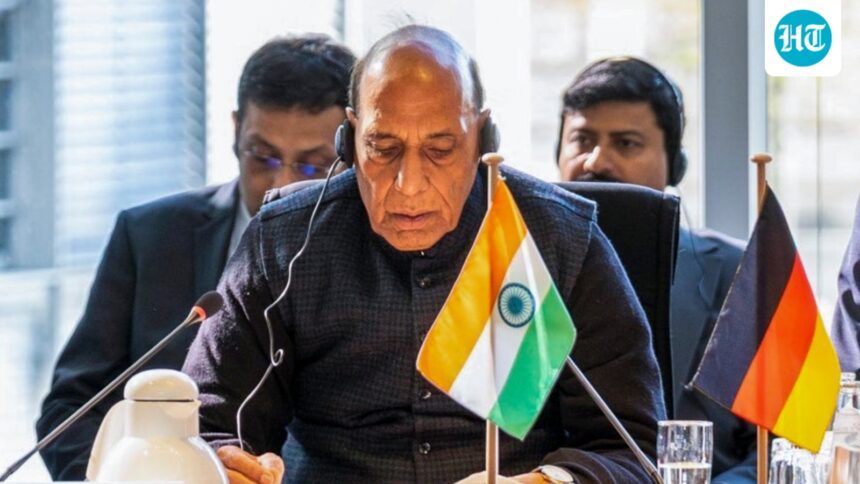
Geopolitical instability in West Asia, caused by the ongoing conflict between the US, Israel and Iran, is no longer a regional issue, given its far-reaching implications for global energy security, food security and economic stability, Defense Minister Rajnath Singh said on Tuesday.

Addressing German parliamentarians in Berlin, Singh said: “For a developing country like India, which depends on the West Asia region for a large share of its energy needs, the disturbances in the Strait of Hormuz are not distant events, but rather stark facts that have direct implications for our security and economic stability.”
He arrived in Berlin on a three-day official visit aimed at strengthening bilateral military relations between India and Germany, with a focus on enhancing defense industrial cooperation between the two countries.
India’s strategy in confronting global challenges
He said that India has adopted a proactive and coordinated strategy to confront the challenges arising from the conflict and mitigate its direct impacts on the country, adding that the Group of Ministers on West Asia is constantly assessing the evolving situation and recommending timely measures to reduce its impact.
Read also: “Iranian gunboats, unknown projectile”: What we know about the two Indian ships that struck the Strait of Hormuz
Addressing the German Parliamentary Standing Committee on Defense and Security, Singh said: “Bringing together key ministries, our deliberations focused on protecting energy supplies, maintaining availability of essential commodities, containing inflationary pressures, and protecting citizens as well as industry from external disturbances. This reflects India’s ability to respond to global crises with calm, foresight and effective institutional coordination.”
India and Germany are scheduled to sign a roadmap for defense industrial cooperation during Singh’s visit. Discussions will also focus on enhancing defense industrial cooperation, enhancing military-to-military engagements, and exploring opportunities in emerging areas such as cybersecurity, artificial intelligence, and drones.
“Atmanirbhar Bharat is not just a procurement programme; it is a call for co-creation, co-development and co-innovation,” he said, making a strong pitch for strengthening defense industrial cooperation between the two countries. He said that India is witnessing an unprecedented transformation in the defense sector, and increasing partnerships with German industry can lead to significant mutual gains.
Read also: India warns Iran of consequences after attack on two tankers in Strait of Hormuz: officials
“We recognize the well-established strengths of Germany’s leading industrial enterprises, while we are also impressed by the strength and dynamism of Germany’s renowned Mittelstand (small and medium-sized enterprises) in advanced and emerging technologies. In India too, our startups and private companies are rapidly enhancing and complementing the capabilities of our larger, established defense enterprises. This is where India and Germany naturally complement each other, and our partnership can go deeper.”
In order to deal with contemporary global challenges, Singh stressed the need for coordinated responses and reliable strategic partnerships. “Prime Minister Narendra Modi and German Chancellor Friedrich Merz have placed a strong focus on strengthening this strategic partnership. We also see a clear convergence of views at the EU level, which is reflected in the growing momentum to engage with India, including through the India-EU Defense and Strategic Partnership,” he said.
Indian Defense Minister visits Germany after seven years; Nirmala Sitharaman visited that country in February 2019 when she took charge. Singh traveled from Munich to Berlin on a special German Air Force plane, accompanied by fighter jets.
“The visit is of great importance for strengthening defense cooperation between India and Germany, with a focus on industrial cooperation, military activities and new areas such as cybersecurity, artificial intelligence and drones,” the Indian Embassy in Berlin wrote on X.
During the three-day visit, Singh will hold bilateral talks with his German counterpart Boris Pistorius and other senior leaders. An “Implementation Arrangement for Cooperation in Training for United Nations Peacekeeping Operations” is also likely to be signed.
Singh’s visit comes at a time when… $The 70,000-crore 75I project to build next-generation conventional submarines in the country is nearing completion. Mumbai-based Mazagon Dock Shipbuilders Limited (MDL) and Germany’s thyssenkrupp Marine Systems (tkMS) will build six advanced submarines under the P-75I command to enhance the Navy’s underwater capabilities.
The first P-75I submarine will be delivered to the Navy seven years after signing the contract, with the rest to be delivered at a rate of one submarine per year. These advanced submarines, a variant of the HDW Class 214 vessels, will come equipped with air-independent propulsion (AIP) systems. AIP significantly increases the submarine’s underwater endurance and reduces the risk of detection. As part of the contract, tkMS will transfer the submarine’s design and technology to India, enabling self-reliance in the defense manufacturing sector.