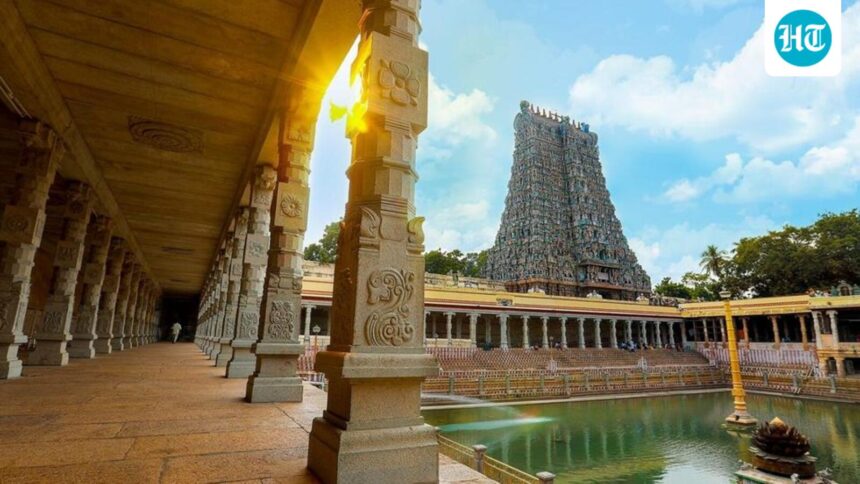
Tamil Nadu is among the richest states in India by all measures, both in terms of GDP and per capita income. They are also the most talented when it comes to history, imperial power, cultural artefacts, and literature. For the rest of India, especially the areas above the Vindhyas, people living south of the mountain range were referred to as ‘Madrasa’. This was not entirely unfounded, as the English East India Company and later the English government created the Madras Presidency which covered an area of over 362,000 square kilometers and had a population of over 30 million between 1870 and 1920. The areas that the British administered from Fort St. George as Madras Presidency were historically hostile to each other, linguistically dissimilar, and were also geophysically distinct. From the southern regions of Odisha (Ganjam, Gajapati, Malkangir and others), to Andhra Pradesh, Lakshadweep, and large parts of present-day Karnataka and Telangana to most of Tamil Nadu itself, the so-called Madras Presidency also consisted of a fertile delta as well as the Nilgiris River where tea and coffee plantations were developed. The presidency continued after the end of English colonial rule, which ended in 1947. It was only after Potti Sriramulu died while fasting while demanding a separate state of Andhra Pradesh that this artificial administrative structure finally disintegrated, and the present state of Tamil Nadu came into existence.

Old tamilkam
Archaeological excavations at Atirambakan near Chennai (former Madras) have provided evidence of human presence through the presence of stone axes and other tools likely used more than 170,000 years ago. In fact, Chennai itself has provided similar dates for tools on a technological, typographical basis, with such cores discovered at Kalapakkam (fist-sized stone tools with sharp, pointed ends) indicating a continuous human presence from the Middle Paleolithic period.
During the last 3,000 years which include the Sangam (2nd BC to 4th AD) and post-Sangam periods, there were three major royal dynasties that roughly ruled the corresponding region that is known today as Tamil Nadu. Therefore Tamilkam preceded the Madras Presidency. It was a vast region, ruled by the Cholas, Pandyas and Cheras, and covered the present-day states of Tamil Nadu, Kerala, Puducherry and the southern parts of Andhra Pradesh and Karnataka. One of the most certain sources for the existence of these three dynasties comes to us from the major rock edict issued by the Mauryan Emperor Ashoka at Girnar in Gujarat. In this edict, Ashoka (r. 304-232 BC) refers to the kingdoms on the borders of his dominion, and among these he lists the Cholas, Pandyas, and Keralaputras, as well as those to the northwest such as the Greek Antiochus and the kingdom of Tamraparni in the east.
Read also: History City | Pre-colonial roots of Christianity in India
These regions appear in Sangam literary texts as a single cultural region, where Tamil was the main language but by no means the only one. Malayalam and Kannada also emerged from this region and period. The ancient Tamilkam region has constantly changed both politically and regionally, and besides cultural continuity, trade has also remained constant. Both the Greek Perimeter of the Red Sea (1st century AD) and Marco Polo’s account (11th century AD) attest to the existence of international trade in Tamil Nadu. Pearls, pepper, ivory and other commodities were the mainstay of this international trade. When the Portuguese, Dutch, English and French arrived in the second half of the 2nd millennium AD, the textile trade took place on the west coast while the spice trade took place on the east coast. Tamil Nadu and its dependent territories like Pondicherry have benefited from both.
Kalbharas and Malik Kafur: Conquerors of Tamilakam
The trio of early Cholas, early Pallavas, and Cheras who maintained rivalries between each other, faced a sudden and powerful enemy between the 3rd and 6th centuries. Scholars have not been able to accurately identify the Kalabhars, their region of origin, the period of their rule, or even the area they occupied after defeating the ancient triumvirate.
“…We have come across conflicting views on the historical reality of the Kalabharas. Some treat them as fearsome rulers who bring terror among the southern powers with their raids, while some treat them as predatory animals,” write S. C. Mishra and Manisha Agnihotri in “Viewing the Kalabharas as Hoax or Historical Fact,” Still others assign them a stage in Tamilkam as ‘Kalabharas’. They are also treated as a widely dispersed tribe, who have caused political and social unrest due to their inclinations towards heretical religions (Jainism and Buddhism).
But from epigraphic evidence such as that at Bulankurici (dated 270 AD) and the 8th century Villicudi copper plate engraving, it is clear that this dynasty did exist. Mishra and Agnihotri wrote about the inscription, “…it is said that a king named Kalabharan captured the vast land and drove out innumerable great kings (Adhiraja) and resumed (the mentioned village) above. The inscription provides a genealogy of the Pandya rulers starting from Pandu who were born as Buddha, Pururava, Maravarman, Ranadhir, Lord Kadungan, Mana Chindan, Ariksari, Chidayan, Mar and is then attributed to Nedumjadaiyan Nedunjaidaiyan defeats the Kadava and Kurumbas and is called King of the Neriyar (i.e. Cholas).” The Kalabhras were eventually destroyed, and their anti-Brahmanical tendencies were probably eradicated from history altogether by the Triumvirate.
Cholas Empire and conquest of Kalinga and Bengal
The greatest dynasty to rule Tamil Nadu was the Later Chola dynasty whose founder was Vijayalaya who took advantage of the dispute between the Pandya and Pallava kingdoms and in 850 AD captured Tanjore (Thanjavur) and revived the Chola dynasty. A succession of kings followed with wars with the Rashtrakutas and Eastern and Western Chalukyas, and by the 11th century, the Chola family had emerged as a prominent power under Raja Raja Chola I (947–1014 AD). Raja Raja brought Chola control over the Maldives, Sri Lanka and all other neighboring kingdoms. After conquering Kalinga and Bengal, Rajendra Chola moved the Chola capital from Thanjavur to a new city. Neelakanta Sastri wrote in Cholas, “Gangaikonda Cholapuram, at the meeting point of the modern areas of Trichinopoli, Arcot and Tanjore, emerged as the Chola capital in the 11th and 12th centuries, and is now a small place with a magnificent temple in ruins.”
However, within a few decades after his death, the Chola empire came close to collapse due to Chalukyan interference and palace intrigues. However, it was Kulotanga I, born into a friendly Chalukyan family, who became king and restored Cola power and expanded diplomatic relations not only across India but also to China. Sastry wrote: “The Chola empire under Kulottunga maintained extensive foreign relations in India and abroad. The incomplete Gahadval prasasti inscribed on the walls of the Gangaikonda-Cholapuram temple shows that Chola diplomacy of this period embraced the North Indian states within its orbit. This prasasti beginning Akuntkotkantha must belong to Madanapala or his son Govindakandra of Kannauj. The inscription begins Citing the forty-first royal year of Kulutunga, he then gives a large portion of the Gahadval prasasti, but stops short without mentioning the name of the actual ruler who makes the record or detailing the gift that provides the occasion for him, and this prasasti found in the distant Chola capital is perhaps evidence of some family connection, unknown, between these two dynasties.
Read also: History City | Transgender identities have always been part of the cultural discourse in India
By the middle of the thirteenth century, the pandas had returned Control the Tamil heart.
However, a new force emerged north in Delhi. Sultan Alauddin Khilji (1296-1316 AD) sent his army under the command of Malik Kafur, a eunuch slave of Hindu origin who rose through the ranks and was one of Khilji’s most trusted generals. His conquest of medieval Tamil Nadu is well described by BRModak in Sayana, “In this period King Maravraman Kokashkhara of the Pandya dynasty died in Madura and a quarrel began between his two sons Veera Pandya and Sundara Pandya. The latter sought help from Alauddin Khilji. Alauddin directed Malik Kafur to aid Sundara Pandaya. Accordingly, Malik Kafur started with a large army and sided with Sundara Pandya. He defeated Vira Pandya… advanced to Rameshwar, plundered the cities on his way, and returned to Delhi with 312 elephants, twenty thousand horses, and a very large treasure of gold and jewels.
HistoriCity by Valay Singh is a column about a city in the news based on its documented history, legends, and archaeological excavations. The opinions expressed are personal.