New Delhi

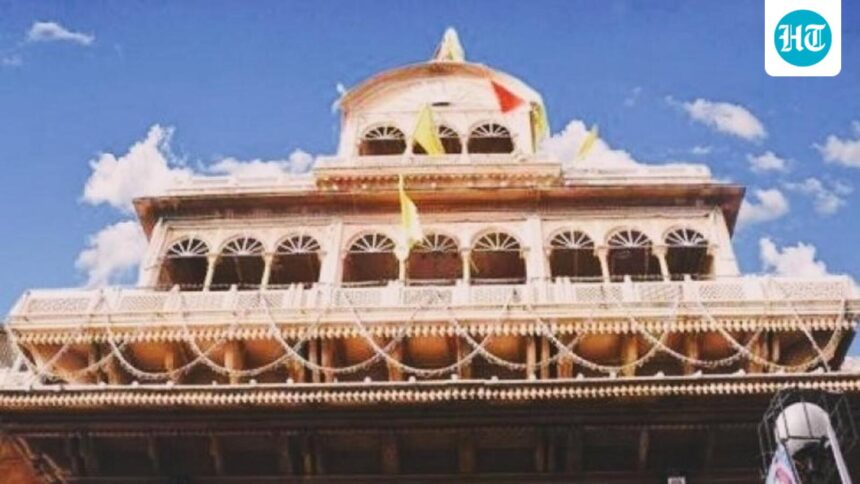
The Supreme Court-appointed committee (HPC) overseeing the management of Banke Bihari temple in Mathura has championed a series of sweeping reforms, led by the moratorium on VIP darshan vouchers and restructuring of temple timings, as necessary measures to ensure safety, fairness and orderly access for the growing number of devotees visiting the shrine.
In a detailed status report submitted before the Supreme Court, the committee maintained that the decision to scrap the VIP darshan system was taken unanimously and was aimed at ending preferential access that allowed a small number of people to bypass queues. The committee said the practice was incompatible with equitable access to the deity and should be removed as part of broader efforts to simplify crowd management and restore sanctity to the darshan process.
The report was recorded when the matter came up last week before a bench led by Chief Justice Surya Kant. Appearing before the committee, Additional Senior Solicitor General of Uttar Pradesh and Senior Counsel Sharan Dev Singh Thakur defended the reforms, asserting that they fall squarely within the mandate given by the Supreme Court. The case is scheduled to be heard on May 18.
Besides removing VIP access, the committee significantly revised the temple’s darshan schedule, advancing opening hours and expanding public access windows in summer and winter. The committee said that the previous appointments had become completely insufficient in the face of the “tremendous increase” in the number of attendees, which led to severe crowding and hardship for worshipers. The committee is headed by former Allahabad High Court judge Justice Ashok Kumar.
By expanding darshan hours and rationalizing the daily schedule of rituals, the committee sought to distribute crowds more evenly throughout the day while ensuring that essential religious practices continued without interruption. In response to allegations that these changes go against ancient traditions, the committee stressed that they were strictly limited to the administrative and secular aspects of temple management.
She stressed that there was “absolutely no interference” in religious rituals and ceremonies, and that all decisions were taken with the participation and, as far as possible, consensus of Goswami’s representatives who form part of the committee.
The report stresses that the reforms must be viewed in the context of growing safety concerns, especially after the 2022 temple stampede. It details how the committee provided specific entry and exit routes, explored live streaming of darshan to relieve physical congestion, and began structural assessments of the temple complex. It also formed a sub-committee to negotiate the purchase of land near the temple to facilitate long-term infrastructure development, a move the committee said was in line with the Supreme Court’s directions to plan comprehensive development of the shrine and its surrounding areas.
One of the most contentious issues raised by the petitioners relates to the alleged cessation of dehri pooja. The committee strongly refuted this in its interim report. The committee explained that the rituals did not stop, but were moved to a different area near the sanctuary so as not to impede the flow of worshipers. She noted that the previous practice led to dangerous overcrowding, with worshipers climbing over barriers and even carrying children over them to catch a glimpse of the deity. The committee said that regulating access to the platform in front of the sanctuary was merely a security measure and did not amount to limiting any basic religious practice.
The committee also discussed in detail all the objections raised by the petitioners against its work. On the issue of selecting Goswami’s representatives, she defended the process as transparent and inclusive, noting that public notice had been issued, applications were called for and all candidates, including those nominated at an earlier meeting, were given the opportunity to be heard before final appointments were made. She said that the previous meeting mentioned by the petitioners had no legal standing, because it was held before the Supreme Court, which formed the committee, and outside the framework that governs the administration of the temple.
On the challenge of revised darshan timings, the committee maintained that the changes were necessitated due to the massive increase in the number of devotees and were made within its express mandate to ensure effective crowd management. The concerns raised were then addressed by preparing a detailed schedule of rituals in consultation with Goswami’s representatives, thus ensuring that religious practices were compatible with the new timings, she added.
Likewise, the formation of a sub-committee to acquire lands near the temple has been defended as a move that follows directly from the Supreme Court directions. The panel includes government officials with expertise in land acquisition and members of the Goswami community, and has already made tangible progress in purchasing land to facilitate infrastructure expansion, the committee said.
On the issue of expenditure incurred from temple funds, the committee acknowledged that some interim expenses, including honoraria and operational costs, are being met from temple resources, but said a request has been made to the state government to shoulder this financial responsibility. She also clarified that government officials working on the committee continue to draw their salaries from the state and do not impose any additional burden on the temple funds.
Finally, the Commission opposed the broader petition filed by the petitioners seeking to restore the previous regime or hold elections under the 1939 Scheme of Administration, arguing that such relief would effectively override the Supreme Court’s August 8, 2025 order pursuant to which the present Commission was constituted.
The dispute over the management of the Banke Behari temple has been under judicial scrutiny for months, with the Supreme Court earlier indicating that reforms aimed at reducing preferential access and improving crowd management appear to be in the right direction. In February this year, the Allahabad High Court also upheld the committee’s decision to extend the darshan dates, stating that the aim was to reduce the hardship faced by pilgrims amid large crowds.