The fact that the BJP’s policies and broader worldview contradict the constitutional framework of the Indian republic is a charge often leveled by its rivals. Another example is that it constantly undermines institutional barriers to preserve the sanctity of democracy.

Opposition parties point to discrimination based on religion in the granting of retrospective citizenship rights through the Citizenship Amendment Act (CAA) as an example of the former. They claim that the Election Commission of India’s blatant targeting of West Bengal, and its Muslim-majority areas, to place millions of voters under a unique “inconsistency” rule under Special Intensive Review (SIR) that could disenfranchise them temporarily, even if not permanently, is evidence of what happened next.
While the government denies this, it usually resorts to pointing out that things were bad in the past as well. An emergency often comes.
The point, as much as political voices want people to do, is not to quibble. It’s to ask a bigger question. Is there something unique about the present moment?
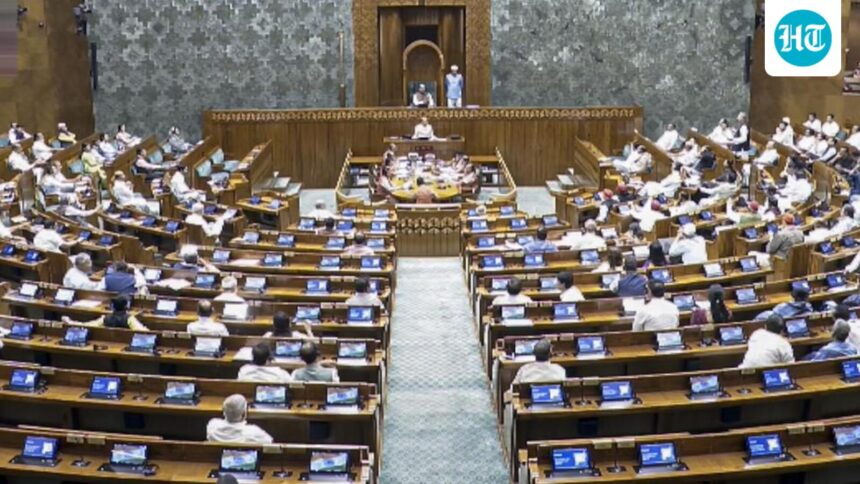
If one accepts the government’s assurance that the southern states will not lose their share of parliamentary seats, the only difference about the ongoing debate in Parliament is the restriction of women’s reservations through intra-state demarcation or gerrymandering. How does this relate to the question posed in the previous paragraph? Here is a reasonable explanation.
The BJP’s victory in 2014 under Narendra Modi was historic, not only in terms of the first non-Congress party to win a majority, but also in its ambitious nature. Modi’s 2014 campaign rhetoric was based on a non-zero-sum appeal, in which the nature of governance, rather than greater constraints on the political economy, was the sole reason India was unable to realize its economic potential.
By 2019, this novel had faced harsh weather. The BJP entered the Lok Sabha campaign with losses in Madhya Pradesh, Rajasthan and Chhattisgarh, and also registered a narrow victory in its largest stronghold, Gujarat. The headwinds were rooted primarily in the growing distress in the rural economy. The Modi government has learned the right lessons. It announced a retrospective cash transfer to farmers in the pre-election budget. Combined with tailwinds from the national security front, it all culminated in an even bigger victory than in 2014.
However, they were not so lucky in Modi’s second term on the external shock front. The once-in-a-century pandemic in 2020 and the war in Europe, after the worst of the pandemic was over, took their toll on the Indian economy. The government had to play its fiscal role ahead of time to avoid absolute destitution, and was in consolidation mode by the time the 2024 elections came. Because of its electoral victories in the state, the Modi government misread the underlying sentiment. It did not do anything special in the pre-election budget. The BJP fell below the halfway mark in the Lok Sabha and the Congress managed to reach almost triple digits.
Since 2024, all state elections have been based on a common feature – the give-and-take model of the electoral deal – along with other state-specific social and religious issues.
This creates a problem for the government before 2029. The nationwide fiscal burden as a result of this populist deal already threatens to overwhelm India’s debt management. It is unlikely that the Center will be able to afford something of this kind on an all-India basis in 2029.
On the other hand, economic conditions seem to be heading towards a perfect storm where everything from AI disruption, energy shocks and US behavior will be a constant stress test for the Indian economy, especially the most vulnerable parts.
The personal attribution of material benefits to voters – as we saw in the proliferation of Pradhan Mantri schemes that preceded it – was the proverbial oxygen in the current system. More and more important assignments are now being transferred to prime ministers. The central government faces the unenviable task of taking responsibility for bad things, such as the rise in fuel prices that are likely to follow the current election cycle.
What can the government do to shape the narrative before 2029 in such circumstances? Recent events, especially the ongoing legislative agenda, should be viewed against the backdrop of this larger question.
Read also: Terms of Trade: Realistic and Perceived India’s International Position
By postponing the generalization of women’s reservation to 2029, the government, especially the Prime Minister, hopes to compensate for the lack of material attribution with metaphysical attribution for women’s reservation. By hitting this bill with border demarcation (and the possibility of cheating) and leaving guarantees to keep the parliamentary share of the South’s share intact outside the text, the government hopes to make the introduction of women’s reservation not a partisan achievement, but a partisan achievement. The bills have been presented in such a way that they can be both opposed or supported.
This may be a cynical policy, but it is not the first time in India. Do you remember the Congress attacks on the communists during the first United Progressive Alliance? Where has Congress’ opposition to the Indo-US nuclear deal been portrayed as support for the BJP against Congress?
Regarding border demarcation, there is no reason to believe that cheating will not be attempted. The Assam Chief Minister’s statements during the state’s 2023 delimitation, the SIR experience in West Bengal etc. all add credence to these concerns, but again, this may not be the first gerrymandering in India.
While it is impossible to fully analyze the qualitative characteristics of electoral districts during previous delimitation processes – we do not have a breakdown of religious classes in electoral rolls – quantitative analysis does indicate that there are wide differences between electoral districts within states. Nor is demarcating borders the only trick to manipulate the majority system in a system of government divided along ethnic and class lines. Many caste-based coalitions have targeted similar goals in the past. The fragmented nature of our political system has left many governments in power with much lower vote shares than the BJP or many non-BJP governments in states today.
It must also be emphasized that some of the opposition’s attempts to counter the BJP’s political appeal depend not on political inclusivity, but on the revival of other fault lines.
What also explains the completely unjustified demands to reserve seats for OBCs or Muslim women while introducing reservation for women when there is no such provision for these communities as a whole. Claims about the government introducing reservation for women early before the caste census is conducted are equally false. The 2011 Census includes data on the population of SCs and SCs, the only social groups constitutionally entitled to reservations in the legislature.
What we have now in the name of the democratic debate in India are competing strategies for forming social alliances – some Hindu-Muslim, some upper-caste and lower-caste – with absolute agreement, at least on the side of intent, on economic strategy. The latter continues to increase the dose of economic painkillers for an economy mired in deep inequality and facing increasingly turbulent external conditions. Despite intentions, there are limits to which this economic palliative game can be played without compromising the financial standards of the economy and retaining the political financing services of big capital.
Read also: Terms of Trade: The Transatlantic Rip Through the Strait of Hormuz
E It is this growing imbalance between the need for and capacity for economic palliatives that has increased the temptation for the regime to attempt a maneuver to usurp metaphysical qualities (in women’s reticence) and improve social divisions in political support to exploit the first-past-the-post system to the maximum through possible manipulation in the name of border demarcation.
One could sound the alarm about the ongoing developments and call them the destruction of democracy. This writer sees it as a desperate attempt to confront the social against the economic in politics.
“The opinions expressed are personal.”