Logo text
[ThefollowingstorycontainsspoilersforSeason2oftheHBOMaxseries[ThefollowingstorycontainsspoilersfromtheseasontwofinaleofHBOMax’sthe house“9:00 p.m.”]
In the final hours of season two the houseviewers have gotten an increasing glimpse into Dr. Robbie’s (Noah Wyle) suicidal thoughts.
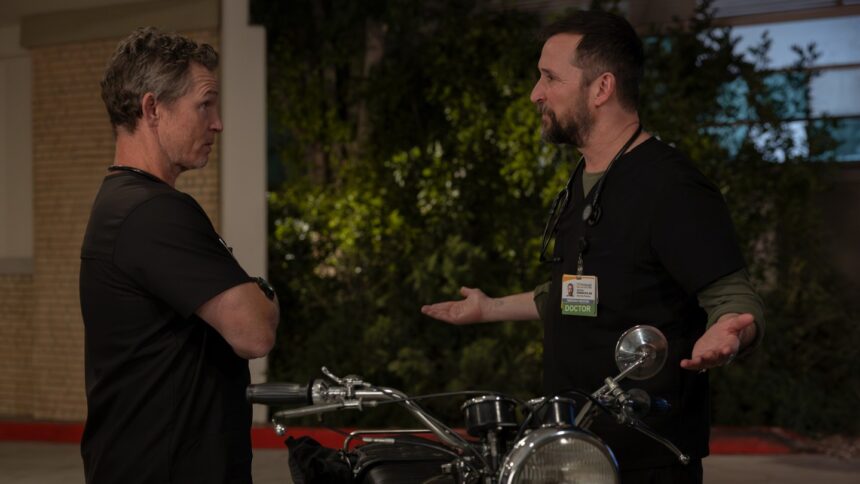
What starts as offhand comments and jokes leads him to confess first to his friend Duke (Jeff Kober) that he doesn’t know if he wants to “be here anymore,” and then to Dr. Abbott (Sean Hatosy) that even though the most important things he’s ever done in his life happened at this hospital, they’re “killing me.”
“I’ve seen so many people die that it feels like it’s seeping out of my soul,” Robbie says.
Although this mental health story may seem extreme, as R. Scott Gemmell, “It’s Real,” with the American College of Emergency Physicians reporting that approximately 300 to 400 doctors die annually by suicide, and the American Medical Association noting that “doctors are at greater risk for suicide and suicidal ideation than the general population.”
As Gemmell argues, after a season of Robbie rejecting traditional treatment for the problems he identified at the end of Season 1, the therapist’s story in Season 2, “shows what can happen if you don’t take the time to solve your mental health issues.”
“Robbie is someone who is very good at giving advice and very bad at taking it, and he wasn’t dealing with his own mental health issues,” Gemmell says. “As a result, things got worse and it got to a point where he was in a really bad state of mind and needed to take steps to get better, otherwise things would get worse and he could end up as a statistic.”
Although Roby had tense discussions with a number of colleagues in the final hours of his Fourth of July shift, it was Abbott who was finally able to engage him in a conversation about his mental health.
“Abbott is similar to Robbie. He was having some of the same suicidal thoughts,” Hatosy says of the night shift Robbie attended on the rooftop. the housePilot episode. “He’s also a character on the show who’s had to manage stress in the same way that Ruby did. They’re understaffed. There’s not enough funding to take care of everything that comes through the door, and that affects those attending positions. They’re very similar but very different at the same time in how they handle things. And Robbie respects Abbott.”
Although Abbott shares why he’s persevering despite losing his leg and his wife and advises Robbie to find a way to “dance in the dark,” Hatosy says all the interactions Robbie has at the end of his shift — chatting with Dr. Mohan (Supriya Ganesh) about her future, talking to Dana (Katherine LaNasa), and Langdon (Patrick Ball) insisting he needs help and saying he’s seen a lot of guys like Robbie in rehab — plus the couple’s experience with the procedure An emergency C-section and Robbie having a quiet moment with baby Jane Doe that will hopefully prevent him from one last dangerous motorcycle ride.
Hatosy reveals that he and Wyle talked extensively about their final scene together in Season 2.
“Coming into that final scene, we spent a lot of time with[[the house Executive Producer]John [Wells]“Who was directing, and Scott was just kind of figuring out exactly where the dynamic was,” Hatosy says. “And I thought it was really important to say that even though Abbott is under the impression that he also does work, his therapist-recommended hobby was golf but he quit working as a SWAT paramedic and got shot. So, again, very similar trajectories. It’s a death wish, something Abbott thinks he’s working on. Maybe instead of once a week, he should go twice a week until he figures it out. But at least he’s talking about it.”
Log in the houseAfter already ordering a third season, Gemmell is hopeful that Robbie will finally get some of the therapy he needs.
“We hope that Season 3 will be about his mental health journey and see him finally acknowledge the need for help and seek it and set himself as an example of what to do when one is struggling,” Gemmell says. “Unlike what we’ve seen the last couple of seasons, which is what you don’t have to do and shut down.”
Before his intimate exchange with Abbott, Langdon shared his perspective as someone who has been to rehab and is trying to deal with his own issues.
“Over the last 14 or 15 hours he has come to terms with the fact that the model that he has looked up to and modeled his life after for so long may not be the authentic example to follow that he may have previously assumed,” Paul says. Hollywood Reporter Which prompted him to exchange anger with his former teacher. “I think that’s why it was so damaging in Season 1, when that rift happened between Langdon and Ruby, there was an assumption like, ‘Look, man, I see you hurting.’ I see what you’re carrying. “I see that you’re hurting, and I see that you’re carrying this pain for the benefit of everyone around you, and I see the responsibility that you bear, and I feel like I can see you and understand you and support you in the way that you need.” And the more Langdon didn’t reciprocate that compassion, and the more his hurt was exposed, I think that was real abandonment. Langdon now had the privilege of sitting with himself for the past 10 months and getting help and cleaning up and having someone to talk to and the space to acknowledge what he felt that Robbie didn’t feel because he had to come to work every day. And I think Langdon is now able to come back to the door and say, ‘Man, you’ve got to stop because you’re not feeling well.’ And this whole ‘give up, don’t talk about it, don’t acknowledge anything that’s going on with you’ kind of thing that I’ve been emulating for a long time, has led me down a wrong path, and I think it’s leading you down a wrong path. I’ve talked to people who have been through what you’re going through, and they’re not uncommon, and they can be overcome, but it takes a willingness to stop and acknowledge them, instead Than just running and keeping running.
At the end of the final hour, viewers got the answer to another mystery from this season, as Ruby learned that new attendee Dr. Al Hashemi (Sepideh Mowafi) suffers from a seizure disorder, which Mowafi said she knew was part of her personality since the end of the audition process, with Gemmill confirming this when she appeared out of view while looking at baby Jane Doe at the end of the first episode of season two, and that she had done extensive research to try to understand.
“I talked to as many doctors as I could. I talked to epilepsy specialists. I talked to doctors with different disabilities and medical conditions and how they manage them,” Mowafi says. “I read a lot of testimonials from people with this condition, or people who have children with this condition.
She also watched footage of people having seizures that “manifested in a very similar way” and insisted that the show’s medical advisors told her if anything in her performance was inaccurate. At the end of the episode, after Ruby insists on Dr. Al-Hashemi to reveal her condition to the administration or else, viewers see her crying in her car, a moment that Maafi says reflects “the world is collapsing around her and the rug has been pulled from under her.” She revealed that the moment also showed another dimension to her personality.
“The car scene at the beginning had a little bit of dialogue where she gets in the car, and she’s about to drive, and she doesn’t,” Mowafi recalls. “She calls her ex-husband to watch her child overnight. Instead of going to pick up her child after work, she asks if he can watch her another night because she’s having car trouble, and her ex-husband says, ‘Yes, of course.’ Are you well? Do you need me to come get you?” And that’s when she’s holding back tears, and she’s trying to hide it and get off the phone with him as quickly as possible and then she’s completely exposed, because I think in that moment she’s used to hiding. She’s used to being isolated. What she wants more than anything is for someone to hold her and say, “Everything’s going to be okay.” She’s got this. She’s not going to lose everything. She’s just internalizing some kind of control in that moment and she can’t.
When she tells Robbie about her condition, after he’s already detected some strange behavior, she truly seeks out his medical expertise as someone she respects, Mowafi says. But the way he reacts destroys the level of trust you put in him, says M Well, this is something that will continue to influence their dynamic in the future.
“She sees that there is a generous, loving, wounded child inside of her, and there is a generous, wounded child inside of her,” Mowafi explains, “and so she takes that part of herself and reveals it to him, hoping to grow closer and find connection through their shared traumas, and it backfires.” “So I think she expected to find in him more of a colleague and friend, in revealing to herself, that he’s threatening her, and that obviously raises her trust issues. She can’t be restricted or excluded just because she has epilepsy, but she can be banned from practicing if she poses a direct threat to patients or herself, and that’s usually at the doctor’s own discretion. They’re the ones who decide if it’s safe, so Robbie comes in and threatens.” To her, this is the biggest betrayal because it is not his calling, and she has proven throughout her life and career that she prioritizes patient care, and it’s not about her ego. So she will handle this responsibly but he should try to report her – she doesn’t need to report herself. She got confirmation from her neurologist saying you’re fine, you just need double coverage, which is standard [the] er. It is unusual to have one coverage. So the way he’s looking at this is he’s taking everything personally and making it about himself and his sense of control and not treating her like a colleague or a professional, which is really unfair, which is ridiculous, and I think that’s obviously going to impact her trust issues moving forward and impact how she relates to him moving forward.
As for Langdon, although he has regained some confidence, particularly through the closed reduction of his spinal injury in the penultimate episode of the season, he is still on a longer journey to recovery that Paul says is “an act of daily maintenance.”
Paul says that after his first day back, he “seems fine,” noting that his character “hasn’t relapsed” but that “that possibility is always there.”
“There are things you can see throughout the season where you can understand that Langdon’s not fully reformed. There’s still some fear and resentment obviously like that conversation with Santos (Issa Briones), that conversation with Ruby, there’s still a sense of injustice and anger around that that hasn’t been fully addressed, and I think it’s going to take some time. There are little breadcrumbs throughout Season 2 that suggest Langdon is coming in and really trying to do his best. But that kind of complete reformation is a shield, and there’s probably still a lot of pain there.” And the bitterness behind it and I think there are still a lot of stories that can be told there.
Meanwhile, given the superficial elements of Season 3, Gemmell confirmed that the show is planning a roughly four-month hiatus until November partly so the hospital will have to deal with cold weather injuries.
“We wanted a shorter jump; there was less story between seasons,” Gemmell says. “We wanted to do cold weather because we didn’t do that. We had the summer, and we did it in September [in season one]And we thought it would be good to do cold weather and what that brings to the emergency room and so on. Emergency situations change seasonally.
It was recently announced that one person who will not be returning is Dr. Mohan who plays Ganesh, who will not be returning for story reasons as the series aims to reflect the reality of staff turnover in teaching hospitals.
While fans were upset by both departures, Gemmell continued to defend the show’s approach to making changes.
“I’m sure people will be disappointed because people will come and go, and that’s the reality of the medical world we’ve created,” Gemmell says. “I think one of the things it does is it takes away the false danger that a lot of shows can have. If you show someone who might not come back, some shows know they’re coming back and so you don’t really believe it, whereas I think here, people don’t come back sometimes, and that adds an authenticity to it and a realistic danger that I think the show benefits from. And I think the show also does something very good, in that it launches the actors’ careers as well. So I think that’s one of the good things as well, that people come to the show, and even if they don’t stay, I think the show is a good starting point for all What comes next.
Dr. Abbott will also miss Dr. Mohan, whom Hatosy asserts “definitely has feelings” for his co-worker, and with whom he had a number of memorable and friendly interactions. But Hatosi suspects they will find a way to stay in touch.
“She could go to Jupiter and he would find her,” he says. “They’ll laugh about some medical case study that no one knows where. Maybe they’ll send a GIF to each other and appreciate how amazing the doctors were who worked on it. It’s sad but I think that’s part of the job and people move on. And it’s part of television. Abbott will miss her.”
Abbott and Mohan are not the only ones house The duo that fans were hoping would have a romantic relationship. However, for this series, where each season takes place over the course of a single day, Gemmell points out that it can be difficult to show the characters’ personal lives.
“Our show never really leaves the ER, so we’re not going home with people,” he says. “We break point of view sometimes, but those are kind of quick little clips of life at the end of a shift. But anything we want to do has to be told, I think, within the confines of our sets, because that’s where the show lives and breathes it.”
Fans are also enjoying the relationship between Langdon and Mel Taylor Durden, which Paul says is similar to a brother-sister dynamic.
“I think there is a sense of sameness,” he says. “There’s a sense of identity that Langdon finds in Mel. Mel is her sister’s primary caretaker, and there’s an element of needing to be needed, and the disillusionment that comes when Mel realizes that Becca (Tal Anderson) is an individual who may not actually need her as much as previously assumed, and that Mel has been carving out an identity of being a provider. And I think that’s something that rings true for Langdon as well as a young husband and father. I think that shared experience of needing that neediness is something he sees in Mel and I also think that Mel is an outsider and doesn’t quite fit in with the kids. Others and I think that’s something that any addict knows there’s a sense of chronic isolation or separateness that any addict understands, and I think there’s just an acknowledgment.
While Mel may be struggling to fit in, she did have a bonding moment with Santos at the end of the Fourth of July shift as the two let their hair down and performed a karaoke version of Alanis Morissette’s “You Oughta Know” during the closing credits of season two.
“It seems like it would be fun to have a little Easter egg in the credits for fans who have dedicated all the time to the entire season and the entire episode,” Gemmell says. “Mel and Santos had such a difficult transition that they felt they needed to let off a little steam.”
Gemmill wrote of the moment he knew Briones could sing and with Dearden on board, he chose Morrissette (“something they could both mourn”) but gave them the option of replacing it with another song, but they kept it.
“They enthusiastically agreed,” Gemmell says. “It was one of the funniest little things I’ve done in a long time.” “It was a beautiful, motivating moment to launch into Season 3 with the hope that these people can survive, that they will do well, that they will thrive, and that we will come back.”