Logo text
One day, philosopher Biggie Smalls pondered the nature of dangerously escalating rivalries.
In a song of the same name, Biggie asked: “What’s beef?”
meat
Bottom line A bold, well-acted and slightly over-extended follow-up.
Broadcast date: Thursday, April 16 (Netflix)
ejaculate: Oscar Isaac, Carey Mulligan, Charles Melton, Cailee Spaeny, Yun Yuh-jung
creator: Lee Seung Jin
His answers included the straightforward “Beef is when you need two to go to sleep”, and the hilarious “Beef is when I see you, guaranteed to be in the ICU.”
Christopher Wallace died, likely a victim of the beef, long before the limited series came out, so Lee Seung-jin had a path of exploration for himself when he released the dark eight-episode comedy. meat back in 2023. The series, about the unexpected consequences sparked by a relatively minor case of road rage, dominated the Emmys and was eventually picked up for a second season, moving from limited series to anthology and rephrasing Biggie’s question as: “What is… meatOr in other words, what is it? meat Brand? And can Season 2, without the exceptional talents of Steven Yeun and Ali Wong, deliver story and themes in keeping with that brand, without distorting what was so deceptive about the original series and its tone?
The answer is mostly “yes.” Season two of meat The brilliance of the first film can’t be reproduced, but without many direct connections, this eight-episode story feels like a complete piece.
Once again, Gene has big ideas to play with and sharp aspects of contemporary American culture to pick apart, and once again, he has assembled an exceptional cast in service of a story that begins tightly boxed and spirals wildly and deliberately out of control.
It’s possible that Gene actually has a lot more on his mind this time around, layering the central conflict with generational, economic, and cultural divisions, alternately mocking and staring with startled horror at the modern condition in ways that don’t always add up. But if it’s the thing that keeps season two from… meat On par with its predecessor, it is overly ambitious, and I have no objection to that.
This time, our special characters – meat It has no traditional antagonists and protagonists, since its primary interest is that subtleties like situational morality and morality are an interchangeable construct—they are a pair of couples, separated by little more than a decade but in stature by a seemingly greater distance.
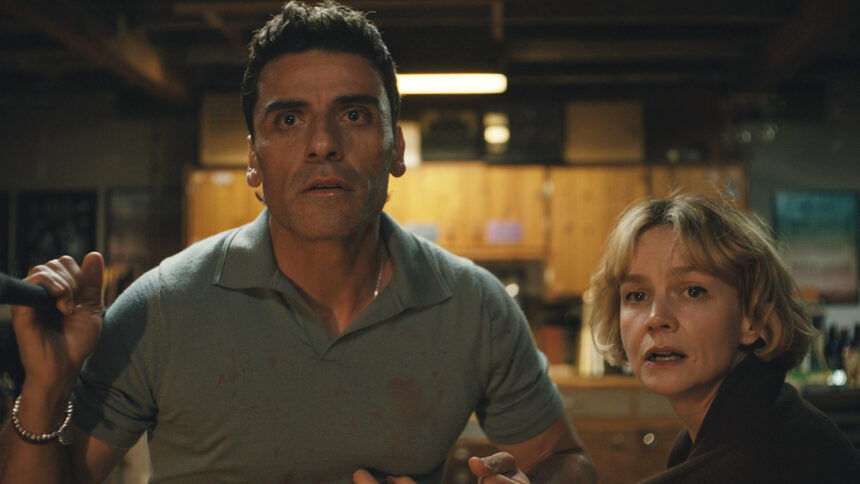
Josh (Oscar Isaac) is the general manager at Monte Vista Point Country Club near tony Montecito, north of Los Angeles. His job is to accommodate the club’s wealthy clientele, personified by Troy William Fichtner, a wealthy music industry mogul (or something like that). Josh is married to Lindsay (Carey Mulligan), an upper-class Brit who has all the signs of outward status that Josh lacks, but perhaps none of his talents or ambition. They’ve been talking for years about starting an upscale bed and breakfast, with no apparent progress, one of many factors adding to the volatility in their marriage.
On the other end of the volatility spectrum are newly engaged 20-somethings Austin (Charles Melton) and Ashley (Caille Spaeny), two of Josh’s henchmen at the club. Ashley is the drinks cart girl at the club’s golf course, while Austin works part-time as an instructor. Austin and Ashley don’t have a lot of money, but they are so in love that they never fight.
On the night of the club’s fundraiser, Josh forgets his wallet and Austin and Ashley are tasked with returning it, getting into the tail end of a heated argument between Josh and Lindsay – a fight that culminates in a violent climax that Ashley films on her phone. Ashley and Austin experience this explosion out of context, and the video depicts it with less context. But the younger pair see an opportunity for career advancement, to win a match they are convinced is rigged against them.
But in this struggle between the haves and the have-nots, are Josh and Lindsay really among the rich? Their situation is made precarious by the arrival of President Park (Yoon Yeoh-jung), a Korean billionaire and the new owner of the club. Park puts new pressure on Josh in part because of the pressure she herself feels in Seoul under circumstances involving her plastic surgeon husband (Song Kang-ho, wonderful if underutilized).
A cycle of blackmail, extortion and fraud soon begins, stemming from a desperate clinging to power and a potential lack of empathy on all fronts. At the same time, the lines between exploiter and exploited, powerful and powerless, hero and villain, blur in ways that are sometimes ironic, sometimes sad, and sometimes dramatic.
There’s a lot going on in Season 2 of meat. Although the number of episodes has increased from 10 to 8, the length of the episodes has increased from less than 40 minutes to as long as 54 minutes for the season 2 finale, which has a relatively epic scale but gets bogged down in at least three different monologues from characters telling viewers what the season is about.
Nevertheless meat Not exclusively a black comedy, its comedic beats thrive with a tougher pace and tighter focus. The two best episodes (directed by Jin and Kitao Sakurai) come midway through the season — a hilarious nightmare in a hospital emergency room and a differently funny nightmare of searching for a missing dachshund named Barbarian — and are the two shortest episodes of the season, devoted primarily to following just one of the couples on a single adventure. One takes a scathing look at the absurdities of the American health care industry, while the other reinforces themes of the season’s unbalanced nature. Both are fast-moving and dazzlingly silly.
These two notable episodes are also largely separated from the country club settlement, which often opens the door to slightly superficial jabs at the club’s vulgar members. They’re a perfectly worthy target, but one that invites inevitable comparisons White lotus (And it allows for some very strange and unexpected celebrities that I won’t spoil here.)
It is possible meat It is actually a parody White lotus Sometimes, especially with a younger couple—a high school dropout and a former Arizona State football star—Gen Zers who know the buzzwords of capitalist criticism (“It’s unfair. On a global level. There has to be a redistribution of wealth,” Austin declares, blankly) without any substance to back it up. They simply see an opportunity to grab the brass ring, and are willing to do whatever it takes to get what they think they deserve, until they discover the meaning of the phrase “whatever it takes.” Or maybe even find out what Reddit is telling them, because meat He’s particularly harsh toward the online proxies that fuel social relationships — the uncaring cam girls, the hollow DM flirtations, and the help forums that make matters worse.
As happened in the first season meat It is a machine driven by unintended consequences, some violent, some salacious, all designed to crush the souls of characters who may not have had souls to begin with.
Even more so than the first season, this round of meat It makes it difficult to root access for anyone. It felt like a real pendulum the first time between Danny (Yeun) and Amy (Wong), both of whom do the wrong things for seemingly justifiable reasons. Here, it’s a struggle between a flawed couple, easier to pity, if only because they don’t realize that there’s nothing the aristocracy wants more than for them to fight to the death rather than care about who actually has the power.
Performance-wise, I sided with the younger couple. I believed Riverdale Veteran Milton May December The performance was more exciting than the promise underscored by the talent, but there is evidence of comedic genius in how ridiculous he makes Austin. Spaeny’s Ashley is half Lady Macbeth, half innocent child, completely oblivious to how her ambitions are changing her and changing a relationship that seems nourishing as long as it relies on a shared appreciation for Hot Pockets. Back to righteousness YesilaI admire how Spaeny uses the height disparity with her leading men as a source of humor and sweetness.
Maybe the show sympathizes with Ashley and Austin because they don’t know any better. Lindsey and Josh have been together long enough to realize their shared toxicity, but they’re giddy when their new rivals give them new targets to their growing dismay. Mulligan offers a torn fragility, while Isaac turns Josh’s tolerant nature into a pathology, but both characters are filled with backstory details that… meat Leaves hanging. It’s a plot point that both couples are mixed race and rarely have to confront their differences, but the show works better with Austin confronting his Korean roots than it does with Josh’s Cuban background.
Yoon, whose presence reminds me that I’m still angry about Apple’s treatment of him Pachinkoshows kindness with a glint of malice, and I really hope the show gives us more of Yoon and Sung together. Several other characters on the Korean side of the story, who grow in importance towards the end, could have used more depth – including Seoyeon Jang’s highly competent translator Eunice and rapper BM’s Woosh, a tennis coach with aspirations of his own.
As was the case in the first season as well, the finale escalates into an action-packed place, with less emotional gravitas this time around. The closing punch isn’t that strong, but the show left me with a lot to think about and many details to enjoy, and I hope Lee Sung Jin gets a chance to show us what else. meat It could be.