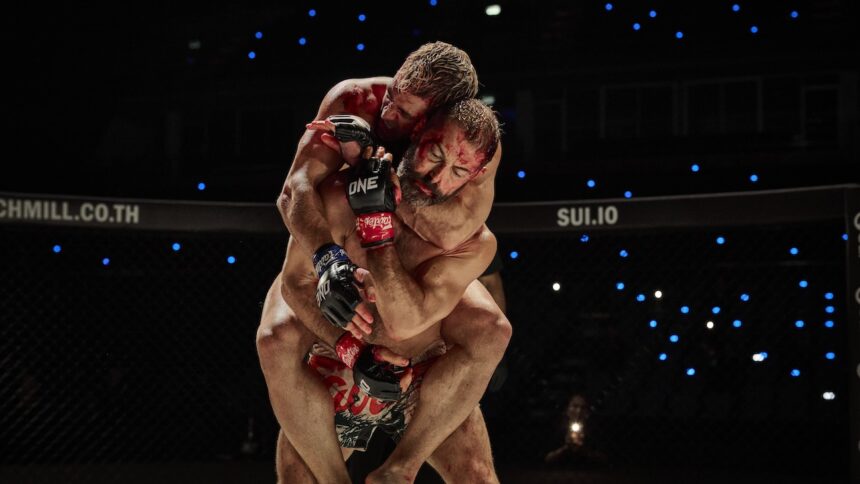
There’s a moment early A monster – A raw opening sequence that quickens the pulse as the film lights up the screen and tips its hat to what’s to come. Directed by Tyler Atkins, it is based on the career-making performance of Daniel Macpherson. A monster Plays like an MMA fight in Rocky-land.
For McPherson, the transformation into Patton James — the mixed martial arts fighter nicknamed “The Beast” — wasn’t just cosmetic.
“I don’t think anyone expected the guy who was used to hosting Dancing with the stars To play the role of an MMA fighter called “The Beast.” Hollywood Reporter With a smile that still held a hint of disbelief. “So I realized I had something to prove — perhaps to myself more than anyone else.”
McPherson not only trained for the role, he disappeared into it. Over the course of three years marked by funding interruptions and false starts, the actor used uncertainty to his advantage, building the fighter’s physical and psychological makeup piece by piece.
The preparation began simply enough: a phone call to former Cronulla Sharks captain-turned-boxer Paul Gallen. From there, McPherson worked with boxing coach Graham Shaw before branching out into Brazilian Jiu-Jitsu and Muay Thai, training each discipline individually before integrating them into a cohesive MMA skill set.
Then came Thailand.
Multiple stints in fight camps — where McPherson deliberately kept his acting career secret — pushed him into unfamiliar territory. “I never told anyone I was an actor,” he says. “I just wanted to be another guy in the gym.”
by the time A monster Finally, McPherson was greenlit, not only building the physique, but getting as close as possible to developing the muscle memory and mentality of a professional fighter. “We had a lot of false starts, and when it finally happened, it was like – this is it. We’re going to do everything we can.”
This commitment has come at a cost.
During the film’s climactic fight scene — which was shot over five punishing days — McPherson tore his adductor muscle, fractured his pelvis, and broke his nose. Production has not stopped.
“It was one of those situations where the make-up department was covering up my real injuries to add fake ones,” he laughs now. “You can’t fake this world. You have to put your body on the line. That’s what the sport requires.”
Director Tyler Atkins understood from the beginning that Beast needed a visual identity that would set it apart from previous genres. His solution came in the form of a four-minute opening scene, a brave act of filmmaking that reframes the narrative before it even begins.
Atkins took the original script and reimagined it, providing a bold and kinetic introduction for Russell Crowe, who also plays Patton’s coach, Sammy, and served as a major creative force behind the film.
Crowe didn’t hesitate and eventually received a writer’s credit on the screenplay alongside David Frigerio (Bad land, encryption).
This sequence—filmed during the first week of production—became the film’s selling calling card A monster internationally during the next 12 months. It’s also where the film’s tone takes shape: intimate, serious, and emotionally volatile.
Crowe’s presence looms large A monsternot only as a performer but as a collaborator. For Macpherson, the opportunity to confront Maximus himself was not lost.
“It elevates everything,” he says. “Every actor, every moment.”
What sets A monster Aside from the glut of combat sports films, there is his refusal to stay inside the cage.
Yes, the fight scenes are deep and grounded, but Atkins and McPherson are more interested in what’s happening outside the octagon — specifically, Patton James’ home life.
“The relationship with his family is the reason I decided to make the film,” McPherson says. “I’m a father. My son is turning 6. This idea of me being a provider, a protector, a role model — that’s what it’s all about.”
It feels like it reframes the stakes. in A monsterEvery punch thrown carries consequences beyond the scoreboard. Violence is never abstract; It’s connected to something deeply human.
McPherson continues: “If you don’t do it right, no one cares whether he wins or loses. But if those fights mean something outside the cage — that’s when it works.”
The film leans into that emotional terrain, drawing less comparison to traditional combat rocky And more character-driven dramas like Gladiator.
“I wanted to approach this in a more immersive way than anything I’ve done before,” McPherson adds. “This was about pushing my acting into new territory.”

A monster It is also a showcase for a new generation of Australian screen talent, most notably singer-songwriter Amy Shark, who made a stunning impression in her acting debut as Sammy’s daughter and successor, Rose.
“She came in and did one of the most aggressive auditions I’ve ever seen,” McPherson recalls. “She really wanted it. And it shows.”
On screen, Shark brings a raw, unpolished energy that complements the film’s aesthetic. It’s a performance that feels instinctive, and could mark the beginning of a parallel acting career.
“This won’t be the last time you see her on screen,” McPherson says.
Opposite him in the octagon is Brian Foster (Xavier Grau), a true martial artist and performer whose presence adds another layer of authenticity. For McPherson, working with Foster required a different kind of humility.
“This was his world,” he says. “I had to step into this without arrogance and learn.”
Like many independent films, A monster It endured a turbulent journey to production. Funding decreased several times. Industry strikes disrupted momentum. At some point, McPherson walked away completely, returning to the stage and touring a stage production of his play The woman in black.
The transformation couldn’t be more apparent.
“I went from 7% body fat and training three times a day to performing eight shows a week on stage,” he says. “When we finished, they told me I had ten weeks to get back to fighting fitness.”
He did it – again – losing 22 pounds in a matter of weeks, for the third time.
“It was brutal,” he admits. “But I felt like the movie reflected real life.”
with A monster As he prepares to introduce Macpherson to a global audience, the actor is already looking forward. The film represents a pivotal point not only in his career, but also in his ambitions.
“I’m in the movie now,” he says. “Producing, financing and developing my own projects. This is where I want to be.”
success A monster It’s already opening in the US, where McPherson plans to spend more time as his film career gains momentum.
“It feels like the beginning of something,” he says. “Let’s go make movies with friends.”
A monster It may arrive wearing the look of a fight movie, but underneath lies something far more reflective – an examination of masculinity, responsibility, and the cost of proving yourself.
For Daniel Macpherson, this is a reinvention. And for Australian cinema, it’s a reminder that sometimes the most powerful stories aren’t about winning the fight, they’re about why you got into the ring in the first place.