

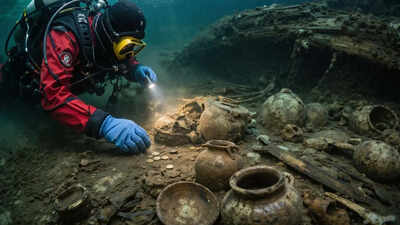
In a stunning archaeological discovery, more than 1,000 Roman artefacts have been discovered in Lake Neuchâtel in Switzerland, providing an insight into life during the time of the Roman Empire.
The artefacts were discovered underwater and are believed to form part of the cargo found on a ship that sank nearly two thousand years ago.According to the Octopus Foundation, which is leading the underwater excavation of the Eagle shipwreck in Lake Neuchâtel, these artifacts form part of the cargo of a Roman ship that has been preserved for centuries.The most surprising element of this discovery is the condition in which the artifacts survived.
Despite being submerged in water for hundreds of years, many artifacts have survived in excellent condition.
Lake Neuchâtel Roman shipwreck Discovery: where and how it was found
The discovery came when underwater archaeologists were searching the area located in Lake Neuchâtel, one of the largest lakes in Switzerland. At first, researchers thought the dark spot in the lake could be a shipwreck.After careful examination by diving into the water, they noticed some round objects that proved to be pottery pieces.
Later, archaeologists learned that the site contained the cargo of an ancient Roman ship, which existed between 20 and 50 AD.
Roman artefacts recovered from a Swiss lake: ceramics, swords, and tools
Excavations have produced a wide range of Roman artefacts, such as ceramics, plates, coins and weapons. Of particular note are the gladiators’ swords, daggers and military equipment, suggesting that the site may have been associated with Roman soldiers. Many ceramics were found in excellent condition, some containing food remains, and scientists are analyzing them.The variety of artefacts indicates deliberate packing of the ship’s cargo.
Roman Ship Shipping in Switzerland: Evidence of Commercial and Military Presence
According to archaeologists, the ship carried kitchen utensils and other necessities manufactured in Switzerland and was headed to a Roman military base. Given the weapons and military paraphernalia on board, there is also the possibility that the cargo was accompanied by a Roman legionnaire.
The size of the artifacts recovered indicates that the shipment may have been intended for a Roman force of about 6,000 soldiers.
2,000-year-old artifacts preserved underwater: why is the case exceptional?
The first striking feature of this find is the outstanding state of preservation of the artefacts. Thanks to the unusual environment of the lake, objects such as ceramics, baskets and other items have been preserved.For example, a complete wicker basket was found containing many ceramic objects.
This is a very rare phenomenon in archaeology that makes it possible to explore details regarding manufacturing, packaging and other aspects.
Why is the discovery of the Swiss lake important for Roman history?
This finding is extremely important because it gives us a rare insight into aspects of commerce, the military, and daily life simultaneously. It gives an idea of how goods were transported, as well as how rivers and water transport were used in Roman times. The presence of military and civilian artefacts together means that military affairs and trade go hand in hand.Furthermore, the fact that the wreck has not yet been discovered leaves much to explore.
What happens after 1,000 Roman artifacts are recovered?
The full collection of items found are now being cleaned and recovered, allowing scientists to analyze them thoroughly.Marks left on the items will be analysed, along with the materials used to make them and even any traces of food left on them. These items will be displayed in the largest archaeological museum in Switzerland.
A final look at the Roman objects found at Lake Suez
Finding more than 1,000 Roman artifacts in the waters of Lake Neuchâtel is more than just a treasure hunt; It is like the key that opens the doors of the past. It refers to the sophisticated organization of the Romans when it came to commercial and military matters thousands of years ago.Above all, these fossils indicate that stories, which could change everything we know about history, are still there to be told and discovered.