Redrawing LS sectors is a point of contention between the Modi government and the opposition. TN CM says women should be given quotas without tampering with the number of seats and their maps

A special session of Parliament has been called from April 16 to 18 to consider two proposed legislation, or bills, to amend the Constitution in order to expand the lower house of Parliament (Lok Sabha) from 543 to 816 seats, and reserve a third of these seats – 273 to be exact – for women.

But it comes with many caveats, one of which is the need to demarcate the boundaries of the electoral map in India. Simply redrawing the boundaries to form more Lok Sabha segments, and perhaps even assembly segments after that.
this The border demarcation plan has emerged as a major point of contention between Prime Minister Narendra Modi’s government and the opposition led by the Congress Party.
The government will need some help from the opposition Passing these bills, because constitutional amendments need a two-thirds majority, which the BJP-led NDA does not have.
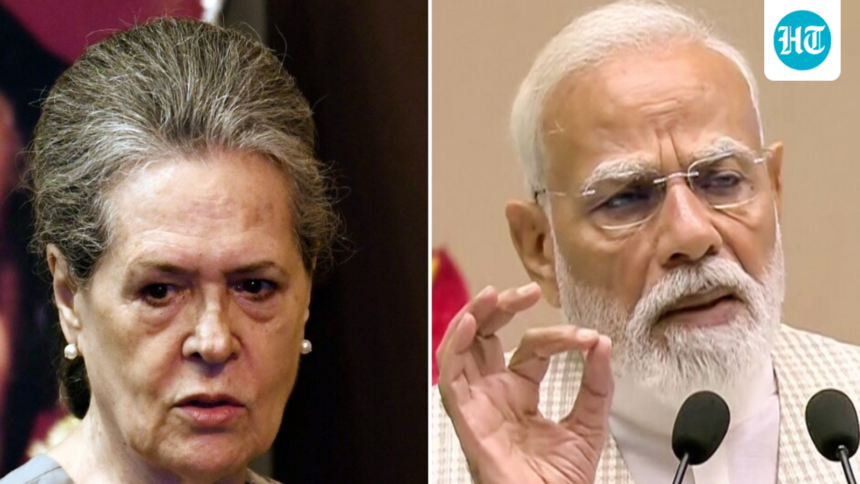
Prime Minister Narendra Modi says the changes fulfill a promise made by all parties together. But Congress leader Sonia Gandhi wrote that the real issue is not women’s reservations at all – which she says no one has a problem with – but the demarcation practice that comes with them.
The two positions were publicly decided within hours of each other on Monday, setting the battle lines ahead of the special session.
What the bills propose: Use the 2011 Census, not wait
Union government led by Modi Approval of submitting two draft laws during the special session.
The first is a constitutional amendment that requires a two-thirds majority in both houses of Parliament. The second concerns the demarcation or remapping of LS seats on the floor. Together, the bills seek to increase Lok Sabha seats by 50% – from 543 to 816 – with an additional 273 seats reserved for women.
It is important that this process be based on the 2011 Census, and not on the ongoing census that began this month and whose data will not be available for some time.
The previous amendment to the women’s quota, which was passed unanimously in 2023, had attached the implementation of the quota to the next population census, which has not yet been in full swing. This means that effective reservation will not be in effect for the 2029 Lok Sabha elections. Because first A population census must be conducted, and then borders can be demarcated, which is a long process.
Now, it is proposed to establish a delimitation commission to redraw electoral district boundaries before the 2029 general election, using the 2011 census rather than waiting for the last election.
Modi: The opposition demanded 2029 and we achieved that
Speaking on Monday, Prime Minister Modi claimed that this particular move will achieve what all parties want. He noted that in 2023, when the original Women’s Reservation Bill was passed, all parties said it should be implemented by 2029.
“No one wanted to pass the bill and not implement it, especially our opposition leaders,” he said. “They were very vocal in emphasizing that it should be implemented in 2029. With this timeline in mind, the government decided to take what the opposition said seriously.”

Modi described the upcoming special sessions of Parliament as a historic moment and urged all parties to pass the amendments unanimously.
“I am sure that once it was passed Parliament’s pride rose [in 2023]“This time too, through the collective efforts of everyone, the dignity of Parliament will reach new heights,” he added.
Sonia Gandhi writes about the ‘real issue’
However, Sonia Gandhi, head of the Congress parliamentary party, made a sharp distinction between the women’s quota and the accompanying demarcation process.
“Reservation for women is not the issue here,” she wrote in a magazine article. “That has already been settled. The real issue is the demarcation of borders, which is very dangerous, based on unofficially available information, and an attack on the Constitution itself.” Hindu.
Any demarcation exercise should be just that, she said It is preceded by a new census, as has been the custom historically.
You have clearly raised the issue of states’ shares in the Lok Sabha. She said any demarcation should not put small states and states that have pioneered family planning – such as most south Indian states such as Tamil Nadu and Kerala – “at an absolute or relative disadvantage”.
Even a proportional increase in seats could hurt such states, she said, because “the difference in absolute numbers will be magnified.”
The BJP said the fixed 50% increase does not disturb the proportional shares of states in Parliament.
Sonia also questioned the timing of the government’s change of position from 2023. “Why did it take Prime Minister Narendra Modi 30 months to back down?” she asked. she asked, noting that the special session was called to manage “political discourses” amid assembly elections in Tamil Nadu, Kerala, West Bengal, Assam and Puducherry.
She accused the government of “being in too much of a rush to bring about very far-reaching changes in our political system.”
Congress leader Mallikarjun Kharge also wrote to the Prime Minister on Monday questioning the timing. He said that the government was seeking the cooperation of the opposition without providing sufficient details.
The South is concerned: They gave quotas, but why demarcate the borders?
Tamil Nadu Chief Minister and MK Stalin accused the government of deliberately mixing the two issues – reservation and redrawing of boundaries of LS seats.
He demanded that reservation for women be implemented immediately, without setting new limits or changing the number of Lok Sabha seats.
“The Union government is not interested in implementing reservations for women. If their concerns were real, they could have done it immediately. Instead of doing so, the BJP-led Center is thinking of using it as a weapon to tackle dissent and undertake population-based delimitation,” he said in an interview over the weekend with news agency PTI.
How to increase seats
The demarcation part of the government’s plan carries significant implications for the federal balance in Parliament.
Under the proposed flat increase of 50%, states like Uttar Pradesh would rise from 80 Lok Sabha seats to 120; Bihar from 40 to 60. These are the Hindi belt states where the BJP is strong.
In the south, where the BJP mostly struggles, Tamil Nadu will rise from 39 to almost 59, and Kerala from 20 to 30.
The government’s position is that since each state’s seats increase in the same proportion, no state’s share in Parliament will change.
The five southern states have – Tamil Nadu, Kerala, Karnataka, Andhra Pradesh and Telangana – combined 23.8% of the current 543-seat Assembly. After the expansion, they will own 23.9% of the 816-seat house. Hardly a change.
However, Gandhi and many prime ministers argue that the proportional quota does not represent the whole picture.
The absolute gap in seat numbers between the northern Indian belt states and the southern states will widen – with the north collectively getting 88 seats and the south 66, according to basic calculations.
This would make it more difficult for smaller blocs to build coalitions to block constitutional amendments or resist changes, for example, in tax-sharing arrangements between countries.
Parliamentary accounts
There are three basic levels of majority for legal changes in India.
An ordinary bill requires a simple majority.
The constitutional amendment under Article 368 requires a special majority, that is, two-thirds of the members present and voting. This is the highest hurdle these bills face.
The Lok Sabha has 543 members. A simple majority means 272. A special majority, two-thirds of the members present and voting, means 362.
The current Constitutional Amendment Bill requires a special majority to change Articles 81 (composition of Lok Sabha), 82 (delimitation), 330 (SC/ST reservations) and 334A (women’s reservation).
The NDA has nearly 293 seats in the Lok Sabha, which is comfortably more than 272 seats but less than 362 seats. In the Rajya Sabha, the NDA has a similar status – a majority but not a two-thirds majority on its own.
The government needs between 60 and 70 additional Lok Sabha votes from outside the NDA to cross the two-thirds barrier, depending on attendance on voting day. It is the regional parties – the Bharatiya Janata Party, the YSR Congress, and others that are not members of the NDA or the All India Bloc – that the swing votes are being drawn to.
The second draft law, related to the formation of a new border demarcation committee, is ordinary legislation and only requires a simple majority that the National Democratic Rally can manage.
The third category, which is a higher category of bills, requires a special majority plus Ratification by at least half of the state legislatures. This applies to provisions that directly affect the federal structure, such as the division of powers between the center and the states, or the election of the president.
None of them require ratification by the state legislature. So, despite the practice’s massive federal consequences – something that angers the South – state legislatures do not have formal veto power. They cannot block these bills. They can only exert political pressure.

Arish Chhabra is an associate editor on the Hindustan Times online team, where he writes news reports and explanatory features, as well as overseeing the site’s coverage. His career spans nearly two decades across India’s most respected newsrooms in print, digital and broadcast. He has reported, written, and edited across formats—from breaking news and live election coverage, to analytical long-reads and cultural commentary—building a body of work that reflects editorial rigor and a deep curiosity about the community for which he writes. Areesh studied English Literature, Sociology and History along with Journalism at Punjab University in Chandigarh, and began his career in that city, eventually moving to Delhi. He is also the author of Little Big City: What Life is Like from Chandigarh, a collection of critical essays originally published as a weekly column in the Hindustan Times, which examines the culture and politics of a city that is much more than just its famous architecture – and in doing so, holds up a mirror to modern India. During his stints at BBC, The Indian Express, NDTV and Jagran New Media, he has worked across formats and languages; Mainly English, as well as Hindi and Punjabi. He was part of the crack team for the BBC Explainer project which was replicated around the world by the broadcaster. At Jagran, he developed editorial guides and trained journalists on integrity and quality content. He has also worked at the intersection of journalism and education. At the Indian School of Business (ISB) in Hyderabad, he developed a website to streamline academic research in management. At Bennett University’s Times School of Media in Noida, he teaches students the craft of digital journalism: from newsgathering and writing, to social media strategy and video storytelling. Having moved from small town to larger city to megalopolis for education and work, his intellectual passions lie at the intersection of society, politics, and popular culture—a perspective that guides his writing and worldview. When he’s not working, he’s constantly reading long-form journalism or watching cerebral content, sometimes both at the same time.Read more