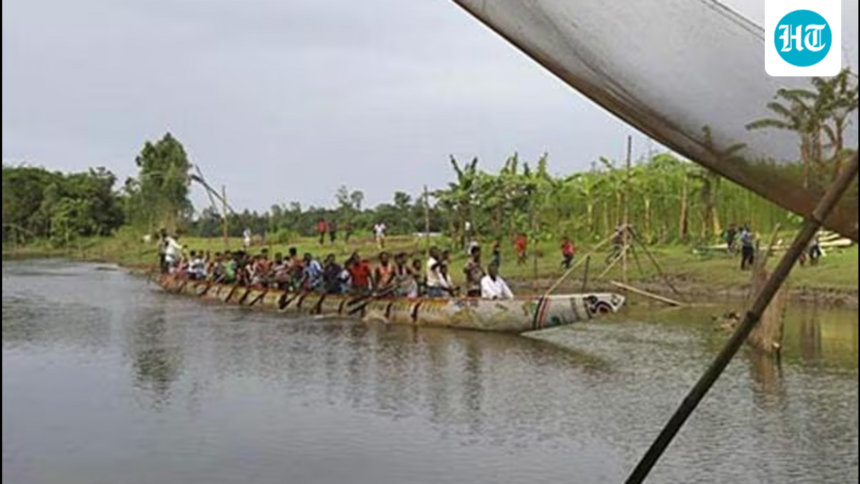
Binimadab Barman, 60, a resident of Dakshin Masaldanga in Cooch Behar, West Bengal, was among those who obtained Indian citizenship when India and Bangladesh ended a decades-long border dispute and exchanged 162 landlocked islands (enclaves) in 2015. With that citizenship came the right to vote in the world’s largest democracy.

More than a decade later, Barman is among those staring at an uncertain future once again. They lost their voting rights as their names were struck from the electoral roll as part of the Special Intensive Review (SIR).
“We are a family of four. Me, my wife and our two children. All our names were under adjudication. My name was deleted. My wife and children passed the SIR test and were registered in the voter list,” Barman said.
Dakshin Masaldanga village in Parma was among 51 former Bangladeshi enclaves transferred to India in July 2015, in accordance with the 1974 Land Boundary Agreement (LBA) and the 2011 Protocol. All 14,864 residents of the former Bangladeshi enclaves in India have opted for Indian citizenship. As many as 989 people out of 38,521 residents of the former Indian enclaves in Bangladesh have chosen to retain their original citizenship.
In December 2015, the government informed Parliament that all those who chose to obtain Indian citizenship had obtained it. She added that the process of including all 14,864 residents of the erstwhile 51 Bangladeshi enclaves in the National Population Register was completed in October 2015, and the process of issuing Aadhar cards and ration cards had begun.
Barman said he was asked to move the appeals court. “I applied online from the nearest computer store [cyber café]. “There, I learned that the names of many others, who were on trial, had also been deleted,” Berman said.
Kabir Uddin Sheikh, 30, a Machaldanga resident who runs an internet café and sells seeds and fertilisers, said the names of four of his family members were under adjudication, and all of them had been acquitted. “The name of my sister, who lives with her husband in another village, has been deleted.”
Usman Jani Sheikh, a resident of Dakshin Masaldanga, said that he and his four family members were included in the electoral list, while his cousin, mother, grandmother and aunt were sent to adjudicate the matter. “After the verdict, while my cousin’s name was cleared, other names were deleted. We have submitted the documents, including Aadhaar card and voter ID number, before the court.”
Of the 1,191 registered voters at the polling booth at Dakshin Machaldanga community hall of Dinhata Assembly constituency, as many as 630 names were under adjudication. About 200 voters out of 1,158 registered at the Gauchulka Basic Middle School polling station were also on trial.
An official said that those who were dropped from the voter list after the matter was decided should move to the courts of appeal. “We have received numerous appeals from deleted voters, both online and offline. It is not possible to determine the number of former residents of the enclave.”
Of the 15,000 or so former residents of the enclave, there were about 12,800 voters in 2015, said Diptiman Sengupta, chairman of the Bangladesh Bharat Exchange Coordination Committee. “The number has now risen to about 13,500-14,000. More than 8,000 names have gone on trial. About 360-370 names have been deleted. The rest have been deleted. Those on the voter list, We provide all kinds of support to these deleted voters so that they can appeal to the courts.
The former residents of the enclave are spread across six constituencies in the Cooch Behar region – Dinhata, Sitalkochi, Mekhiliganj, Setai, Natabari and Mathabanga. About 50% of its population is concentrated in Dinhatta. Former enclave residents are one of the deciding factors in getting two seats.
Ajay Roy, BJP’s Dinhata candidate, claimed that several thousand more Bangladeshis had crossed into India illegally and settled in border towns and villages, apart from about 15,000 who took Indian citizenship in 2015. “The SIR will also expel them. They will have to leave India the same way they entered the country, crawling under barbed wire along the international border,” he said.
In 2021, the BJP won seven of the nine assembly constituencies in Cooch Behar. TMC got two. The ruling Trinamool Congress (TMC) party’s Udayan Guha won the Dinhata seat after it was vacated by former Union minister Nisith Pramanik. In the 2024 Lok Sabha polls, the TMC is ahead of the BJP in five seats, including Dinhata and Sitalkuchi.
Rafiqul Shaikh, another former resident of Patrigash enclave whose name has been deleted, said there were a lot of concerns about the Citizenship (Amendment) Act and the National Register of Citizens in 2024. “Maybe this was going against the BJP. The SIR had a huge impact as many people were being prosecuted.”
TMC leader Partha Bhowmik said those who obtained citizenship in 2015 have been put under the judiciary and criticized the Election Commission of India, accusing it of being an agent of the BJP and not adhering to the Constitution.