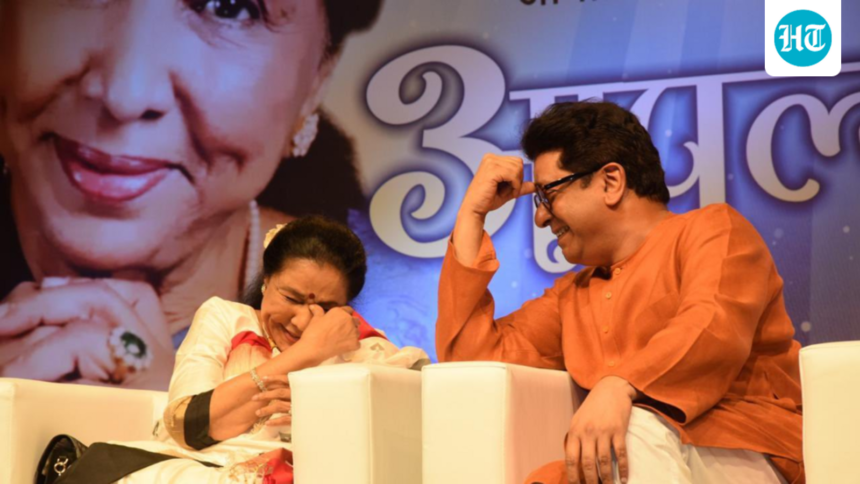
Veteran singer Ashatay Bhosle has passed away. In a few speeches I gave, and in a conversation I had with her later, I said “Lata (Mangeshkar) Didi and you are the Leonardo da Vinci and Michelangelo of Indian film music.”

When you look at the works of Leonardo da Vinci, you always feel a sense of perfection, precise precision, an incredible sense of stillness, and an almost immediate spiritual experience. All of this is felt in Diddy’s vocals, where everything sounds so perfect, so perfect.
On the other hand, Michelangelo’s work carries grace, intensity, playfulness and even rebellion. At times, his sculptures seem eager to break free from the stone. The same can be said about Achatai’s songs. In her singing there is longing, joy, boldness, and that innate human recklessness; The desire to leave everything behind. It all resonates through her voice.
These days, a lot of people call themselves artists, then “veteran artists,” and say things like “Singing is my passion” or “Acting is my passion.” But fate had never given Achatay the luxury of saying such things. At the age of fifteen, she had to get back on her feet and support her family, armed with nothing but the natural talent of her voice. With this capital, I started singing. At such a young age, she endured tremendous personal hardships. However, instead of letting grief consume her, she overcame it, and the courage that had shaped her life found its way into her voice.
As I mentioned earlier, Lata Didi’s voice embodies perfection and exquisite composure. In the emotionally charged atmosphere after India gained independence, her voice sounded like the voice of that era. At such times, in order to form one’s identity and wait patiently for songs that suit one’s expression, only she knows how much patience to have.
In ‘Piya Tu Ab To Aaja’, there is a bold and direct call to the lover. In ‘Aaiye Meherbaan’ there is charm and playfulness. In ‘Dil Cheez Kya Hai Aap Meri Jaan Lijiye’, there is elegance and delicacy. In “Dum Maro Dum”, there is rebellion and a strong desire to break all boundaries. And the same achatai, in Marathi devotional music, sings “Mage Ubha Mangesh, Pudhe Ubha Mangesh,” expressing a deep longing for Lord Shiva, the eternal symbol of separation, who pervades the universe and watches over everything.
At almost every stage of her personal life, she has faced storms. However, she never broke down, never turned her pain into a weapon, and never allowed bitterness to take root. It was as if she had mastered the art of dealing with grief. That’s why Didi (Lata Mangeshkar) has always felt divine, while Ashtay has always felt deeply human.
Just as I had the honor of being with Didi, I was also fortunate to be with Aşatay. I consider myself fortunate to have witnessed the presence of these two sisters, who have shaped the emotional landscape of this country for decades. For me, it’s not enough to see Achatay as just a veteran singer, as her journey through music has been extraordinary. It will stay with us forever, and new layers will be revealed over time.
I have said in my speeches: “If Lata Didi, Achatai, and artists like them had not existed, and if they had not immersed us in their emotional world, this country might have descended into chaos. They have given us a standard of true greatness and where to look for it.”
Just as Leonardo da Vinci and Michelangelo shaped the European Renaissance in their own distinctive, despite their apparent contradiction, so Lata Didi and Achatai shaped the Renaissance of Indian film music. A few years ago, Dede died, and today Achatay is gone. And with her passed away the last pillars of the musical renaissance in India.
(Translated from Thackeray’s post in Marathi on X)