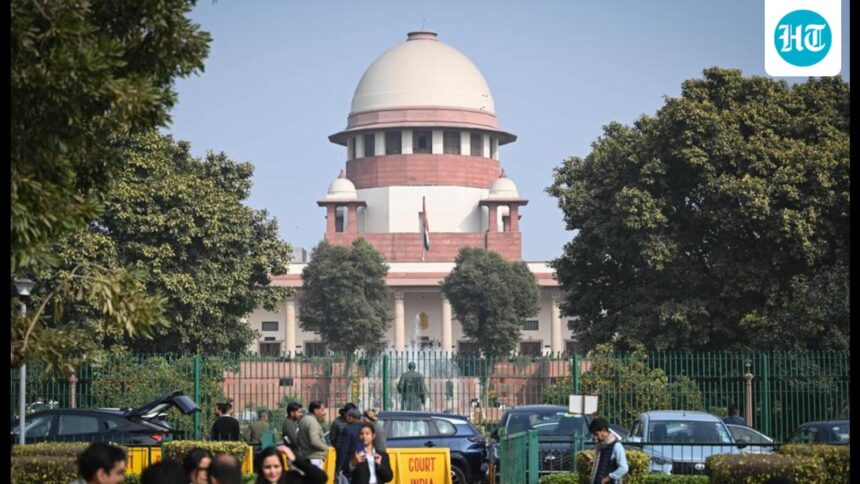
The Supreme Court has issued a stark reminder that patriarchal control over women’s lives persists, often invisibly, but on a massive scale, even as India enacts laws and delivers a series of progressive rulings aimed at securing gender equality.

A bench of Justices Sanjay Karol and N Koteswar Singh said that despite constitutional guarantees and ongoing institutional efforts, “patriarchy continues to permeate everyday life,” raising a disturbing question for society as a whole: Why do women’s bodies, choices and lives continue to be so deeply controlled?
The court made these observations while confirming the life imprisonment sentence for a man convicted of killing his wife in Rajasthan in 2011 by setting her on fire. She said the incident had its roots in domestic violence and reflects the ongoing threat of dowry-related violence.
By placing the case within a broader social context, the court noted that India, even more than seven decades after independence, continues to grapple with the gap between constitutional ideals and lived reality.
“The Constitution promises equality, non-discrimination on the grounds of sex, and the right to life and liberty… However, cases like this prove that even after so many years, rights… remain out of reach for many,” the court said in its April 4 ruling.
It underscored the recurring judicial concern that legal reform, no matter how broad, was insufficient to dismantle the entrenched social hierarchies governing gender relations.
The bench traced the path of legislative and judicial interventions aimed at improving the status of women, from the Dowry Prohibition Act of 1961, to protection from domestic violence and harassment in the workplace. He pointed to a series of landmark rulings that expanded women’s rights in various fields, from the abolition of instant triple talaq and the adultery law to the recognition of women’s equal rights in the armed forces and in inheritance.
However, the court noted that these efforts have not fully translated into real equality on the ground. “Despite this ongoing interference from various branches of government, the empirical data shows that all is not well. It presents a realistic picture indeed,” the ruling said.
Supporting its concerns with data, the court pointed to the extent of violence women continue to face. She pointed out that more than 448,000 crimes against women were recorded in 2023, while dowry-related violence still claims the lives of more than 6,000 people annually, describing these numbers as a reflection of “the continuation of practices that have been prohibited for a long time.”
Domestic violence complaints also remain among the most common grievances reported to statutory bodies, highlighting women’s continued vulnerability within the home, ironically the place that is supposedly the safest.
The council described it as a “paradox” that visible progress coexists with deep-rooted inequality. India has seen rising literacy rates, economic growth, and increased participation of women in education and the workforce. Gender roles, especially in urban areas, are evolving. But the court said that in large parts of the country, especially rural and semi-urban areas, patriarchy remains ingrained in everyday life.
“Power within the family remains overwhelmingly male, and women’s autonomy is often conditional and restricted,” the jury noted, adding that even working women still bear disproportionate domestic burdens.
The court rejected the trend that views extreme acts of violence against women as isolated incidents. Instead, these crimes were described as a manifestation of a deeper structural problem. “Practices such as domestic violence or even extreme acts such as burning one’s wife… persist not as aberrations, but as indicators of a diseased social order,” the ruling said.
Perhaps the most powerful part of the judgment lies in its concluding reflection. “After decades of laws, schemes and reforms… why does the control of women’s bodies, their choices and their lives still persist so deeply within society?” The court asked. She said the answer may ultimately lie not in laws or courtrooms, but in “we the people of India.”