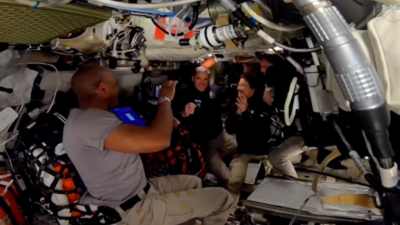
Since time immemorial, space exploration has been synonymous with great magic, and has attracted many people. But being out there in space isn’t like magic. Through NASA’s Artemis program, astronauts flew to the moon aboard the Orion spacecraft that was specifically designed to serve as a home and workplace in space.
Contrary to what is commonly observed in films, the Orion crew has a limited living space designed to ensure effective survival in the harsh conditions of deep space. Within this unit, astronauts spend their time eating, sleeping, working, and performing various mission-related tasks, as they travel millions of kilometers away from Earth.
Inside the Orion crew module on Artemis II: The astronauts’ living space
A comprehensive overview of the Orion spacecraft’s interiors prepared by the Canadian Space Agency reveals that the most important element inside the Orion spacecraft is the crew module, which is the only cabin occupied by the crew throughout the mission.
According to NASA, it is “the pressurized portion of the Orion spacecraft… where the crew will live and work on their journey to the Moon and back.”The Orion capsule itself is rather small and occupies an internal volume of 330 cubic feet, compared to the space provided by two small cars. However, it is ingeniously designed to carry up to four crew members for long periods of up to 21 days.The interior of the Orion crew module allows astronauts to be strapped into specially designed seats at launch and landing.
Once they reach orbit, some of these seats can be moved out of the way to create additional space in the cabin.
Living conditions in Orion: sleeping, eating and working
Space life aboard Orion can be described as space camping. There are no private cabins, just one place where astronauts spend their time for everything from sleeping to working.Sleeping accommodations are also primitive. Astronauts sleep in sleeping bags attached to walls or another surface so they stay in place while they sleep. Even details such as sleeping bags and window shades for the sleeping area were developed by specialists in accordance with the requirements of NASA engineers.The food is packaged and heated before the crew eats it. There is also a sanitary cabin on board including a private toilet. Exercise equipment is also available to keep you fit in a microgravity environment.All work in this capsule is done with the help of the most advanced digital interfaces. There are screens that display information about everything around them and provide the opportunity to carry out work efficiently.
Life support and safety aspects in deep space
However, one feature stands out as important when considering the experience of living inside Orion: the spacecraft’s onboard life support systems.
The air pressure, humidity, oxygen, temperature and carbon dioxide in the spacecraft are carefully regulated.Furthermore, apart from making conditions as comfortable as possible inside the spacecraft, safety concerns were also of paramount importance. The capsule is designed to provide adequate protection against micrometeorites and the inherent radiation hazards of outer space. If necessary, astronauts can take shelter inside on-board storage facilities in the event of a solar storm.Finally, all the essentials such as water, power and oxygen needed to survive and operate aboard Orion come directly from the European Service Module attached to the underside of the crew module.