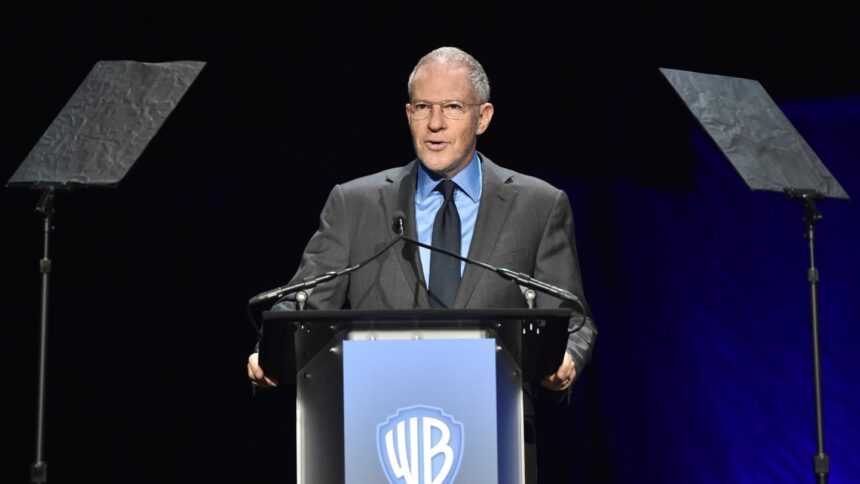
After leaving the movie studio head position, the next era for some executives could be the wilderness. As for Toby Emmerich, a veteran Warner Bros. executive, And New Line, which has nurtured billion-dollar revenues such as The hobbit Triple and green-lit BarbieHis exit in 2022 came during another studio sale with a soft landing. On his way out, he got a deal from Warner Bros. David Zaslav’s Discovery has a five-year arrangement to finance his own shingle, Fireside, and is producing a biopic about a young Sylvester Stallone from Amazon MGM. I play Rockyamong other features.
His next bet? Expanding its banner to include television development — with financial backing from Warner Music billionaire Len Bravatnik’s Access investment vehicle — and an additional partner in veteran producer Amanda Krentzman. The CEO notes, frankly, that it’s not a seller’s market for shingles in development, but he sees an opportunity as big studios retreat from the era of rich package deals. Emmerich spoke with Hollywood Reporter On his plans and the industrial scene.
You’ve spent your career focused on film development, and currently have a first-look film deal at Warner Bros. Pictures. Now that you’re stepping out as studio head, what’s the solution to expanding your banner to television?
I think some of the best stories happening on the planet right now are happening on television. And the talent that creates those stories, the storytellers, is not necessarily, as far as I can see, discriminating against film or television. They are happy to work in both mediums. So, as a producer, your job is to find talented people, hold on to them and not let them go. If they’re going to TV, you have to go there with them.
What’s behind your company name, Fireside?
The theory is that storytelling began in caves with the invention of fire, and you had to wait for the meat to cook. And while the meat was cooking, you’d tell each other stories about hunting or something, and maybe you’d paint paintings of them on the wall that looked like moving pictures in the flickering firelight, but the idea that there was something so primal that humans needed to tell and tell stories to each other.
How did you connect with Len Blavatnik’s team and what was his investment firm Access interested in?
I have known Len for 25 years and have always been interested in doing something with him. He’s also a lover of storytelling and I think he has distinct tastes. I knew Danny [Cohen, formerly of the BBC, who now leads Blavatnik’s Access Entertainment] Since he worked with Lin and came close to landing a few projects with them over the years, but nothing got 100 percent there. Since I was full-time in television and Lane had already worked with Danny, the idea of being able to partner with them to try to find projects to do together was very attractive, to me at least.
Part of the pitch that’s being made is that studios pull back on TV development funding, so they can help fill that gap. Can you break that down more on the landscape now?
It seems to be a strong buyer’s market right now for TV writers, and many writers who used to have overall deals where they were getting paid by studios to develop material are losing those deals. And so there’s an opportunity, it seems, to work with writers like that in a modest way to maybe develop some things to the point where studios become interested in grabbing them.
When you say lost, do you mean that there are fewer signings or fewer renewals of deals?
I think a little bit of both.
Writers make rich deals only to find that the market is less booming than it was a few years ago.
I think so, unlike the more proven and in-demand models.
At what stage of the development process are you looking to support projects?
It really depends on the project. I would say the point at which you can attract the right partner.
There has been an uptick in the number of TV pilots greenlit this season after a long downward trend. What do you think of the mini-renaissance?
It is a pendulum with ebb and flow. It’s a good sign, but it doesn’t mean we’re returning to the heyday of what they used to call “Peak TV.”
You’re relying on the Warner Bros. group, where there’s a lot of talk about there not being enough Hollywood business in Los Angeles. What do you think of “Stay in Los Angeles” and other red tape-cutting efforts to keep production local?
Warner’s collection seems mysterious to me. It feels like there’s a lot of stuff being filmed there. So, anecdotally, there seems to be a lot of production happening in L.A., but clearly not enough is happening in L.A., and I think that’s unfortunate.
Do you think there are a lot of tough choices being made about what concessions producers might need to make to continue filming in Los Angeles?
I think it’s always a push and pull process where you want as much of your spending to show up on screen as possible. And if you can make the same show in a remote location for a lot less money, so you have more money to spend on the cast, and the cast shows up on screen, then you want to do it. Then, of course, the crew wants to stay home in Los Angeles, so you have to shoot in Los Angeles, but then you cut other things down the line. It’s a constant struggle.
I wasn’t actively involved in the production that I otherwise had to deal with I play Rockywhich I think in a normal world we would have shot this movie in New York and Pennsylvania. We ended up shooting it in New Jersey because they got the best tax deal, and that’s where I feel like we’re just seeking tax deals around the world a lot of times.
Besides the production journey, AI is the other topic everyone is talking about when it comes to the Hollywood jobs or workflows affected. How, if at all, does this affect what you do now?
People who know how to use AI best will have an advantage. So, spending time using Claude or ChatGPT or Perplexity — even for creative executives and screenwriters — I don’t think AI can write a script for you, but it can actually give you very good script feedback. It is certainly interesting to see how they are analyzed. What AI looks like today will be very different from what it will look like two years from now.
Do you think it works for things like coverage?
No, I tried it. I didn’t find that it was really able to give me what I thought was good or accurate coverage. I would say that the AI coverage is not very good, but the human coverage is not good either.
I think as a producer you realize that there is no substitute for reading the script. Clint Eastwood in his office has the framing coverage of the script the unforgivenwhich is a “hard pass”, and takes advantage of how difficult the pass is in coverage.
But when Clint showed me that coverage and told me the story, it confirmed what I always tell my colleagues and friends, which is, “Don’t rely on the coverage.”
You know what it’s like to work under the uncertainty of a merger, having been promoted to lead the Warner Bros. film unit. When AT&T was buying the studio, then exited when Discovery took over. Now it looks likely that Warners will have a new owner in Ellisons, how does this turnover impact the pipeline strategy?
What David Ellison has said publicly is that each studio will offer 15 titles per year for a total of 30 titles. I take his word for it and this sounds very powerful and promising. I’m sure there will be efficiencies and synergies, but to have two independent studio labels or two studio entities that each produce 15 films a year, that sounds really promising to me. I hope I get a share of those movies to be Fireside movies.
**
This interview has been edited and condensed for clarity.