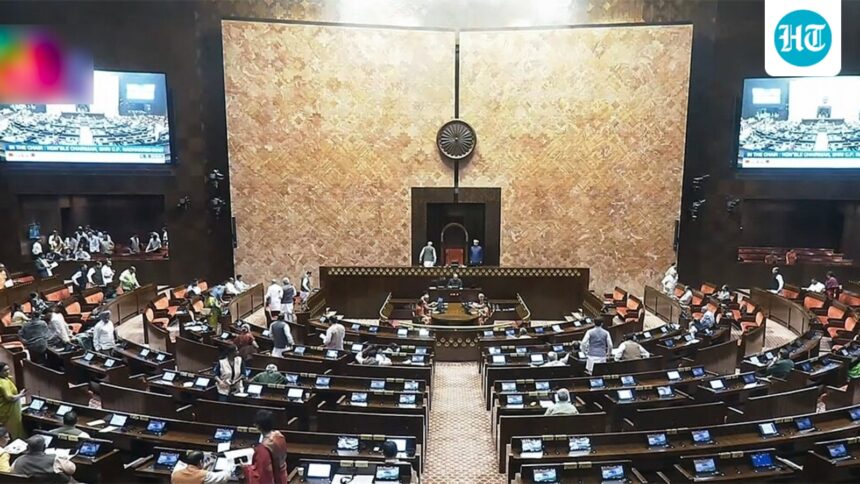
The second half of the Budget session ended on Thursday after key legislations were passed, including the Central Armed Police Forces (General Administration) Bill, and the Jan Vishwas (Provisions Amendment) Bill, a bill that seeks to recognize Amaravati as the sole and new capital of Andhra Pradesh.

The two chambers are scheduled to meet again on April 16 in a short session to push for amendments to the implementation of the Women’s Reservation Law.
During the budget session, the political narrative shifted from domestic issues and the upcoming Assembly elections to the ongoing war in West Asia, which has disrupted global fuel lifelines, including India’s LPG supply. Prime Minister Narendra Modi assured the country that the government was relentlessly trying to downplay the impact of the West Asian war even as he warned that difficult global conditions could persist for a long time and called on people to prepare and unite, just as they did during the Covid-19 pandemic.
In a statement in the Lok Sabha – his first since the outbreak of war on February 28 – Modi described the attacks on commercial ships and the obstruction of the Strait of Hormuz as unacceptable, addressed concerns about their impact on fuel, fertilizers and national security, and said that a unanimous voice should come out to the world from the Indian Parliament on this crisis.
The session also saw the opposition move a no-confidence motion against Lok Sabha Speaker Om Birla – the first such move in 39 years – but it was defeated. The Opposition also filed the first-ever notice of no-confidence against Chief Election Commissioner (CEC) Ganesh Kumar, which remains pending, even as a BJP legislator tried to move a substantive motion against Opposition Leader Rahul Gandhi.
Read Also: Decriminalize minor offenses and impose heavy penalties for land encroachment: Key amendments proposed in Jan Vishwas Bill
Both houses approved six bills, including legislation to make Amaravati the sole capital of Andhra Pradesh, to reform the quota for IPS officers in senior posts in the CAPF, and a controversial bill that significantly narrows the definition of transgender people.
The Lok Sabha approved the Finance Bill 2026 before the Rajya Sabha sent it back to the House. Requests for grants or ministry budgets were also approved even as the government rejected the opposition’s request to discuss the work of the Ministry of Foreign Affairs.
According to PRS – a non-profit organization that provides research support to Members of Parliament – the productivity of the Budget session so far has been 79% and 100% in the Lok Sabha and Rajya Sabha, respectively.
On Thursday, the Lok Sabha passed the CAPF Bill by voice vote, even as opposition members demanded that it be sent to a parliamentary committee for comprehensive discussion and deliberations. The bill was approved in the Rajya Sabha on Wednesday.
The draft law stipulates that for appointment of IRS employees in CAPFs, 50% of the posts will be filled by deputation at the rank of Inspector General and not less than 67% of the posts will be filled by deputation at the rank of Additional Director General.
Responding to the discussion, Minister of State for Home Nityanand Rai said that the Opposition is confused about the measure, which in turn is confusing people. He added that the multiplicity of rules for the different central powers was an obstacle to their smooth operation and that the new law would take care of such issues. “The opposition has tried to create confusion. Historically, Sardar Patel had dreamed of a strong system in India, and this has been developed over the years. The role of the CAPF has been expanded. There were some ambiguities. He believed that for clarity, an overall structure should be formed. Earlier, there were various laws that led to ambiguity. The law also guarantees financial benefits.”
In a video statement, Opposition Leader Rahul Gandhi criticized the CAPF bill and asserted that his party will repeal such a “discriminatory law” when it comes to power.
He recalled that he recently met Assistant Commandant Ajay Malik, who claimed that he did not get any promotion despite 15 years of service. “Despite more than 15 years of loyal service – no promotion, not even the right to command his own force. Because all the top posts are reserved for IPS officers. This is not just one officer’s pain – it is an institutional injustice happening to millions of CAPF personnel,” he said in the video he shared on X.
The session also saw the government blocking the Foreign Contribution (Regulation) Amendment Bill, 2026 in the Lok Sabha on Wednesday following opposition protests and controversy in the poll-bound state of Kerala.