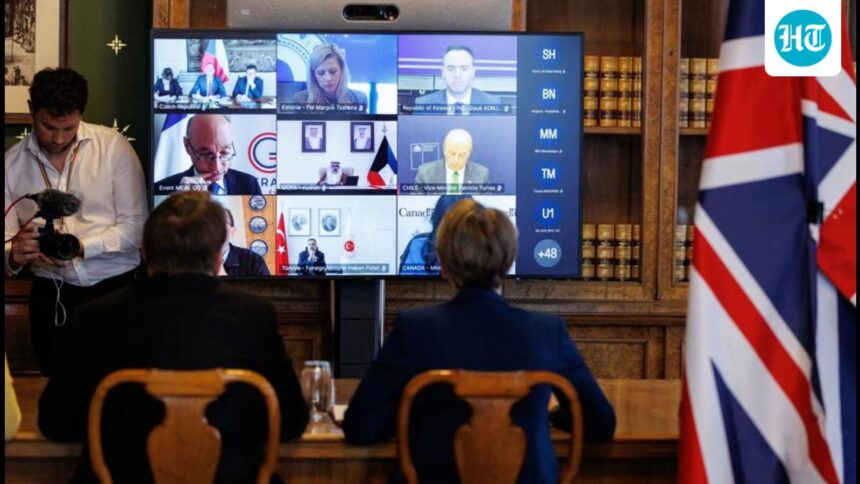
Foreign Minister Vikram Misri represented India at a meeting of over 30 countries convened by the UK on Thursday to explore ways to reopen the Strait of Hormuz against the backdrop of growing global concerns over disruption to energy and fertilizer supplies due to the closure of the strategic waterway.

Al-Masry joined virtually the meeting chaired by British Foreign Secretary Yvette Cooper on Thursday afternoon, along with representatives of countries such as France, Germany, Italy, Canada and the United Arab Emirates. The United States was not scheduled to attend.
“The United Kingdom has invited several countries, including India as well, for talks on the Strait of Hormuz,” Foreign Ministry spokesman Randhir Jaiswal said at a weekly press conference.
He reiterated that India supports free and open trade shipping and maritime security in line with international law. “We continue to advocate for ensuring safe and free navigation through the Strait of Hormuz as a matter of priority,” Jaiswal said.
There was no official reading of the outcome of the UK-led meeting, which was held hours after US President Donald Trump said during a televised speech about his war against Iran that securing the strategic waterway was a problem that other countries needed to address.
Jaiswal said India is in touch with Iran and other countries to ensure “safe and unhindered transit” through the Strait of Hormuz for Indian-flagged commercial ships bound for the country with products such as LPG and LNG. “Through this conversation that we’ve had over the last few days, six Indian ships… have been able to cross safely [the Strait of] Hormuz. He added: “We are continuing to communicate with the parties concerned in this regard.”
New Delhi’s focus is on 18 Indian-flagged ships, including oil and gas tankers, and 10 foreign-flagged ships carrying energy products bound for India that are currently located west of the Strait of Hormuz, which is used to transport 50% of the country’s oil imports. The Iranian side currently allows Indian-flagged ships to pass through the strait on a case-by-case basis.
People familiar with the matter said the UK meeting was unlikely to lead to any immediate breakthrough. They said that ensuring the safe passage of Indian ships through the strait remains a complex issue and requires close coordination with the Iranian side to ensure the safe passage of ships through the mined waterway.
During his address to the nation, Trump said countries unable to secure fuel supplies due to the closure of the Strait of Hormuz should either buy oil from the United States or “get some late courage” and “just take” the supplies. He also said the strait “will open naturally” when the conflict ends, but did not provide a clear timeline for ending hostilities.
Jaiswal also said at the press conference that there were no discussions between India and Iran on making payments for safe passage of commercial shipping through the Strait of Hormuz. He added that Indian warships stationed in the Arabian Sea and the Gulf of Aden as part of Operation Sankalp, which was launched in 2019, are working to secure shipping and maritime trade lines and provide support to Indian commercial ships in the region.