Povarti (Chhattisgarh): As the sun sets behind the tall trees, a soft orange light spreads across Povarti, once a Maoist hub in Bastar district and home to slain Maoist leader Madhvi Hidma and his deputy Parsi Deva, who surrendered on January 2 this year. Buvarti is located about 100 kilometers from the Sukma district headquarters, surrounded by forested hills on three sides. Outsiders were not allowed to enter the village between 2000 and February 2024, when security forces set up a camp.

Outside Hidma’s house, his mother, Buji, in her mid-60s, sweeps the mud floor of her small straw and bamboo hut. It bears witness to the winds of change. “I can now see the children walking to school every morning inside the Buvarti security camp,” she said, but she did not mention anything about her son’s death.
“We will have electricity for the first time soon,” Buji said in his Gondi accent.
She added that she owns a small, unregistered plot of land where she grows rice and millet. When asked why she was not getting rice from the fair price shop operating inside the camp, she said she was aware of the matter but had not been issued an Aadhaar card or ration card. Buji lives alone since her three daughters got married.
About 200 meters from Pojje hut there is a small thatched house owned by Barse Deva. Sitting on a plastic chair outside the house, Pars Boodram, Deva’s brother, said the change in the village was clear. “A few months after the camp opened, there were difficulties, as the Javanese used to regularly summon villagers for questioning and other purposes, but now things are normal. The roads have reached Bovarti, and in the near future things will be better for us,” Boodram said.
He added that many residents in the seven villages of Buvarti now have ration cards. He said: “Food rations are distributed in the camp, where there is a general distribution store, and all medical facilities are located in the hospital located in the camp as well.”
The family includes seven other members, including a Parsi wife, two children, a sister and another brother. The family depends on agriculture for its livelihood.
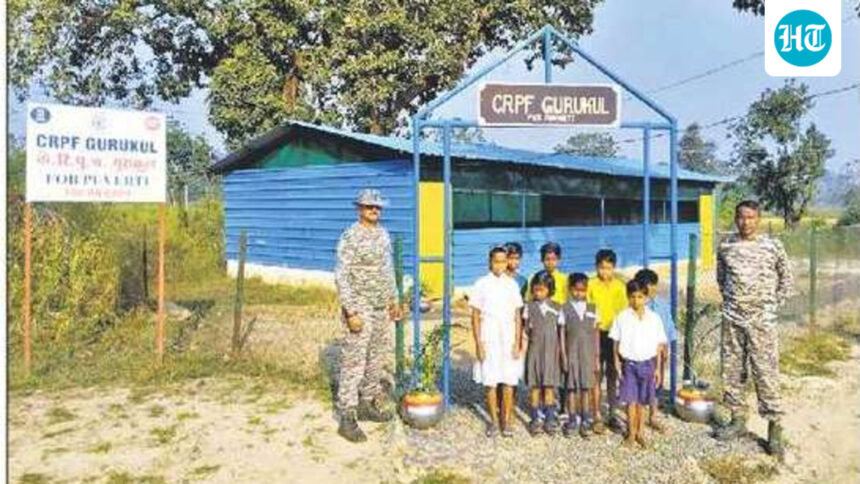
The village is now connected to Silgar, about seven kilometers away, via a mud road. Three iron bridges were built to make the span moveable. A security camp has also been set up inside the village, where the Central Reserve Police Force has set up a small hospital. In addition, a fair price shop and a school were opened, where village children are now enrolled and attending classes. Electricity poles and mobile phone towers were erected and water taps were installed. Pars Lachman, 10, who joined the school at the camp a year ago, said there were two teachers. “Most of the children have started going to school and are enjoying it,” he said. “I want to become a teacher after my studies.”
Earlier this week, the government announced that it had achieved its goal of liberating the country from left-wing extremism. In the past two years, many previously inaccessible villages in all seven districts of Bastar Province have witnessed the establishment of security camps, followed by the establishment of basic government facilities such as roads, ration shops, schools and health services.
The state government launched the Niyad Nellanar Yojana, which aims to expand governance and basic services to 494 villages falling within a 10 km radius of 86 security camps in Bastar district.
Officials said approval had been given for the establishment of 31 new primary schools and the reopening of nearly 50 previously closed schools. Sanctions have been imposed on 49 fair price shops, 185 anganwadi centers and 19 sub-health centres, they added. To benefit from the government schemes, around 108,000 Aadhaar cards and 59,488 Ayushman cards have been issued.
About 116 all-weather roads and 112 mobile towers have been approved, of which 43 are operational. The government has set targets to electrify all villages in the region by December 2027 and ensure access to banking or postal services within a five-kilometre radius. Across Bastar division, more than 33,000 houses have been approved under Prime Minister Janneman, and more than 18,000 houses have been completed. A special project has agreed to build 15,000 houses for families affected and surrendered by the Maoists. Under the Prime Minister’s Rural Housing Scheme, 38,000 houses have been approved, while 9,010 houses have been approved under Nayad Nilanar Yojana, officials said.
The Yojana is scheduled to reach Bhovarti in the next few months.
A senior intelligence officer working in the area said that about a dozen armed Maoist cadres were still active in Bastar.
Inspector General of Police, Bastar District, Sunderraj P, said Povarti’s transformation reflects a broader transformation in the region. “From a village overshadowed by Maoist influence associated with Madhvi Hidma and Parsi Deva, Puvarti today stands out as a story of resilience, stability and new beginnings, bringing renewed hope to local communities. The establishment of security camps and regular communication with villagers has enhanced safety, mobility and confidence, encouraging greater participation in social and economic life,” he said.
The rise and fall of Al-Hamda
Hidma was recruited by Maoist leader, Badranna, in 1997 and was the first Bovarti to join the force. Hudma continued to recruit more than 100 people from the area over the years. According to security officials, the village also served as the headquarters of the Maoist No. 1 Battalion, which had about 140 heavily armed cadres, many of whom were handpicked by Hidma and Deva. “It was the village where several major ambushes of security personnel were planned. There was a large hut inside the village that served as a war room for the Maoists,” a senior officer at the Bovarti camp said.
Hidma was killed in an encounter on November 18, 2025, in the Maridomili forest area of Alluri Sitarama Raju district in Andhra Pradesh, near the Chhattisgarh-Telangana border. Weeks later, Parsi Deva, who was considered one of the senior commanders after Hadma City and headed Battalion No. 1, surrendered on January 2, 2026, along with several other cadres.
In the dim light, Buggy finished mopping the floor and turned to her water bowl. “Things have changed now,” she said, taking weary steps toward the local hand pump.
Deva’s brother, Boodram, echoed her, saying the change was clear but slow. “We want peace in this region. We want to study and we want to do jobs.”