

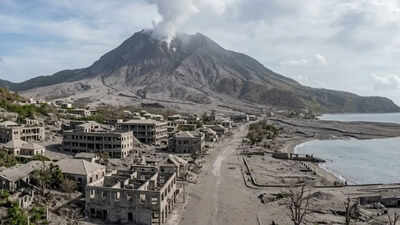
In 1997, the Soufriere Hills volcano erupted and buried the city of Plymouth on the island of Montserrat. The capital, once a bustling commercial hub, was covered in several feet of ash and debris within a few hours, prompting a permanent evacuation.
The Montserrat Volcano Observatory states that more than 80 percent of Plymouth’s infrastructure has been destroyed by volcanic eruptions. Although Plymouth is now an uninhabitable exclusion zone, it remains legally the island’s capital today. The city has been compared to “modern Pompeii” and serves as a reminder of the devastating effects of geology. They also provided scientists with valuable information about how volcanoes affected and displaced modern civilization over time.
how Soufriere Hills Volcano Plymouth wiped off the map
Plymouth’s destruction was caused primarily by pyroclastic density currents (PDCs) — gravity-driven clouds of hot gas and rock. Research published by the US Geological Survey (USGS) and the Montserrat Volcano Observatory (MVO) indicates that these flows reached temperatures exceeding 400 °C (752 °F) and traveled at speeds of more than 100 mph. The PDC flows behaved like fast-moving fluids, and due to the fluidized nature of these high-velocity currents, they were able to cover entire buildings from their base to the second floor with a dense matrix of fine ash and tephra.
This rapid burial thus preserved Plymouth in a frozen state, giving archaeologists the opportunity to study the ash and volcanic clay from everyday items of life in the twentieth century.
These artefacts represent a unique, but fragile, means through which archaeologists will gain knowledge about life in the Caribbean during the twentieth century.
How MVO monitors structural deterioration in a restricted area
The city of Plymouth, the legal (legal) capital of Montserrat, was destroyed, including all of the city’s infrastructure.
However, the Government of Montserrat points out that although the government has moved its administrative functions to the north of the island in Paradise, Plymouth’s legal status as the official seat of government is still preserved in the constitution and other records. The southern half of Montserrat is designated as a restricted area for District V and cannot be accessed without a police escort due to the ongoing threat from the volcano.
This continuous and complete legal and physical isolation of the city allows the Montserrat Volcano Observatory (MVO) to use GPS and seismic sensors to study accelerated structural failure, corrosive loading from the weight and chemical acidity of the volcanic tephra.
How volcanic tephra reshaped Montserrat’s topography
According to research by the Journal of the Geological Society, the large amount of volcanic material deposited at Plymouth permanently reshaped the island’s topography and expanded its coastline.
The ash layers, more than 12 meters (39 feet) thick in some areas, have altered the island’s drainage basins and coastline. In addition, the high porosity of volcanic tephra acts as a thermal insulator; So, in addition to the lack of light, it creates a slow decay rate for all the organic materials and artifacts that may be buried underneath.Based on data from NASA’s Earth Observatory, these environmental changes have produced pioneering plant species that specialize in the exclusion zone and provide a unique model of biological succession in a post-eruption tropical environment.
Stay up to date with our live blog for minute-by-minute coverage of the Israel-Iran war including breaking news, missile attacks and the latest updates on the Middle East crisis.