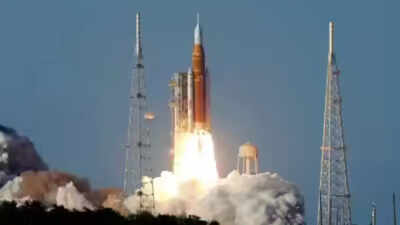
The four Artemis 2 astronauts launched on April 1, 2026, and are currently in high Earth orbit, completing critical inspections of the Orion spacecraft. With the successful launch from Kennedy Space Center, the crew of Reed Wiseman, Victor Glover, Christina Koch and Jeremy Hansen will perform convergence operations while performing manual pilot tests.
After a 23.5-hour recording period in high Earth orbit, Orion will perform a translunar burn, shooting the crew toward the Moon (about 4 days from launch time). This mission is considered historic because it is NASA’s first manned mission into deep space in nearly 50 years. It will help prepare for future missions to land on the moon.
Artemis 2 lunar mission: Where are NASA astronauts currently located?
With the launch well underway on April 1, 2026, astronauts are now performing an inspection of the Orion spacecraft while in high Earth orbit (HEO).
During their first 24 hours in space, astronauts test life support systems and auxiliary defenses needed for close-quarters operations. This includes a manual demonstration in which the crew maneuvers Orion near the Interim Cryogenic Propulsion Stage (ICPS) to check handling quality.This first stage is crucial to ensuring that the spacecraft is functioning properly and that the astronauts will be safe during their flight before they can test the engines again to complete their transition to translunar injection for a journey into deep space.
4-day window for lunar entry
Once it completes its first 24 hours in orbit and ensures that all systems are operational, Orion will perform a trans-lunar burn (TLI) using the Orion Service Module engine. This maneuver provides the “outward thrust” needed to escape Earth’s gravity and begin a four-day transit to the Moon. The time period between here and arriving at the moon is 4 days. During that period, the astronauts will continue to monitor how well Orion is performing and will continue their pre-planned, time-controlled science observations as they approach the lunar environment.
the Lunar flyby and deep space exploration
The Orion spacecraft will fly by the Moon at a lower altitude of about 4,600 miles (7,400 kilometers). This was planned using a “free re-entry” trajectory where the spacecraft would be propelled back to Earth by the Moon’s gravitational field without the need to perform a high-powered, high-speed rocket engine to return it. This mission is extremely important because it represents the first time in more than half a century that humans have traveled this far from the planet and will provide essential data for the Artemis III mission, which aims to land the first woman and the first person of color on the moon.