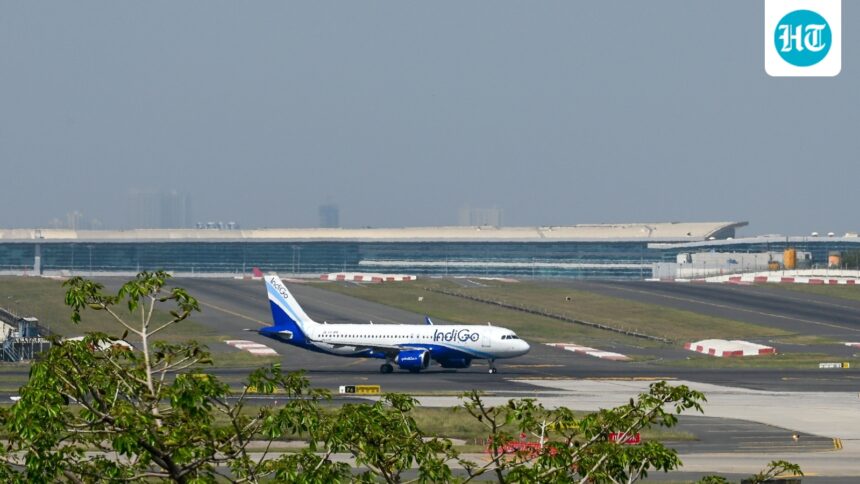
Jet fuel prices rose 8.56% on Wednesday, with IndiGo, India’s largest airline, becoming the first to pass on the increase by announcing a new fuel surcharge of up to $950 per sector on internal roads $10,000 on long-haul international flights for all new bookings from April 2.

However, the overall increase in aviation turbine fuel was moderate – the government said it coordinated with oil companies to pass on only a partial and intermittent rise in global oil prices to domestic airlines, avoiding a much sharper increase.
ATF fares, which account for about 40% of the airline’s operating costs, in Delhi have risen by 100%. $8,289 per kiloliter $1,04,927 per Kuala Lumpur from $96,638 per Kuala Lumpur last month. IndiGo’s revised surcharge schedule begins on $275 for distances up to 500 km $600 per section on roads 1,000-1,500 km long such as the busy Mumbai-Delhi corridor, and $950 for roads longer than 2,000 km. Previously, the airline had an apartment $425 fuel surcharge on all domestic flights and up to $2300 on international roads.
This partial increase comes with the sharp rise in global jet fuel prices in the region. According to the International Air Transport Association (IATA) Aviation Fuel Monitor report, fuel prices have risen by more than 130% month-on-month. The Ministries of Petroleum and Civil Aviation decided to pass on only the intermittent increase to domestic airlines, while international operations will bear the entire market-related price.
“With market-linked fuel prices, a large number of international flights may not cover the variable costs, and airlines may have to reconsider capacity deployment on certain routes. A moderate ATF pricing mechanism for international operations by Indian airlines can help stabilize capacity and prevent sharp price fluctuations,” said an industry official, requesting anonymity.
Civil Aviation Minister K Ram Mohan Naidu said the calibration increase will help protect passengers from sharp price hikes while reducing the cost burden on airlines, supporting the continued stability of the aviation sector and ensuring smooth movement of cargo and air connectivity for trade and logistics.
In a post on The oil marketing companies affiliated with Prince Sultan University, in consultation with the Ministry of Civil Aviation, implemented only a partial and intermittent increase of 25% ( $15/litre) for local airlines.
For international routes, the additional charges will range from $900 L $10,000 per sector depending on distance and region. “Although fully compensating for the increase in fuel prices would require significant price adjustments, IndiGo has passed on a proportionately lower amount to customers keeping in mind the burden involved,” the airline said in a statement.
Ajay Singh, Chairman and Managing Director, SpiceJet, said the government’s decision to ease the ATF fare increase will help airlines navigate one of the most challenging global crises in recent times and materially insulate domestic air travel from the sharp rise in fuel costs.
“A moderate rise is unlikely to give any respite to Tata group-owned Air India, as its international operations constitute a major portion of its overall operations,” said a former airline official who requested anonymity.
Airlines are already facing rising costs due to the conflict in West Asia, which has forced longer flight routes due to airspace restrictions, leading to increased fuel consumption on many international routes. Domestic aviation remains overcapacity, with around 3,300 domestic departures per day compared to around 175-200 international departures currently for Indian airlines, making moderation in ATF fares even more important for the domestic market.
“International supply has decreased significantly, but despite the increase in costs, demand has not yet been affected – this is currently a supply problem, not a demand problem. As fuel costs fall and the geopolitical situation improves, supply will increase and international prices will gradually decline,” said an industry expert, who asked to remain anonymous.
Even on the domestic side, price easing may not last. “Prices are expected to remain high even if ATF prices decline for 1QFY27, but for this to continue through Q2 will be difficult given the impact of seasonality. This is a classic aviation cycle – when costs rise, prices rise immediately; when costs fall, prices fall slowly. Even if ATF declines, prices may correct only 5-10%, and not fully come back,” said another source from within the industry.