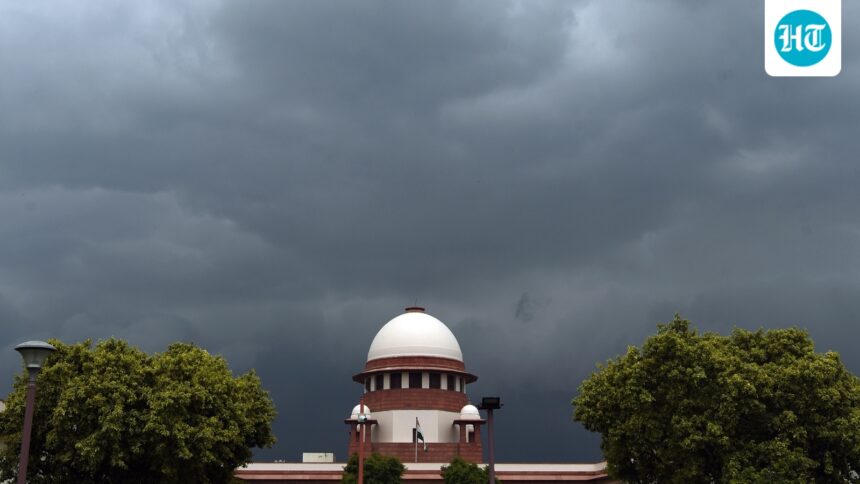
The Supreme Court on Tuesday criticized the Union government for continuing the pattern of relentless litigation, thereby burdening the Supreme Court with avoidable appeals.

A bench of Justices BV Nagarathna and Ujjal Bhuyan imposed a penalty of Rs $25,000 on the Center challenging the Punjab and Haryana High Court’s ruling reinstating the CISF constable. Dismissing the Special Leave Petition (SLP), he questioned why the Federation had chosen to take the matter to the Supreme Court despite the concurrent findings of the Supreme Court.
“We fail to understand why the Union of India and others approached this court by attacking the order of the Supreme Court bench. We reject this SLP with cost $25,000,” the bench ordered.
During the hearing, Justice Nagaratna delivered a sharp rebuke, asserting that the government, though it often expresses concern about judicial suspension, is itself the largest contributor to the backlog. “This is a case of imposition of costs with the class. We have been screaming. Leave your arguments aside. Reliance, reliance, who is the bigger litigant?” She noted, echoing concerns the judge raised days earlier at the Supreme Court Bar Association’s national conference.
At that conference, Justice Nagaratna described the government as playing a “dual role” — as a provider of judicial infrastructure and “the largest generator of litigation.” It warned that the state’s tendency to routinely pursue appeals, rather than restraint, was the main structural driver of judicial congestion.
This criticism found immediate echo in the courtroom on Tuesday. The Authority stressed the urgent need for an internal liquidation mechanism within the government litigation mechanism, especially at the stage of requesting a legal opinion.
“Why doesn’t the law officer take the view that in case of absence of 11 days, the dismissal is disproportionate, and the High Court has granted relief, and we will not go to the High Court? Instead of giving such an opinion, you can proceed against it?” Justice Nagarathna asked.
The judge’s remarks reflect an institutional concern she had previously articulated that government officials are often motivated to file appeals out of caution. While dispute resolution may call for vigilant scrutiny, pursuing litigation is viewed as a safer bureaucratic option, leading to a cycle in which “appeals become routine rather than rare.”
It concerns a Central Security Force policeman who was dismissed from service after about ten years on two charges: unauthorized absence from duty for 11 days, and alleged misconduct in relation to facilitating the escape of a fellow policeman’s daughter, who later married his younger brother.
The officer’s absence occurred during a period of authorized medical leave, although he was not found during the search. In the second charge, the woman in question appeared during the disciplinary proceedings and stated that she had no complaint. It is also undisputed that she voluntarily married the policeman’s brother.
A single judge of the Punjab and Haryana High Court vacated the dismissal and ordered his reinstatement with continued service. The Tribunal upheld this decision, found no violation of the law or deviation and concluded that the dismissal penalty was disproportionate and that no dismissal misconduct had been proven. Despite these simultaneous results, the union went to the Supreme Court.
The court, referring to the factual context, noted the personal circumstances faced by the policeman. She continued: “Do you know the tension in the family if there is an escape? He had to reconcile his family and marry them, and then he returned after that.”
The union’s lawyer tried to limit the relief by protesting against the award of back wages, citing the principle of “no work without pay,” noting that the matter had been pending before the Supreme Court for six years.
However, the court was not convinced. It refused to intervene in the Supreme Court’s order regarding back wages. As the union continued to press this issue, the court proceeded to reject the petition with costs.
Justice Nagaratna also made a pointed reference to the recent SCBA conference, suggesting that the judiciary’s concerns about unnecessary government litigation are part of a broader institutional introspection.
“We took the conference seriously. It wasn’t just going to a resort and coming back. Many of the judges traveled, we prepared, we did our homework,” she said.
As she put it at the conference, the government “openly expresses concern about the backlog of judicial cases, while simultaneously fueling this backlog through relentless litigation,” creating a paradox in which the state becomes “both complainant and cause.”