

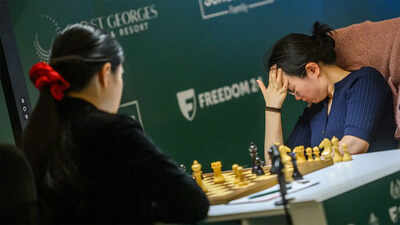
A match during the first round of the 2026 FIDE Candidates Championship. (Image source: FIDE)
The Candidates’ Chess Tournament, which began in Cyprus on Sunday, made sure the men did not lose on time. But only after step 41. Until then, they may suffer for not following the legendary Bobby Fischer principle, aiming to create excitement arising from a time stampede.Go beyond boundaries with our YouTube channel. Subscribe now!In contrast, the women’s candidates, who will play simultaneously in the same hall, will have an increase of 30 seconds from the first move. But they only get 90 minutes for the first 40 moves while the men get 120 minutes for the first 40 moves.GM Swapnil Dhopade, one of the famous chess coaches in India, said, “They want to create some excitement. Especially when the players reach move 40 and there is no increase in the clock. If a player is under time pressure, it is interesting to see if the player completes 40 moves in a few seconds remaining without getting anything wrong. Controlling time outdoors is an experiment to make the game of chess more exciting!”The disparity in time control between men and women was present across the 2024 candidates as well.
Fisher invented his version of a digital clock that provided an increment option for each movement made. The idea was to ensure that the player with a better position on the board would only be punished with a loss if he continued to play sub-par moves.The “lose in time” principle assumes that the player in the better position will make moves to his opponent’s advantage and to his detriment. This principle does not apply if the opponent does not have a pawn or winning material left on the board.
In such a case, turning the clock to zero results in a draw.IM, author and coach V Saravanan said, “Different time control for different sections is really strange. The FIDE might have done this after consulting with the participants. If not, it’s a strange setup.”Seven-time national champion Praveen Thepsai described the decision as ridiculous.When told that in practice, men get 10 more minutes (120) than women (110) (plus) in the first 40 moves, Thepsay disagreed. “The increase cannot be compared to the time available,” he said, acknowledging the lack of time for women as well.