The government moved on Friday to protect key industries from ongoing gas supply disruptions, increasing commercial LPG allocations by 20% to 70% of pre-crisis levels. The additional supply will prioritize labour-intensive sectors such as steel, automobiles, textiles, dyes, chemicals and plastics, which are critical to wider economic activity.The move is aimed at stabilizing industrial operations, said Prashant Vashisht, senior vice president (corporate ratings) at ICRA, adding that increased domestic LPG production and substitute imports “have narrowed the deficit, providing some relief.”
He watches
Center pushes PNG: LPG supplies may be halted where pipelines are available
This measure will help steel mills, especially small units, to maintain production, said Pankaj Chadha, chairman of engineering export body EEPC India.
“Steel is a key sector in the engineering goods sector and its shortage could severely impact the production chain. Additional allocation to LPG would reduce supply bottlenecks and ensure stable production,” he added.
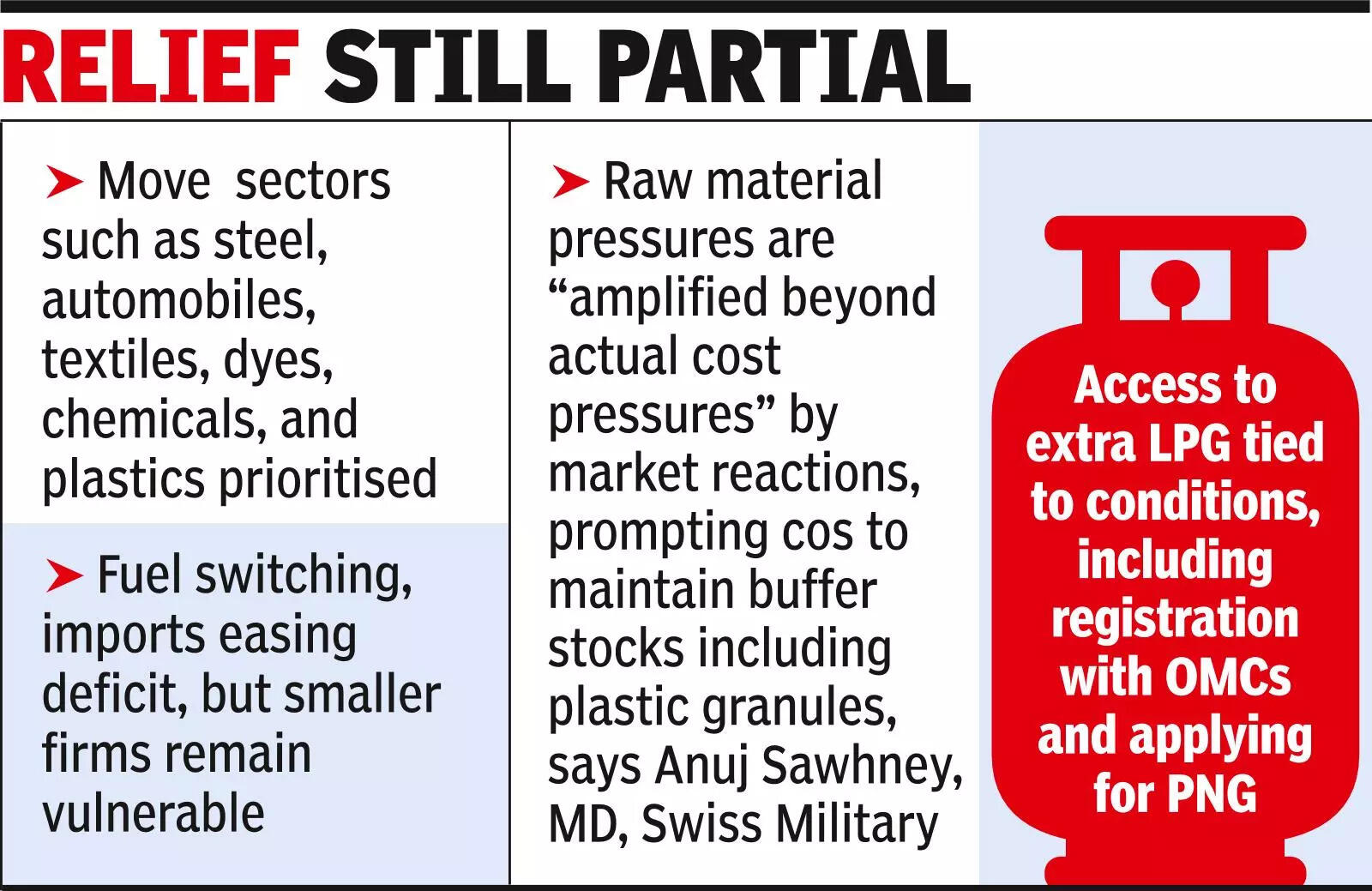
To reach 70% of pre-crisis levels Move to give priority to labor-intensive sectors
However, the apparel sector sees the move as a partial relief but doubts it will meet even half of the demand in the near term. Thread processing, which is crucial to clothing production, is largely gas-based.
Supplies to hundreds of units in Tirupur were cut off for 10 days, affecting around 100,000 employees. The shortage has disrupted the credit and risk cycle in favor of well-capitalized buyers, while costs of raw materials, including polyester yarn, and transportation have risen.
“Shipping and raw material costs have risen dramatically, making it difficult to process yarn,” said Alexander Nieroth, director of NC John Garments.The gas shortage began with conflict in West Asia and the near-total closure of the Strait of Hormuz to commercial shipping, prompting the government on March 12 to reduce its commercial allocation of LPG to 20%. Since then, allocations have gradually increased to 70% of pre-crisis levels.Access to the additional 20% is conditional. Industrial users must register with oil marketing companies such as Indian Oil Corporation, HPCL and BPCL, and apply for pipelined natural gas connections with city gas distribution entities to qualify.
Downstream industries and units that rely on LPG for specialized heating needs, where natural gas cannot replace it, will receive priority.Manufacturers in various sectors are adapting to the shortage by taking various measures to maintain production. Ajay Singhania, Managing Director, EPACK Permanent, noted that the shortage of LPG and pipelined gas has reduced production by almost 50% over the past three weeks. “We have initiated temporary measures such as partial fuel switching across operations, but these come with efficiency and cost trade-offs.
For the consumer durables sector, where demand is seasonal, continuous availability of power is crucial to ensuring just-in-time production.Automotive component makers, especially forging and casting units, continued production with some switching to in-house solar-powered electric heating. A Chennai-based source said the switch to renewable energy helped overcome the situation with relative ease, even as stocks fell from 15-20 days to 2-3 days. He added that small companies are feeling pressure due to the heavy reliance on liquefied petroleum gas.(With contributions from Reba Zacharias, G Balachandar, P Vaitheswaran, and Asmita Dey)