Alexander Kluge, the German director whose career spanned more than six decades and helped define the New German Cinema movement, has died. He was 94 years old.
Kluge’s family confirmed his death to German media on Wednesday. The cause of death was not mentioned.
Kluge was a signatory of the 1962 Oberhausen Manifesto, which called for an auteur-led New German Cinema and is credited with helping to ignite the New German Cinema movement. It was a favorite on the international festival circuit, especially in Venice. His first appearance was in 1967 Epsicheid von Gestern (Published in the United States as Yesterday’s girl), which depicted the struggles of a young Jewish refugee from East Germany, won the Silver Lion, the first post-war Italian festival award for a German director. Two years later, Die Artisten in der Zirkuskuppel: Ratlos (Artists under the big top: confused), an experimental collection of film, merging newsreels and interviews that explore societal ideals and protest movements, won Venice’s Grand Prix, the Golden Lion.
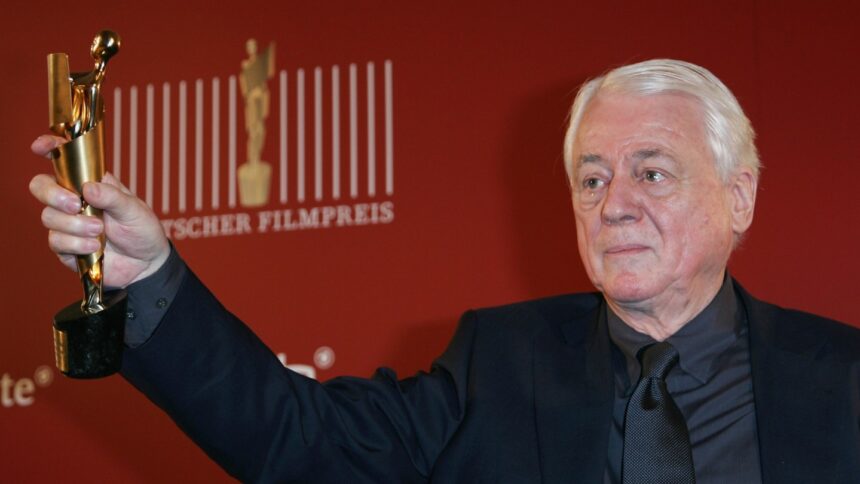
Other notable films included Stark Manor (Strongman Ferdinand), winner of the Vipreschi International Critics Prize in Cannes in 1976, and Germany in the fall (1978), his anthology film, made in collaboration with other directors of German New Cinema including Volker Schlöndorff and Rainer Werner Fassbinder, dealt with far-left terrorism in Germany at the time and the subsequent crackdown by the German state. One of his last major works was The Nine Hours News from ideological antiquity: Marx-Eisenstein-DC (2008), a bold reimagining of Sergei Eisenstein’s unfinished project on Marx’s theory capital. In the same year, he received the Lifetime Achievement Award from the German Film Academy.
Born in 1932 in Halberstadt, Kluge initially obtained a doctorate in jurisprudence and began practicing law. His time at the Frankfurt Institute for Social Research brought him into close contact with the famous German philosopher Theodor W. Adorno, whose mentorship shaped Kluge’s intellectual path. By 1958, he was turning to cinema, working as an assistant to legendary German director Fritz Lang.
Kluge’s influence extended beyond cinema. He was a prolific writer of short stories, essays, and philosophical texts, and received literary honors including the Georg Büchner Prize, the Theodor W. Adorno Prize, the Heinrich Heine Press Prize, and the Klopstock Prize. In 1987, he founded the television production company dctp, where he created news and debate programs such as 10 vs 11, News and storiesand Metternacht magazine.
Klug remained active into his 90s, writing books and designing art exhibitions. His latest work is the visual essay 2025 Primordial diversityexploring artificial intelligence and the future of moving images, and premiered at the Rotterdam International Film Festival.
As a true polymath, Kluge never separated art from politics or philosophy. As a film director, writer and television producer, he interrogated modern life, memory and society, leaving an indelible mark on German culture. The Berlin Film Festival remembered him as a “cherished guest for decades… whose passion for filmmaking, critical thinking and storytelling shaped German cinema and inspired generations of filmmakers.”