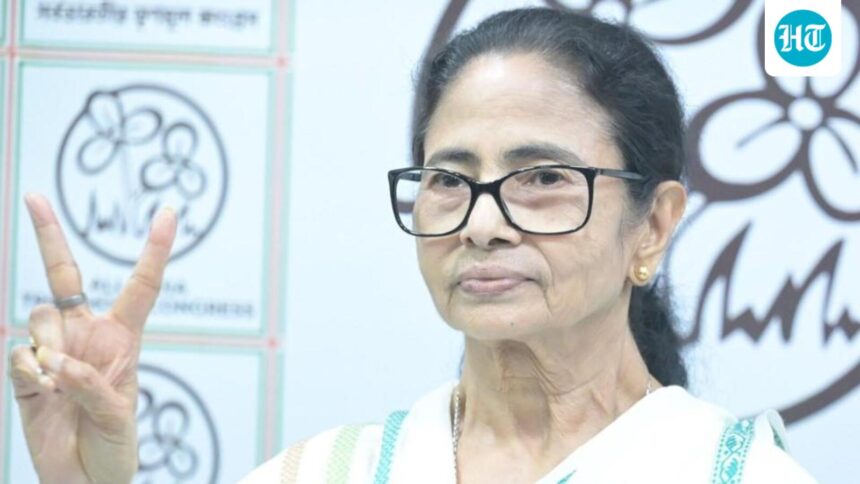
West Bengal Chief Minister Mamata Banerjee is contesting her fourth election from Bhawanipur constituency or as it is popularly known as Bhabanipur.

Bhawanipur or Bhabanipur grew from a small village, which was part of the fifty-five villages (Dehi Panchangram) purchased by the East India Company from Mir Jafar in 1758, to become the heart of political power in West Bengal. This journey has been gradual: in the 19th century it developed into a suburb dominated by communities of artisans and merchants, and in the following decades it became known as Cinema Barra due to the presence of its many cinema halls.
Home to Indian legends like Subhas Chandra Bose, Satyajit Ray, Gurudutt, and Hemant Kumar, politicians like Siddharth Shankar Rai, Shyama Prasad Mukherjee, and current Prime Minister Mamata Banerjee, the story of Bhowanipore is as old as it is fascinating.
It is one of the oldest areas of Kolkata (formerly Calcutta), and the history of this city would not be complete without this neighbourhood. As the first city in India built by the English, Kolkata has come a long way. But then, even in 1901, it was already a more than century-old base for invaders from Europe. The Battle of Plassey (1756) took place more than sixty years after the British built Fort William in 1690 in Calcutta. In less than a century, this land of malaria and swamps, which contained a few fishing villages and weaver communities, became the official headquarters of the rapidly growing East India Company.
In the 1750s (mid-18th century) Bhowanipore was located outside the city and was considered a safe haven whenever reports of malaria deaths or cholera outbreaks spread panic among the English occupiers. In Calcutta Old and New, HEA Cotton wrote in 1901, “…every Englishman was able to avoid the plague-stricken air of Calcutta by taking up residence in the garden hoses outside its boundaries. Clive (Roper Clive) lived at Dum Dum, Sir William Jones, at Garden Reach (later the last Nawab of Awadh was imprisoned in this area), and Sir Roberts Chambers had a house at Dum Dum.” “Kossipur (Kashipur) and another at Bhowanipore, far from the city in those days (1760s) but within sight of the present cathedral.”
Read also: History City | Hormuz and Noukhidha’s connection to India
Bhabanipur lies between Kalighat and St Paul’s Cathedral which was built in 1847. Fort William and the over 4 km long moat built to protect against Maratha invasion remained the core of English Calcutta until the 19th century. The Maratha trenches can still be identified today by a small trail while the rest of them have been paved and filled and form today’s AJC Bose Ring Road.
Mamata’s famous appearance as a lawyer before the Supreme Court earlier this year reminded us of her all-too-brief career as a lawyer.
Banerjee attended law school a few kilometers from her home in Bhowanipore, which has its own legal heritage dating back to the 1840s when there were no universities, Port Trust or even the Hooghly Bridge. There were disputes and they were decided in different forums. Since Indian penal and procedural laws and the law of evidence had not yet been developed, legal battles were fought in areas where they related: company affairs or within English-controlled territories, the Queen’s Courts. For the English living in Calcutta, there was a separate court. Hindus and Muslims were arguing according to their own laws in the Persian language. Cotton recounted that typical day, “Before the civil magistrates of the Sudra Diwani Adalat (Sadr Diwani Adalat) and the local law officers of Bhowanipur, the barristers and Munshis argue over an obscure question of Hindu and Mohammedan law in Persian. In the courtroom in the park, Sir Henry Seton and his colleagues of the High Court administer the laws of England in English and exercise separate jurisdiction over all who reside within the borders of the kingdom. Martha Deitch.”
In fact, until the second half of the 19th century, those who lived in and around the trench were called trenchers! The White Town and the Black Town in which the Indians lived were divided by the ditch they had once dug together as protection against the Marathas.
Raja Binaya Krishna Deb wrote in his book The Early History and Growth of Calcutta: “Between 1742 and 1753, the development of the city consisted chiefly in the rapid increase of the houses of native Indians, both kucha and puccha—mostly kucha—in the outlying parts of the European city within the Maratha Moat.”
The Saddar Diwani Adalat was the highest court of appeal for civil and revenue-related cases, and has changed location several times since it was first established in 1772 by Warren Hastings, the first Governor-General of Bengal. Originally built as a military hospital, the building was taken over by William Benteck for the Company Court and the building could be restored to its original purpose in 1862 when the Supreme Court was built. The building is located within the campus of the prestigious Eastern Command Hospital of the Indian Army.
Read also: History City: Tehran’s encounter with history
The suburbs of Bhowanipore and Kalighat grew at a rapid pace and in fact prevented the spread of the white city to the south of Calcutta which was central to the apartheid that the British had tried so hard to impose. Ranjit Sen wrote in The Birth of a Colonial City, “Racial segregation of the natives was not possible because of the presence of Kalighat and Bawanipore in the immediate vicinity. Preserving the cultural identity of the strong English Isles race by keeping them isolated in the south was equally impossible because a cosmopolitan city with a mixed population existed as a buffer between the natives to the north and the whites to the south.”
As Mamata gears up for what is being described as the “mother of all contests”, we can be sure that the history of this district will be richer whether she wins or loses to the BJP’s Suvendu Adhikari, who was once her loyalist.
HistoriCity by Valay Singh is a column about a city in the news based on its documented history, legends, and archaeological excavations. The opinions expressed are personal.