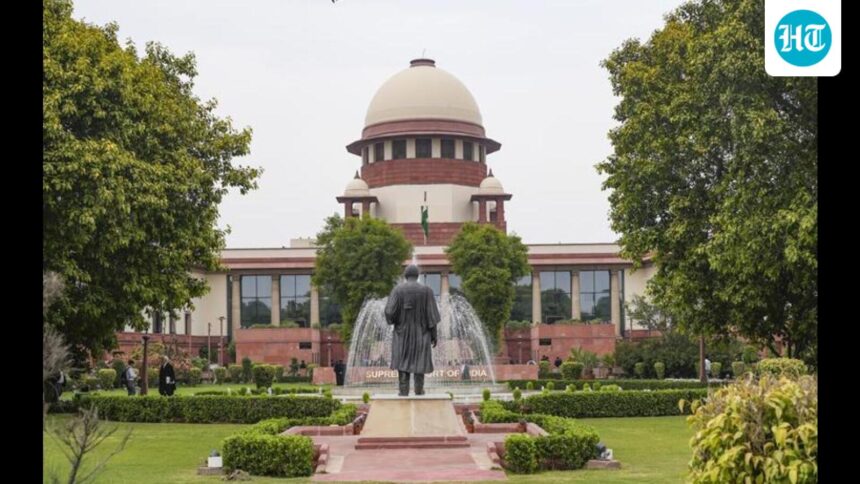
The Supreme Court on Tuesday held that conversion to Christianity and other religions results in loss of Scheduled Caste (SC) status, holding that a person professing a faith other than Hinduism, Sikhism or Buddhism cannot claim the constitutional protections available to members of the Scheduled Caste.

Upholding the Andhra Pradesh High Court ruling, Justices Prashant Kumar Mishra and Manmohan said that once an individual voluntarily converts to another religion and actively practices it, the legal entitlements associated with SC identity, including protection under the Scheduled Castes and Scheduled Tribes (Prevention of Atrocities) Act, cease to apply.
It upheld the reasoning of the Supreme Court that the constitutional scheme under the Constitution (Scheduled Castes) Ordinance, 1950, limits SC status to specific religions, and that conversion outside this framework automatically disqualifies a person from claiming that status. The court stressed that the decisive factor was the religion he embraced at the time of the accident, and not merely the presence of a caste certificate.
The judgment arose out of a case involving a priest from Andhra Pradesh who invoked the SC/ST Act, alleging caste-based assault and abuse by some individuals in his village. The accused challenged the proceedings on the ground that the complainant, Chinthada Anand, had converted to Christianity and was actively working as a pastor, which disqualified him from invoking the protection reserved exclusively for the Supreme Court.
The Supreme Court observed that the facts on record leave little room for doubt. The petitioner did not claim any return to his original faith nor any readmission into his caste community. On the contrary, evidence showed that he had been practicing Christianity for more than a decade and held prayer meetings regularly as a pastor. The bench observed that these “concurrent facts” clearly establish that he continued to practice Christianity at the time of the alleged incident, making him ineligible for the High Court status and consequent protection.
The decision effectively upholds the April 30, 2025 judgment of the Andhra Pradesh High Court, passed by Justice N. Harinath, which quashed the criminal proceedings initiated under the SC/ST Act. The Supreme Court held that the caste system was alien to Christianity and that a voluntarily converted person could not benefit from a law designed to address caste discrimination within the Hindu social structure and its legally recognized extensions.
The Supreme Court rejected the argument that continued possession of a caste certificate would entitle the complainant to protection under the Scheduled Castes and Scheduled Tribes Act. It explained that the validity or cancellation of such a certificate is a separate administrative matter to be dealt with under the Andhra Pradesh (Scheduled Castes, Scheduled Tribes and Backward Classes) Community Certification Act, 1993. It was held that mere non-cancellation does not revive or maintain eligibility once the conversion has taken place.
The case goes back to a complaint filed by Anand from Guntur district in 2021, in which he alleged that some individuals opposed his evangelical activities, assaulted him, and used caste-based insults. Based on his complaint, the police registered the offenses under the provisions of the SC/ST Act as well as the Indian Penal Code and filed a chargesheet.
One of the accused, Akala Rami Reddy, approached the Supreme Court seeking quashing of the case, arguing that invoking the SC/ST Act was legally indefensible given the complainant’s admission of conversion.
Agreeing with this contention, the Supreme Court held that the protective framework of the SC/ST Act is specifically for members of Scheduled Castes and Scheduled Tribes, and cannot be extended to those who have chosen to step out of that social and legal category by converting to another religion. It noted that allowing such claims would be an abuse of the law.