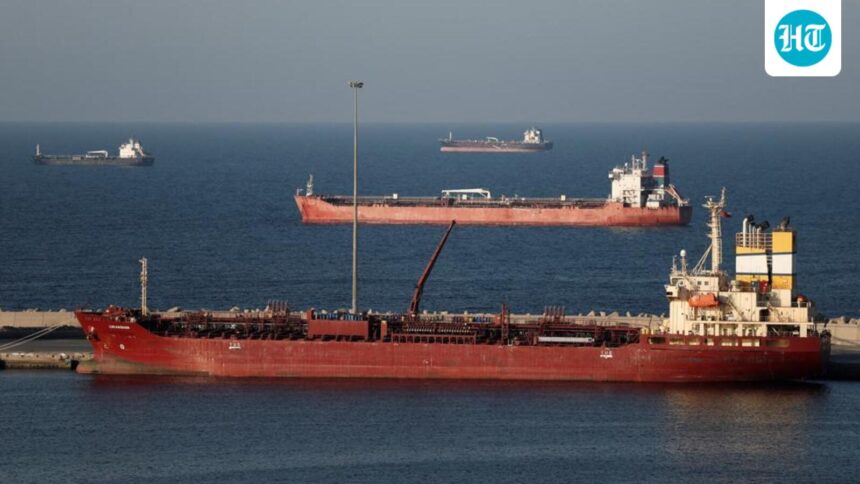
In the third week of the US-Israel war on Iran, the closure of the Strait of Hormuz by the blockading West Asian nation has led to an imminent global shortage of gas and fuel. In India, one of Iran’s oldest trading partners, the crisis is worsening day by day as most of India’s energy needs are met through gas and oil that pass through this narrow gateway between the Persian Gulf and the Arabian Sea.

Like most of the Persian region, Hormuz has Zoroastrian roots that now survive only in name. During the twilight of the Sassanid Empire, around 640 AD, the Chinese traveler Xuanzang reported on Pu-la-si (knight) while traveling in Sindh. According to his account, the main trading city on its eastern border was Homo, which scholars associate with the ancient city of Hormuz located near present-day Minab. Later, at the end of the 8th century (785-805 AD), another Chinese report described an important trading city in Ta-shi (Iran) called Mu-lu, which was also identified as Hormuz.
India and Hormuz
The earliest Indian reference to ancient Hormuz and its trade with India appears in a Sanskrit work from Gujarat dating back to the 13th century. The Jagadu-charita, written by Sarvananda, narrates the life of a Jain merchant from Gujarat, who was active around 1256-1258. The text says that Jagadu maintained regular trade relations with Iran and even had his own agent stationed in Hormuz to manage his commercial activities. It is noted that he transported goods using his own ship.
Further evidence of flourishing trade between Gujarat and Hormuz during the 13th century is found in a document preserved at Lekhabadati. The document contains instructions from an official named Jayataka at Patan in Gujarat to Vijayasimha, who was stationed at the port of Ghoga in the Gulf of Cambay. Jayataka ordered him to report on the types of goods, as well as the number and breeds of horses, carried by any ship arriving there from Hormuz.
The presence of Iranian Muslim traders in Gujarat has also been indicated by a remarkable bilingual inscription discovered at Somnath (Veraval) on the Gujarat coast. The inscription in Sanskrit (almost complete) and Arabic (partially damaged) has been dated according to four eras: Hijri, Vikramā, Vallabhi and Samhā. They all date back to 1264 AD. It records the construction of the mosque as well as the shops and land allocated to provide revenue for its maintenance.
This centuries-old association between the western coast of India and the Persian Gulf still exists through the Nakhoda, a community of ship captains dating back to at least this bilingual inscription at Somnath.
Historian Ranabir Chakravarty writes in Merchants Who Owned Ships on the West Coast of India that the main figure in this bilingual chronicle is a nakhoda, called Nur ad-Din Firuz, whose Sanskrit name is Noradina Peruga. “He came to Somnath (Somnath in the Arabic script) from the famous port of Hormuz located at the entrance of the Persian Gulf. From Hormuz (Hormuzjavilakula), Firuz came to Somnath to do some work (karyavasat). In order to impress him with his social status, the inscription presents Nakhoda Noradina as the son (suta) of Nao (=Nuvitaka) Khoja (Khwaja) Abu Ibrahim, i.e. father of Ibrahim. Today the Nahuds can be found from Malabar in the south to Konkan is in the north on the west coast.
Among the main items imported into India through the Hormuz were horses and slaves. Hormuz had a customs post called Bangsar, derived from the Sanskrit word bhandagaram, which became popular from Iraq to Indonesia to describe the warehouse. Before the industrial revolution and oil-based geopolitics destroyed the old world order, Hormuz was a highly strategic strait for empires. Whether it was the Ottomans, Iranians, Arabs or Portuguese, who took control in the sixteenth century after defeating the local king Turan in 1515.
Hormuz was in fact a key for the Portuguese in the state of India, and the commandant of this port was the coveted position given to Vidalgos.
In 1565, the Portuguese traveler Gaspar da Cruz wrote: “Ormuz… is one of the richest countries of India of all the rich countries of India, through the many and rich goods that come from all parts of India, and from all parts of the Arabian Peninsula and Persia, even the lands of the Mongols, and even from Russia in Europe. I saw merchants there, and from Venice. And so the people of Hormuz say that the whole world is a ring and Hormuz is a stone.” From her…”
India’s links with Hormuz and Iran pre-date the Portuguese by centuries. Indian spices, ivory, textiles, medical drugs, and jewelry were imported into Iran and beyond to European countries. In return, the merchants served the need for horses, weapons, and slaves to and from India.
In his book “History of the Persian Gulf,” Iranian historian Muhammad Baqir Vossoughi writes about the importation of African and Indian slaves to Hormuz and the export of horses to India. “Since the climate of southern India was not suitable for horse breeding, the Bahmani (Muslim) kings of the northern Deccan and the Hindu kings of the Vijayanagara region were regular customers. In 1506, three thousand horses were exported to India, and this quantity reached ten thousand head in 1567.”
Citing the Persian historian Fereshta and other contemporary sources, Vosoughi writes: “In search of better jobs and economic conditions, young Iranians left for India from different regions. There are about ten to twelve thousand Iranian warriors in the Deccan region. Some of these warriors were from the Turkic-Iranian tribes who left Iran after severe insecurity during the fifteenth and sixteenth centuries, and immediately after India’s entry joined the military forces.”
One of these warriors, according to legend, became the Sultan of Bijapur. Amir Yusuf Adil Shah, the son of a fruit seller from Iran, came to Deccan to sell his master’s horses. He remained behind and entered the services of the Bahmani Sultanate, where he attained high military rank, eventually founding a new dynasty in 1489.
Portuguese rule, which lasted for nearly 200 years, obliterated Hormuz’s independence, and by the 17th century, its status as a port of the Iranian kingdom was consolidated.
Voshoghi writes that by implementing their overwhelming military policies, the Portuguese disrupted the region’s trade and created conditions under which Hormuz merchants could not continue their activities and, as a result, gradually left the region’s economic scene. Since then, Hormuz has remained under Iranian control, either directly or indirectly.
HistoriCity by Valay Singh is a column about a city in the news based on its documented history, legends, and archaeological excavations. The opinions expressed are personal.