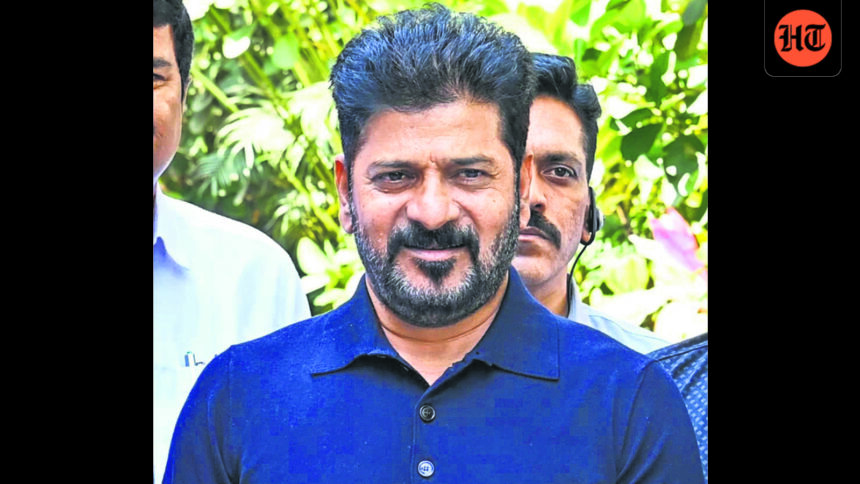
Telangana Chief Minister A. Revanth Reddy on Friday said that his government has adopted the Mosi Rejuvenation and Riverfront Development Project for the sustainable development of Hyderabad city, to provide a clean and green environment to the people with focus on economic development.

Speaking to reporters after giving a presentation on the project, the Prime Minister said it aims to transform Hyderabad’s riverfront, improve environmental conditions and position the city to compete with leading global urban centres.
He said that during his recent visits to global cities like Singapore, Dubai, London and Seoul, he studied their urban development models to understand what Telangana needs to achieve sustainable growth.
“Economies across the world have flourished along the river basins. If Telangana and Hyderabad are to move forward on the path of development, the Musi river must be rejuvenated,” the Prime Minister said.
Revanth Reddy pointed out that Hyderabad inherited a wonderful urban legacy from the rulers of the Asaf Jahi dynasty. He added that the reservoirs built more than a century ago still meet the city’s drinking water needs today.
The Prime Minister wondered why opposition parties like the Bharat Rashtra Samithi Party and the Bharatiya Janata Party were opposing the Mosi renewal initiative. “If they are not supportive of the project, they should at least make constructive suggestions on how to implement it,” he said, adding that he was open to accepting useful recommendations from all sides.
Explaining the project in detail, Managing Director of Musi Riverfront Development Corporation Limited (MRDCL), EV Narasimha Reddy, said the project aims not only to mitigate the effects of floods but also to transform the river corridor into a major economic and urban infrastructure asset.
He said the 2020 Hyderabad floods were among the heaviest rainfall events recorded in the city in the last century. The floods claimed the lives of more than 50 people and caused severe damage $5,000 crore, with several districts being submerged along the Mosi corridor.
“Rainfall patterns are changing rapidly. Hyderabad now often records 200 to 300 mm of rain in 24 hours, events that were previously considered a ‘once in a century’ occurrence but now happen every three to five years,” he said, adding that reviving the Musi is no longer optional but essential to prevent future disasters.
The proposed Musi Riverfront project aims to unlock the potential of a 55-kilometre-long river corridor in Hyderabad. To prepare the master plan, a consortium comprising Meinhardt Singapore, RIOS and Cushman & Wakefield was appointed as the overall master plan.
In the first phase, focus will be on two river stretches – the Isa and Musi rivers that meet at Gandhi Sarovar, and will include major flood mitigation and infrastructure works. This includes cleaning rivers by removing accumulated silt and debris, profiling the river bed based on hydrological assessments, building flood mitigation walls and stabilizing slopes, developing roads along the river banks, installing sewer mains and stormwater drains, and constructing water retention structures such as dams and barrages.
The initial cost of the first phase is estimated at $Rs 6,500-7,000 crore, excluding land acquisition costs and transferable development rights (TDR).
A major parallel infrastructure project by the Hyderabad Water Supply and Sewerage Board (HMWSSB) will support the Musi rejuvenation plan. The project proposes a 20 TMC water augmentation system.
The project also proposes extensive sewerage infrastructure along the Osmansagar-Himayatsagar stretch up to Gandhi Sarovar. A circular barrier is planned to be constructed along the Outer Ring Road corridor to facilitate the distribution and reuse of treated gray water for landscaping, irrigation, construction and industrial purposes.
The development plan also proposes new connectivity infrastructure including vehicular, multi-modal and pedestrian bridges. In total, 14 bridges are planned along the corridor. In addition, three dams will be constructed to store water.
The main focal point of the project is the Gandhi Sarovar at Babu Ghat, a site of historical and spiritual importance where the ashes of Mahatma Gandhi were immersed in 1948. Located at the confluence of the Isa and Musa rivers, the site is considered one of the important memorial monuments in Hyderabad, the official said.