

In his 1931 book The American Odyssey, James Truslow Adams coined a term that went on to define the classical life that the United States promised the rest of the world. The “American Dream,” as Adams described it, was a vision of a society in which life should be better, richer, and fuller for all, offering opportunities based on ability and achievement rather than social class or birth.Inspired by this promise, Indians began migrating to America in the 19th century, with numbers increasing significantly in the 20th century. America ticked all the boxes for them: city life, better income, improved opportunities, and a slightly higher social status back home, where life could be spent working to the core, while still becoming a family man rather than a billionaire.Bhikji Balsara, a Parsi businessman, became the first Indian to gain US citizenship through naturalization in 1910. But the pinnacle of honorary Indian-American symbolism arrived much later, with Satya Nadella becoming CEO of Microsoft in 2014 and Sundar Pichai becoming CEO of Google in 2015. What began with Punjabi farmers moving to the US West Coast eventually evolved into families taking out thousands of dollars in loans to send their children to the US so they could chase the American dream, The cost doesn’t matter.
The Dark Age of the American Indian
Fast forward to Barack Obama’s presidency from 2009 to 2017. Those years saw the maximum number of Indian Americans appointed to senior positions in the administration for a community of about three million people at the time, leading some to jokingly describe Obama as the first “Indian American president.”This was followed by Donald Trump’s rise to power between 2017 and 2021. Despite courting Indian American voters, Trump received only about 16% of the Indian American vote in 2016.
A 2020 survey of Asian American voters later found that nearly 28% of Indian Americans supported it.Joe Biden’s presidency further strengthened Indian-American representation when he chose Kamala Harris as his running mate in 2020. Harris would go on to serve as Vice President from 2021 to 2025, becoming the first person of Indian origin to hold the position.Trump’s re-election in 2025 marked what he called the beginning of America’s “Golden Age.”
However, for many Indian Americans, the political and cultural climate since then has become much less pleasant.
The American Indian is burning
The word ‘anti’ has seen a marked rise when it comes to anything related to Indian Americans in America since 2025. A poll conducted by the European Council on Foreign Relations in the same year revealed that 75% of the Indian population was ‘welcome to Trump’. However, within America, Indian Americans increasingly point to a sense of vulnerability in the same country that once symbolized opportunity.A recent survey conducted by the Carnegie Endowment for International Peace examined the attitudes of approximately 5.2 million Indian Americans living in the United States. The Indian American Attitudes Study (IAAS), in partnership with research firm YouGov, surveyed 1,000 Indian American adults. The results revealed a disturbing fact. Many participants reported experiencing online bias and racism, in-person harassment, and discrimination, forcing some to change the way they spoke, dressed, or participated in public life to avoid confrontation.
Anti-Hindu Zoom
Hindus make up at least 55% of the Indian-American community, and are heavily represented in sectors such as technology, medicine, and academia.The immediate conclusion many observers draw from the survey is that the hostility experienced by Indian Americans often overlaps with hostility toward Hindu identity, raising concerns about the rise of Hinduphobia or anti-Hindu bias.However, researchers and institutions rarely use the term explicitly, reflecting the ongoing debate within academia and policy circles about how best to categorize anti-Hindu bias.According to the survey, since the beginning of 2025, one in four Indian Americans have been called insulted. The report described the United States as a “hub of anti-Indian digital racism.” What I’ve also noticed is that a lot of the online hate directed at Indian communities often invokes Hindu religious symbols, traditions, or references.
Track Hinduphobia online
In October 2025, anti-H1B hate exploded online with slurs directed solely at Hindu gods, traditions, and names. A post that went viral on Several other posts talked about “satanic gods” and “monkey gods,” with one best-selling author arguing against migration to temples.
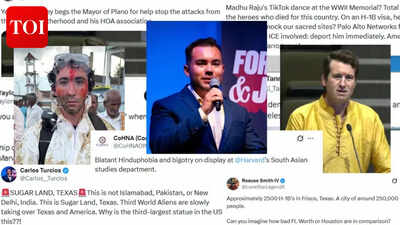
Around the same time, American Tyler Oliveira’s video, mocking the Gurihaba festival in the village of Karnataka, received 5 million views on X. Without making any effort to find out the significance of the festival or talk to the locals, he decried it as “a poo-throwing festival within India,” much to the dismay of Americans waiting to troll everything about the country and its culture. Critics argued that the video failed to explain the cultural or ritual context of the festival and instead encouraged mockery of Indian traditions.In another video that went viral on X, comedian Alex Stein attended a Plano City Council meeting where he mocked Hindu customs, while wearing a yellow kurta with shorts, flip-flops and a red tilak. The conservative media personality mocked the culture’s cow worship and the use of cow dung and urine in a satirical manner, prompting many Indian Americans to walk away.
Whether due to this incident or broader cultural tensions, the Carnegie survey indicated that nearly one in five respondents avoid wearing bindis and tilak, with 23 percent of Indian Americans believing Hindus face significant personal discrimination. Furthermore, in 2022, research conducted by the Network Contagion Research Institute at Rutgers University documented this pattern where social media has been systematically weaponized to target Hindu communities often by bots and geopolitical players. She also warned Hindu communities to be careful as online hate often tends to slip into the physical world.
The attacks go beyond social media
Ways in which Hinduism is visible have also been targeted, including temples and idols. In 2025, shots were fired at an ISKCON temple in Utah while worshipers were inside. Several Hindu temples were vandalized in Indiana and Southern California, while a temple statue was attacked in North Carolina. California has also documented a rise in hate crimes involving Hindus, although anti-Semitism remains the most common category of religious hate crimes in the state.I also encountered a Institutions have been accused of insensitivity. In February 2026, Harvard University was accused of “blatant Hinduphobia” by the Hindu Coalition of North America which criticized the university over artwork displayed for a Sanskrit course on the South Asian Studies Department’s website. The coalition accused the university of bigotry because it added an image that looked “straight out of a horror movie” starring a black Hindu character wearing a tilak, with “some sort of ghostly statue dangling in his hands.” While the university issued an apology on its website on behalf of the department, saying it was “deeply sorry” for posting an “insensitive” photo, it echoed the ignorance with which the depths of Hinduism are treated even by a prestigious academic institution in the US.
Madhu Raja controversy
The most recent example of anti-Hindu hatred was a video of Indian-born technician Madhu Raja filming the “Don’t Rush Challenge” with a woman at the memorial on the National Mall honoring Americans who served in the armed forces during World War II and those who died as a result of the war. After the video went viral online, Raja was reportedly mocked and forced to delete his social media accounts. There have also been calls for him to be fired from Palo Alto Networks, where he is believed to work.Some posts also called for Raja’s deportation, claiming he was in the country on an H-1B nonimmigrant visa.
This happened after videos of American fans doing flips near the Lincoln Memorial, a white bride posing in a reflecting pool and a man in a Spider-Man suit strolling past WWII fountains with many other similar “disrespectful” videos of American history flooded the internet daily.
What lies ahead for Indian Americans?
A study he conducted Network Contagion Research Institute (NCRI), claimed that in 2025, 24,000 posts on X were viewed more than 300 million times. Anti-India content on the platform has tripled in the year alone. Hatred against India Hinduphobia has made Indians orphans because the second best thing that distinguishes them in a world ruled by capitalism and their influence through evangelism is their religion, and the first, of course, is their sheer audacity to be gifted. For many observers, this trend raises difficult questions about assimilation and identity.Consider the Indian-American golfer Akshay Bhatia, who had a dramatic playoff win at the Arnold Palmer Championship in March 2026. Some online commentators have noted how thoroughly he has assimilated into American culture, arguing that other than his name, there were few clear markers of Indian identity.“The other thing you missed about Akshay Bhatia is – absorption,” said one post on X, like many others. In the Carnegie survey, while Indian Americans were willing to retreat into their culture, give up tilaks, bindis, etc., they still did not plan to leave the country and a majority recommended the United States for employment. Indians as civilians in the country have had to barter for existence since time immemorial. With the British colonialists, they became Sepoys and Bapus, so that the Mughals, Subedars and Mansabdars, could all live on their own land, in their own society and culture while practicing their religions. For generations, America’s immigrant communities have managed to strike a delicate balance between assimilation and cultural preservation. Indian Americans today face a similar dilemma: how to maintain a clear cultural identity in a political environment increasingly shaped by debates over immigration, nationalism, and global competition.The American dream promised an opportunity that could not be erased. For many Indian Americans, the coming years may determine whether that promise remains.