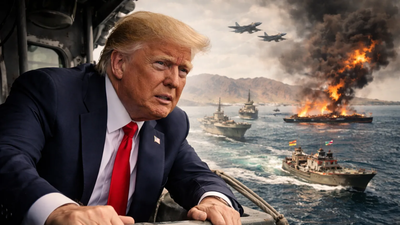
The Trump administration has dramatically downplayed the possibility of Iran moving to close the Strait of Hormuz in response to US military strikes, leaving Washington scrambling to manage the economic fallout as the conflict disrupts one of the world’s most important energy routes, according to sources cited by CNN.Officials familiar with internal discussions said that the Pentagon and the US National Security Council did not fully take such a scenario into account while planning the ongoing operation against Iran. This oversight has now left the administration facing what some officials described as a worst-case scenario, with global oil shipments under pressure and energy markets unstable.
‘It will burn gas and oil sites’: Iran’s Revolutionary Guard issues chilling warning to Trump, Israel over energy strikes
Strategic planning gaps
Sources cited by CNN said that although officials from the US Treasury and Energy Departments were present during some planning meetings before the process began, the detailed economic forecasts and interagency analyzes that typically shape such decisions played a lesser role.
Treasurer Scott Besent and Energy Minister Chris Wright were involved in the planning and implementation phases of the conflict.
reconnaissance
How do you think the global energy market will be affected by the conflict with Iran?
But the sources said President Donald Trump’s preference to rely on a small group of close advisers limited broader discussion across government agencies about the potential economic consequences if Iran responded by closing the strait.Senior administration officials also admitted to lawmakers in classified briefings that Iran’s potential closure of the waterway was not entirely planned, according to CNN.
The assumption within the administration was that such a move would hurt Iran more than the United States. This view was shaped in part by previous Iranian threats that did not materialize after US strikes on Iranian nuclear facilities last year.
A shockwave across diplomatic and industrial circles
The unfolding situation in the Strait has raised eyebrows among diplomats, former US economic officials and energy executives.“Planning to prevent this exact scenario, as impossible as it has long seemed, has been a fundamental tenet of US national security policy for decades,” a former US official who served in Republican and Democratic administrations told CNN.
“I’m astonished.” Shipping companies operating in the region have repeatedly requested military escort from the US Navy for oil tankers, but these requests have so far been rejected. According to two industry executives cited by the outlet, US military officials said they had not received orders to begin escort operations and warned that the risks to naval assets remained too high.
Limited options for Washington
US officials noted that Iranian drones, missiles and naval mines pose major threats to ships trying to cross the narrow waterway.
In military simulations of a potential conflict with Iran, one of the main risks identified was that ships became tightly packed in checkpoints such as the Strait of Hormuz, Bab el-Mandeb and the Red Sea, making them vulnerable to attack.Wright acknowledged the limits of current military capabilities.“It will happen relatively soon, but it can’t happen now. We simply are not ready,” Wright said in an interview with CNBC, referring to the potential sea escort of commercial ships.He added: “All of our military assets are now focused on destroying Iran’s offensive capabilities and the manufacturing industry that provides it with its offensive capabilities.”Bessant told Sky News that the naval escort would begin “as quickly as militarily possible.”“It was always in our planning that there was a chance that the US Navy, or perhaps the international coalition, would escort the oil tankers through,” he said.
Iran points to pressure strategy
In his first public remarks since taking office, Iran’s new Supreme Leader Mojtaba Khamenei indicated that keeping the Strait of Hormuz closed may remain a “pressure tool,” according to a statement read on Iranian state television.The warning raised concerns in global energy markets because the narrow waterway is a major corridor for oil and liquefied natural gas shipments from the Middle East.Energy industry executives have privately urged U.S. officials to seek a quick end to the conflict, according to sources familiar with the discussions.
Many companies are reluctant to send tankers through the strait while hostilities continue.
Trump downplays the importance of turmoil in oil markets
Despite market volatility, Trump continued to downplay the economic impact.“The US is the largest oil producer in the world, by far, so when oil prices go up, we make a lot of money,” he wrote on Truth Social.Trump said that preventing Iran from obtaining nuclear weapons remains his primary goal.“What is of greatest interest and importance to me, as President, is preventing the evil empire, Iran, from acquiring nuclear weapons and destroying the Middle East and indeed the world,” he wrote.The White House defended the planning process. “Through a detailed planning process, the entire administration was prepared for any potential action taken by the Iranian terrorist regime,” White House spokeswoman Anna Kelly said.She added that the disruptions in energy markets will be temporary and will ultimately benefit the US economy in the long term.
Emergency measures are under consideration
With energy markets under pressure, the administration is exploring several measures to mitigate the impact on fuel prices.The Treasury Department has already temporarily lifted sanctions on Russian oil shipments stuck at sea. The White House is also considering a limited waiver of the century-old Jones Act, which requires goods transported between US ports to be carried on US ships.“In the interest of national defense, the White House is considering waiving the Jones Act for a limited period of time to ensure critical energy products and agricultural necessities flow freely to U.S. ports,” press secretary Carolyn Leavitt said in a statement to CNN.Officials are also considering regulatory changes to ease fuel production requirements during the summer months in an effort to lower gasoline prices.However, experts warn that such measures may only partially offset the impact of disruptions to global oil supplies.“I think it would be a very small potential offset compared to the factor driving gasoline prices higher, which is concerns about physical supplies of refined products around the world, as well as crude oil,” said Clayton Siegel, an energy expert at the Center for Strategic and International Studies.