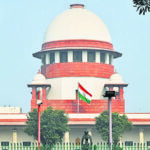
The Supreme Court on Thursday stayed states for violating its ruling on appointment of director generals of police (DGP) and sought responses from six states on why contempt of court proceedings should not be initiated over their failure to recommend names to the Union Public Service Commission (UPSC).

The order came a month after the Supreme Court on February 12 allowed the UPSC to point out to those states that had failed to respond to its requests to send names for appointment of DGP ahead of the expected vacancy.
Following this order, the UPSC submitted a list of six states namely Punjab, Himachal Pradesh, Arunachal Pradesh, Goa, Manipur and Mizoram which did not respond to the commission’s request to send names. Two other states – Jharkhand and Uttar Pradesh claimed to have enacted their own laws in line with the 2006 Prakash Singh ruling that directed states to follow the ruling to enact their own laws.
“These states (six) have not submitted any proposals to the UPSC to appoint officers as DGP. Prima facie, these states are in contempt,” a bench headed by Chief Justice of India (CJI) Surya Kant said.
Two weeks after the order was published, the bench, also comprising Justices Joymalia Bagchi and Vipul M Pancholi, said, “The states are called upon to answer that in the absence of any valid law enacted by them in relation to the Prakash Singh judgment, why appropriate action should not be taken under contempt of court to withhold the appointment of the DG of the DG from the committee proposed by the UPSC.”
UPSC lawyer Hrishikesh Baruah told the court that in 2019, the Supreme Court had passed an order directing that any state law inconsistent with the 2006 ruling should be kept in abeyance. The states of UP and Jharkhand informed the court that they have laws in place which require a committee headed by a former chief justice or a Supreme Court judge to recommend to the committee.
“The Union government, UPSC and states are bound by the directions given in Prakash Singh. Can you formulate a law contradicting it? We hope that the states will not create an embarrassing situation for themselves,” the court said. The two states were asked to respond as to why the names were not recommended as per the earlier ruling even as UP submitted that it would soon respond to the committee.
Punjab, represented by senior advocate Abhishek Manu Singhvi, told the court that the state had also passed a law in this regard and it was stuck as the President had refused to give approval. He added that this decision of the president is now subject to appeal.
The court explained that these procedures are not intended to limit the states’ right to enact laws, nor to the president’s refusal to grant approval. “If you have a law, follow it. If you don’t, follow our rule. You can’t make a law outside the Constitution. Use it as a shield against contempt.”
When it was West Bengal’s turn to respond, senior advocate Rakesh Dwivedi said the names had been sent to the UPSC. But the bench noted that “the state is more busy sending its own DGs to the Rajya Sabha,” in an apparent reference to the ruling party in the state – Trinamool Congress (TMC) which nominated former DG Rajeev Kumar to the Senate.
The court also criticized Chhattisgarh which failed to implement the recommendation sent by the UPSC in May last year.
Senior advocate Raju Ramachandran, who is assisting the court as amicus curiae, told the court that instead of the court bothering about the appointment of state-level DGs, the concerned high courts could consider these matters as they involve implementation of the Prakash Singh judgment. However, he strongly recommended that the validity of various state laws enacted in this regard be heard by the Supreme Court.
The court agreed to consider this proposal by the amicus curiae on the next date. Prakash Singh, who was himself a former deputy DGP, also filed a request for a direction that after the UPSC recommends consolidation, a high-level committee of the chief minister, leader of the opposition in the state and a chief justice nominee should choose the DGP.
The bench rejected the proposal as “impracticable” and said: “To choose a DGP, you need a central authority. UPSC is that body and so far, there are no complaints against it.” Ramachandran supported this view by adding that the DGP should be an officer who enjoys the confidence of the CM and hence the choice should be left to the state alone.