In an AI-driven world, knowledge and content sharing cannot remain isolated. The future requires active engagement between open knowledge platforms, credible media organizations, and AI-powered discovery engines, to balance openness and responsibility.

Open knowledge projects such as Wikipedia provide basic knowledge, Journalism provides context, and discovery platforms like OTTplay enable discovery and consumption. Connecting these layers responsibly can fundamentally improve how audiences navigate today’s world of massive content.
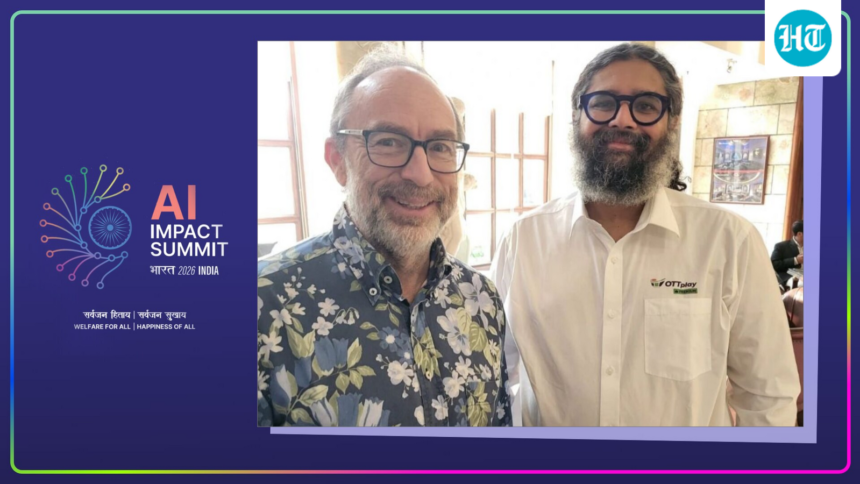
When Avinash Mudaliar, co-founder and CEO of HT Labs, met Jimmy Wales, founder of Wikipedia, the conversation touched on the relationship between open and trusted knowledge with local human context and the future of content discovery in the age of artificial intelligence.
“As AI reshapes how information is created, discovered, and consumed, one fact has become clear: AI systems are only as reliable as the cognitive foundations on which they are built,” Wells shared. “In many ways, Wikipedia has quietly evolved into one of the most important neutral knowledge graphs on the Internet, enhancing research, learning, and, increasingly, AI itself.”
As the flow and proliferation of content increases, organized and verifiable information becomes critical. Fostering open datasets on cinema, language and cultural history ensures that discovery is guided by trusted knowledge rather than algorithmic noise. This intersection opens up exciting possibilities of how a legacy media organization like Hindustan Times, along with its innovation hub HT Labs, can contribute to the evolving AI ecosystem. With initiatives like HT Archives preserving decades of trusted journalism and OTTplay, an AI-led OTT aggregator created by HT Labs, this reflects how trusted journalism, archival knowledge and AI-powered platforms can shape the next phase of the global media technology ecosystem.
“We are entering a phase where AI will no longer be judged by its quantity,” Mudaliar said The content it can generate, but only through the extent to which it responsibly understands and contextualizes knowledge. At HT Labs, our focus is on building bridges – between open knowledge platforms, institutional archives, and AI-driven discovery engines, so users don’t just find more information, they find meaning. We are actively exploring collaborations with legacy knowledge institutions and global platforms to ensure trusted archives and cultural memory are organized in ways that make them AI-able.
ready. The real opportunity lies in transforming India’s media and cultural heritage into intelligent discovery systems for the next billion users.
In the age of artificial intelligence, cultural leadership will be those who create knowledge Entertainment is not only accessible, it can be discovered intelligently.
“At the Wikimedia Foundation, our mission has always been to ensure that knowledge remains open, verifiable, and accessible to everyone,” Praveen Das, principal director of partnerships for South Asia at the Wikimedia Foundation, noted during the broader dialogue. “As artificial intelligence reshapes how people discover and consume information, collaboration with media organizations and media organizations becomes even more important.” Technology innovators. Exploring partnerships with organizations like HT Labs can allow us to think about how open knowledge, trusted archives, and intelligent discovery platforms complement each other to not only distribute information faster, but to make it more contextual, reliable, and meaningful to users across languages and geographies.
Echoing this perspective, Avinash Mudaliar asserted that in an age obsessed with producing content faster, the real competitive advantage may lie in better organizing and preserving the truth.
The next phase of media and artificial intelligence may not be about who owns the information, but who helps the world understand it.
It reflects a broader movement: India is positioning itself at the forefront of responsible AI, trusted and open data ecosystems, and a globally discoverable culture.
As these thought leaders engage in the dialogue, one thing becomes clear: The next revolution in AI will not be based solely on data. It will be built on trust Knowledge, preserved history, and intelligent discovery all work together.