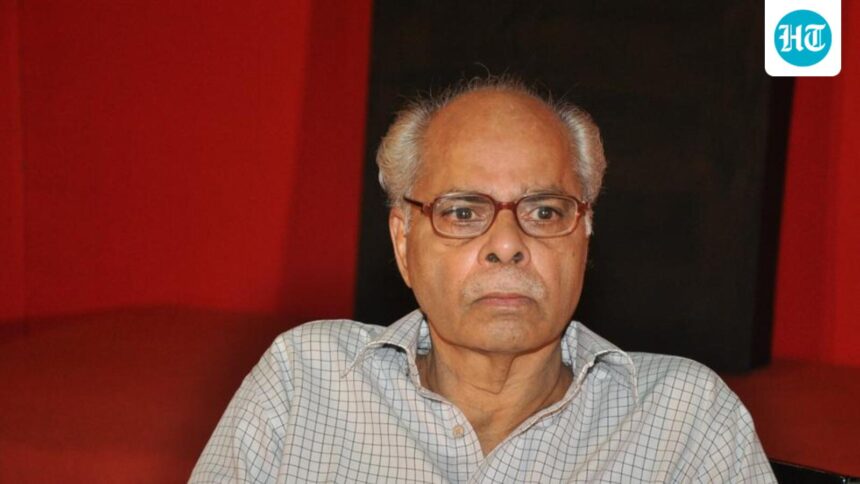
Renowned historian and academician K N Panikkar died at a private hospital in Thiruvananthapuram on Monday. He was 89 years old.

He suffered from age-related health complications and is survived by his two daughters, Ragini and Shalini.
Panikkar worked as a professor of history at Jawaharlal Nehru University (JNU), where he also served as dean of the School of Social Sciences. He also served as Vice-Chancellor of Sri Sankaracharya University of Sanskrit and Chairman of the Kerala Council of Historical Research (KCHR).
Panikkar was born in Guruvayur in present-day Thrissur district of Kerala in 1936, and completed his education at Victoria College in Palakkad and Rajasthan University. He taught at various institutions including the University of Rajasthan and the Indian Institute of Public Administration before joining JNU in 1972 as Professor of History. His teachings and work led to him heading the Contemporary History Archive at the prestigious University of Delhi.
His main area of research was cultural and material history during the colonial period.
Read also:Noted playwright Jatinder Singh Brar has died at the age of 81
His writings documented the history of the struggle of ordinary people, farmers and workers against imperialism. One of his notable works was his book on the Mappila Rebellion in Kerala in which he persistently analyzes the religious and peasant uprisings in the state between 1836 and 1921.
His other books are An Indian Guide to Communalism, Culture, Ideology and Hegemony – Intellectual and Social Consciousness in Modern India and Colonialism, Culture and Resistance.
His academic experience prompted the then Kerala government to appoint him as Chairman of an expert committee on the content of textbooks. The committee he chaired submitted its report in October 2008.
Kerala Chief Minister Pinarayi Vijayan extended his condolences to Panikkar and described his death as an irreplaceable loss for India’s secular and democratic movements.
“Through his writings, teachings and speeches, he constantly reminded people that India’s pluralism was shaped by the course of history and its collapse would lead to the collapse of the country itself. His words were like a light in the minds of the people at a time when Indian secularism was shrouded in the dark clouds of communalism,” the Prime Minister said in a statement.
The Prime Minister added: “His life was a constant struggle against attempts to revive the four varna system with all its decaying elements and against replacing historical facts with myths and speculation. He is considered one of the best historians on the international scene.”
CPI(M) State Minister MV Govindan described Panikkar as the guardian of Indian secular ideals.
“The country will never forget the powerful contributions made by KN Panikkar as a historian, intellectual and advocate of secularism. He opposed those who tried to distort history and use it as a shortcut to power,” the Communist Party of India leader said.